
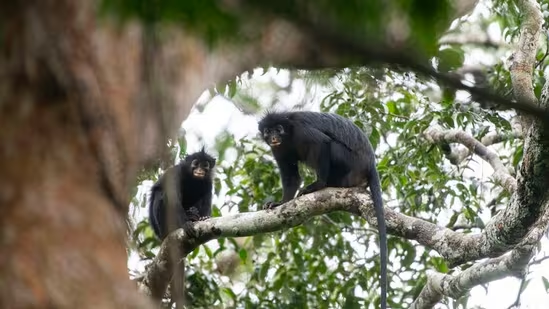
Scientists have discovered a new previously unknown monkey species in the dense rainforests of the Democratic Republic of Congo (DRC). This ends years of painstaking fieldwork in one of Africa’s least-explored regions.
The newly identified primate, named Likweli (Colobus congoensis), was formally described in a peer-reviewed study published Wednesday in PLOS One. Researchers say the elusive monkey likely remained hidden because it occupies a tiny range inside the Congo Basin and rarely encounters humans.
The discovery marks only the second new monkey species identified in the region in the past 15 years. Scientists believe the finding could offer fresh insights into primate evolution while highlighting the importance of conserving one of the world’s richest biodiversity hotspots.
Also read: Scientists take another step towards lab-made life
What is the new Likweli monkey species?
The Likweli belongs to the Colobus genus, a group of leaf-eating monkeys found across West and Central Africa. Researchers named the species Colobus congoensis to honour the Democratic Republic of Congo.
The primates have a striking appearance. They feature jet-black fur, a distinctive pink-and-orange mouth, and produce a deep, roaring vocal call unlike that of neighbouring monkey species. Adults weigh about 15 pounds (around 7 kilograms) and measure roughly four feet from nose to tail.
Local hunters also refer to the monkey as “kasaba nkoni,” meaning “branch shaker,” a name inspired by its behaviour in the forest canopy.
Researchers estimate the monkeys occupy an area of only 650 square miles, roughly two-thirds the size of Luxembourg, making them one of Africa’s most geographically restricted primate species.
Genetic analysis suggests the Likweli separated from its closest known relative about five million years ago, making it an ancient branch of Africa’s monkey family tree.
Lead author John Hart believes the species could become vital to understanding primate evolution.
“I think it’s going to be a very important species for the ecology,” Hart said. “I also think that once its genomics are fully explored, people are going to know a lot more about the evolution of African primate fauna. It looks to be an ancient lineage.”
Also read: Longevity expert Dr Vass explains how light exposure affects our metabolism: ‘Light is a metabolic signal’
How did scientists find the elusive primates?
The first photograph of the monkey was taken during a 2008 expedition along the Lomami River, but researchers could not immediately determine what they had seen.
“Probably not many people who would be interested in discovering monkeys and things had ever gone there,” conservation scientist Ashley Vosper, who captured the first image, told The Washington Post.
For more than a decade, the mysterious primate evaded further detection.
In 2018, repeated sightings convinced scientists they had encountered an undescribed species. That launched an intensive field project involving years of expeditions through dense rainforest. Researchers conducted patrols covering more than 3,000 miles, recording 114 direct observations over four years.
To confirm the discovery, scientists analysed skin, skeleton and tissue samples collected from three monkeys confiscated from hunters during government patrols.
“We brought in every piece of evidence that we could,” anthropologist Kate Detwiler said.
“Every piece said, ‘Wow, this is distinct.'”
Most Likweli sightings occurred inside Lomami National Park, a protected area established after researchers discovered another monkey species, the Lesula, in 2012. Hart said conservation efforts may have unknowingly protected the newly identified primate.
“We were lucky that included in that park area was the range of this unknown monkey,” he said.