“We live each day fearing that we may be shot or killed, and in constant fear of being attacked and beaten.”
These are the stark words of Najwa, a Palestinian farmer in Hebron in the occupied West Bank, whose land, family and community are under daily attack.
Israeli settlers have stolen their livestock, trampled their crops, destroyed their greenhouses, broken into their home and attacked them with pepper spray. The relentless campaign of violence, harassment and intimidation has driven most of Najwa’s neighbours off their land; only a few families remain in the valley.
Today, settler violence in the occupied West Bank has soared to its highest level since UN monitoring began in 2006, with an average of six attacks recorded each day.
Settlers have shot and stabbed children, committed sexual violence, and set fire to mosques – yet they benefit from near-total impunity. Palestinian women and girls are at particular risk: not only do they face violence and harassment from settlers, but they are also often forced to stay at home for protection, cutting them off from education and reproductive healthcare.
CLICK FOLLOW: TO FOLLOW US
Sign up to get the latest insights and analysis on
Israel-Palestine, alongside Turkey Unpacked and other eSPORTY
These horrific acts are not isolated events, and the people responsible for them are not rogue actors. They are at the vanguard of a settlement expansion project that is directed, funded and authorised by the Israeli state itself, and made possible by its discriminatory policies and practices.
It’s a project that has the ultimate aim of territorial expansion, achieved through an appalling strategy of illegal land annexation and ethnic cleansing.
The UK government already accepts that Israeli settlements in the occupied West Bank are illegal under international law. So why does it continue to permit trade that helps normalise and sustain them?
Alarming growth
Israeli settlements already control more than 42 percent of West Bank territory, confiscated from Palestinian communities, along with the majority of the region’s water resources. These illegal settlements are supported by a massive system of bypass roads and railways, as well as industrial parks for settlement-based businesses.
And they are growing at an alarming pace. This year alone, Israeli authorities extended civil and administrative authority across the West Bank, approved 34 new illegal settlements, and allocated record funding for settlement infrastructure.
According to a 2024 advisory opinion from the International Court of Justice, states must take concrete steps to end any support that maintains Israel’s illegal occupation of the West Bank. This isn’t a suggestion; it’s an obligation.
The UK now faces a choice: continue enabling a system it recognises as unlawful, or join a growing number of countries prepared to match their words with action
The fact that trade is still allowed means that dates, grapefruits or avocados grown on land forcibly stolen from Palestinians can appear on supermarket shelves in the UK. A recent investigation by the legal non-profit Global Echo found that one in six Israeli shipments to the UK and EU contained agricultural products that originated in illegal settlements.
Meanwhile, trade in services far surpasses goods. This not only financially benefits settlements; it tacitly legitimises their presence on illegally occupied territory.
Palestinians in the West Bank live under a brutal system of apartheid and military occupation. While Israeli settlers travel freely across the territory, Palestinians are confined by checkpoints, gates and permit controls that can stop them from accessing schools, universities, workplaces, hospitals and even their own families.
Entire communities face repeated military raids, arrests and displacement, while Palestinians are subjected to a separate legal system from Israelis living in the same territory.
Many Palestinian women who have little option but to work in illegal settlements face exploitative conditions: the overwhelming majority have no written contracts, earn significantly less than minimum wage, and report sexual harassment and physical abuse at work. The result is a system of institutionalised discrimination that governs almost every aspect of daily life.
State complicity
Other governments are finally waking up to their own complicity, and taking long-overdue action to right this wrong. Earlier this month, Ireland’s parliament approved legislation banning some trade with settlements, following in the footsteps of Spain, which introduced a ban last year.
Why the UK allows Israeli settlers to terrorise the West Bank
Read More »
The bill, which passed through the Irish Seanad on Wednesday and will now to go the president to be signed into law, isn’t perfect. As it stands, it will result in a ban on the €200,000 ($229,000) or so of goods traded with illegal settlements each year. As a symbolic gesture, this matters, but by allowing the provision of services – comprising up to 70 percent of trade between Israel and Ireland – to continue, it fails to fully comply with the requirements of international law.
A coalition of more than 40 trade unions, NGOs and civil society groups, including Action Aid Ireland, is pushing for a total ban on both goods and services, to ensure those legal obligations are met.
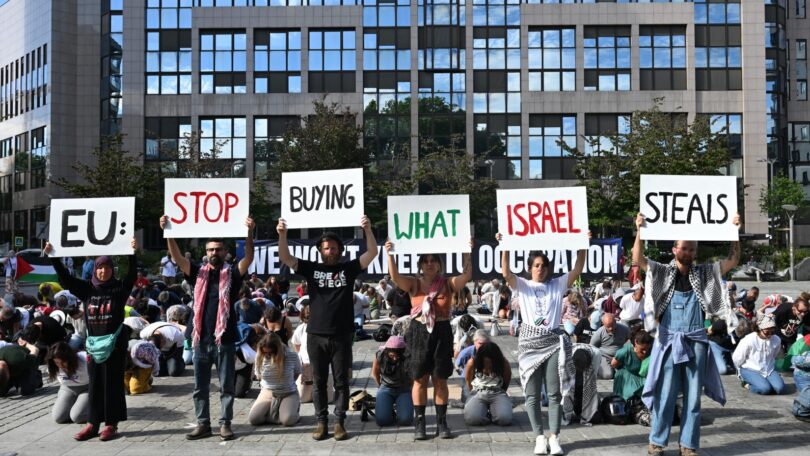
The UK has an opportunity to go further than Ireland, and bring about a comprehensive ban on trade and investment in illegal settlements. Pressure for such a move is building: 238 MPs, including 141 Labour members, now back a full ban. Meanwhile, EU foreign ministers are reportedly mulling a range of options to restrict settlement trade.
There are some signs that UK government policy is starting to shift. Last month, for the first time, the UK explicitly advised British companies against economic activity in the illegal settlements. This is a step forward, but requesting voluntary compliance from businesses is not enough; it must be made mandatory.
Meanwhile, on Wednesday, the trade minister said the UK government was working on a full ban on trade with goods and services with settlements. This is a welcome development and we urge the incoming government to take this forward and prioritise swift implementation.
The government’s response to Israel’s actions has failed to match the scale and severity of the violations taking place. Across the occupied West Bank and Gaza, where the genocide continues and more than 1000 people have been killed since the so-called ceasefire came into effect, the Israeli government is conducting a systematic assault on Palestinian life and rights.
Until the UK and other countries impose robust measures with clear economic consequences, there is little hope the situation will change
Until the UK and other countries impose robust measures with clear economic consequences, there is little hope the situation will change.
Banning trade with settlements is an obvious tool the UK government has at its disposal to hold Israel accountable and end its own complicity in this illegal occupation. It must also suspend its trade and partnership agreement with Israel until widespread and systematic violations of international law are brought to an end.
Ireland’s legislation will not, on its own, end the occupation. But it is the beginning of accountability. It reflects a growing recognition that states cannot condemn illegal settlements while continuing to trade with them.
The UK now faces a choice: continue enabling a system it recognises as unlawful, or join a growing number of countries prepared to match their words with action.
The views expressed in this article belong to the author and do not necessarily reflect the editorial policy of Middle East Eye.