
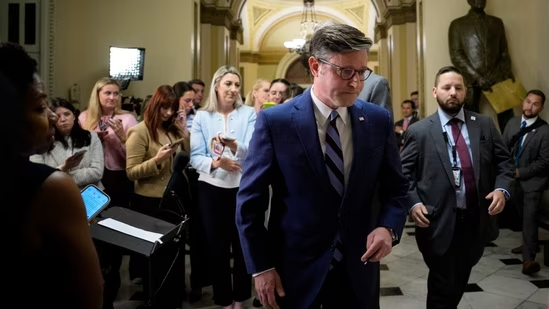
WASHINGTON—Mike Johnson doesn’t even try to put his phone down anymore.
Almost three years after he took over as House speaker, the Louisiana Republican’s job is more overwhelming than ever. The self-described “wartime speaker” is working to advance the GOP agenda with only a narrow majority while managing unruly colleagues—and fielding calls from President Trump at all hours of the night—as he looks to rally Republicans to a history-defying win in the midterm elections this fall.
“I’m like a triage surgeon in an active battlefield,” he said in a recent interview with The Wall Street Journal. “All I do is go from crisis to crisis, hemorrhaging wounds, all day long.”
The speaker, 54 years old, who often casts struggles in terms of his Christian faith, says he wants to stay in the job if Republicans hold on to the majority and sees any possible challenge to the gavel as unlikely to succeed. He demurs when asked if wanted to remain the party’s leader if the GOP loses.
“I love people, I love solving problems,” he said. “I love to take on complicated things and make them simple, or attempt to do so. I love the idea of facing a challenge.” At the same time, “It’s a very taxing job. It requires total devotion and sacrifice.”
Trump will often call late. “ ‘Mikey, are you sleeping?’ ” Johnson said, imitating the president’s voice during an interview with the Journal last month at the congressional baseball game. “No, not really,” Johnson responds. “ ‘Yes, you are, Mike. I can always tell when you’re sleeping.’ ”
“ ‘I’m up now. What do you got? What’s going on?’ ”
Over several days last month, the Journal got a view into one of the most politically fraught and exhausting jobs in the country. Johnson’s work life is a blur of meetings, questions from swarming reporters, TV hits, fundraisers and party events. Punctuating his schedule are fights over the latest failed vote or intraparty blowups that has become a staple of the Republican-run House, conflicts that often prompt Trump to intervene.
The Journal’s interviews took place in the back-corridors of Nationals Park—where he gave a speech rallying the Republican baseball team—a motorcade ride from the Capitol to a conservative women’s event and a morning at the Capitol as the speaker tried to corral his members during a weekly GOP conference.
14 minutes of family time
Johnson estimates he had about 14 minutes of family time on a recent Monday night when he got back home around 9 p.m. to his home in Washington’s Capitol Hill neighborhood—which he said was a “normal day” for him. By 11 p.m., he was back on the phone trying to put out fires over a House Rules Committee hearing. At 6:30 a.m., his phone began buzzing again. Johnson is typically back to the Capitol by 8 a.m., and one of his staff’s first questions is: coffee or (the energy drink) Celsius?
Johnson admits he can’t keep up with it all. He flashed his phone screen, which showed 1,477 unread text messages and 829 unlistened-to voicemails. He says he has been late to major life news, including deaths of friends or their loved ones. Johnson says he is constantly apologizing to people he didn’t respond to quickly: “I’m so sorry I did not see your six previous text messages. I just happened to see this one. I love you.”
His day is largely cut up into 15- or 30-minute chunks, with some segments going longer such as party meetings, series of votes or sit-downs with Trump. He counts only two times over the last two years that he tried to disconnect and unwind in the evenings with his wife, daughters who work in Washington and youngest child after he returned home from the Capitol. He learned his lesson.
“When I picked the phone back up, it was a bonfire that needed to be put out sooner,” he said.
The latest conflagration on Capitol Hill centers on the stalled SAVE America Act, which mandates stricter voting rules. Trump at the last minute canceled the signing ceremony for an unrelated bipartisan housing bill, saying the voting bill needed to pass first. The word came too late for Johnson, who was on stage touting the housing measure. Democrats said the blowup was the latest sign of Republican dysfunction.
“I talk to the president every day, and we’ll talk about it again,” the speaker told reporters. “I’m encouraging him to sign it, but it’s going to become law one way or the other.” The measure became law without Trump’s signature last weekend.
A ‘false narrative’ about Trump
Johnson is a constitutional lawyer by trade who was first elected to the House in 2016. He won the speakership after a band of GOP dissidents ousted former Rep. Kevin McCarthy (R., Calif.), and a group of other candidates were blocked or rejected. He has kept his grip on power in part through a close relationship with the president, regularly joining him at events such as the recent UFC fight outside the White House.
GOP leaders often turn to Trump to help win over recalcitrant members on fights ranging from surveillance powers to spending bills. Johnson said Trump has at times joked that the president is the speaker of the House. But Johnson said it is just that—a joke.
There is a “false narrative that somehow President Trump is helping to run the House,” Johnson said. “It’s a partnership.”
Republicans’ narrow margin that includes one independent—currently 219 to 212—means Johnson needs all the help he can get. “We do not have the luxury of party discipline, like the old ways,” Johnson said. “They used to whip people around and take things from them and punish them. We can’t do that to get every single person.”
When Republicans led by Rep. Anna Paulina Luna (R., Fla.) held the House floor hostage by blocking a procedural “rule” vote starting last month, Johnson visited the White House. But the standoff, centered on the SAVE America Act, continued—despite Trump having urged Republicans to stop obstructing—and House GOP leadership sent lawmakers home early for the July Fourth break. The freeze lifted Tuesday, and Johnson is now plunging ahead with an uphill fight to pass tens of billions of dollars in new military funding.
When he took the gavel, Johnson quickly sought to shore up his standing with the House Freedom Caucus—the home of many of the members who voted to oust McCarthy.
“I don’t come to you, I come from you,” he said he told the conservative caucus. “I get up with the same exact thing in mind that you have,” he recalled telling them.
Recently, Sen. Raphael Warnock (D., Ga.), a Baptist pastor, questioned the speaker’s faith after Johnson said he prayed about the passage of the president’s “One Big Beautiful” tax law. Johnson, who has voiced discomfort making direct attacks against people of all political stripes, says his first inclination was to challenge Warnock to a national theological debate, but his staff talked him down holding a one-on-one meeting with the senator.
Johnson said the two had a “delightful” debate, rooted in each man’s understanding of the Bible, about the role of government helping the poor vs. the role of the individual.
Warnock said he and Johnson “shared an honest and candid conversation about our faith.” He criticized Republicans’ moves to cut spending on healthcare and nutrition benefits, which he said conflicted with Bible teachings.
Johnson could just have months left in the job. Polls show congressional Republicans in trouble in the fall because of Trump’s sinking popularity and worries about the economy. Historically, the president’s party almost always loses House seats in the midterms.
Republicans “have nothing of substance to run on,” said Democratic Congressional Campaign Committee spokesman Viet Shelton, pointing to concerns about healthcare, gas and other costs.
Johnson says he tries to do at least two fundraisers each week. He sometimes schedules two in the same restaurant so he can speak to one room, eat a corner of his plate, walk to the other side of a partitioned room and speak to the next group, and nibble a bit more. That number sometimes jumps to four.
As the midterms approach, Johnson is aware that if the Republicans were to keep their majority, it would mark only the second time in 90 years that the president’s party has pulled off the feat.
He sees an opening, however, in the rise of Democratic socialists who have been capturing Democratic primaries. He says that will give voters a fresh reason voters to back Republicans—as they see the contrast between “common sense and crazy”—and keep him in charge.
Write to Olivia Beavers at Olivia.Beavers@wsj.com