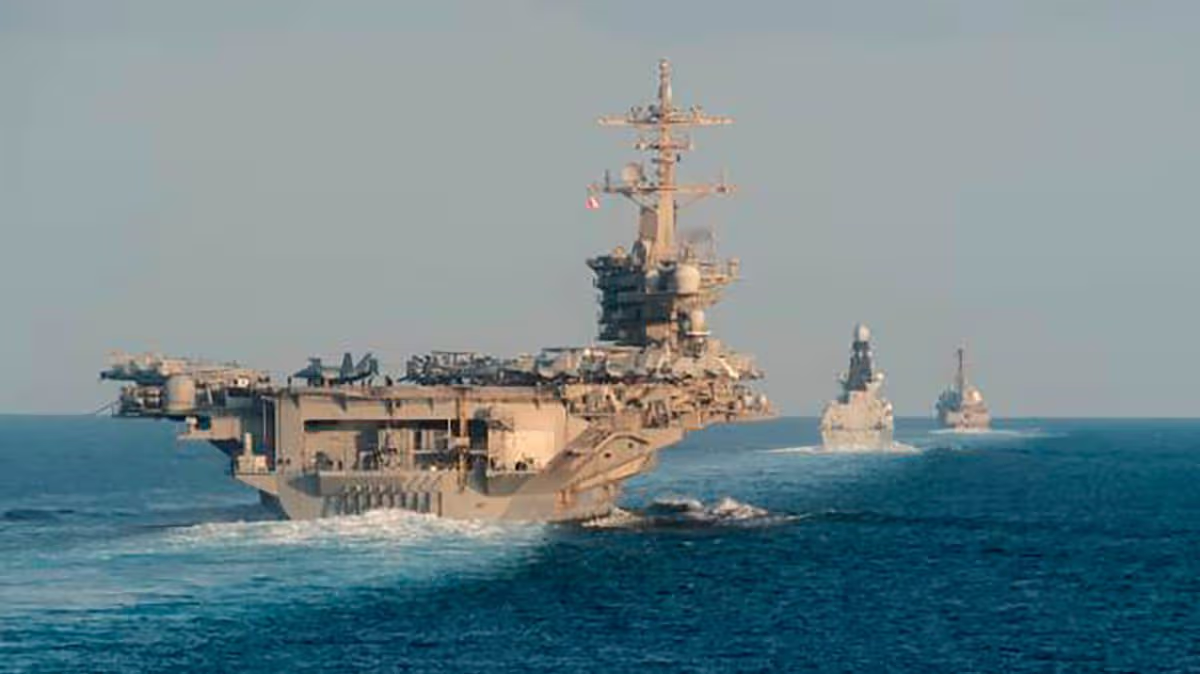

The United Arab Emirates has gained expanded access from the U.S. to coveted artificial-intelligence chips after aiding America in recent months by carrying out dozens of airstrikes against Iran, intercepting hundreds of missiles and keeping oil moving through the Strait of Hormuz.
The move by the U.S. to give greater AI capabilities to the U.A.E. caps a yearslong push by the Gulf state to obtain American technology to diversify its economy. The decision also highlights the central role chips have come to play during diplomatic discussions.
Under a Trump administration rule change announced Friday, the U.A.E. will be treated like European countries, South Korea and India when buying technology, military items or energy infrastructure that could have military applications, the Commerce Department said. The U.A.E. previously was in a group that included China and Yemen.
The change is likely to draw scrutiny because it rewards a country whose national-security adviser became a top business partner of the Trump family last year.
The shift allows the country’s main AI company, G42, to buy chips freely from companies such as Nvidia for at least the next nine months. It removes limits on large U.S. companies including Microsoft and OpenAI that have planned data centers in the country. Those companies previously needed licenses approved by the Commerce Department to export chips needed to run AI models, a laborious process that can take months and is frequently delayed. The greater chip access could be worth billions of dollars, industry analysts said.
In recent months Emirati officials have indicated that G42, which is controlled by the U.A.E. national-security adviser, Sheikh Tahnoon bin Zayed al Nahyan, plans to become a U.S. company, mostly owned by U.S. investors, people familiar with the discussions said. Tahnoon is the U.A.E. president’s brother.
U.A.E officials led by Tahnoon have lobbied for chip access going back to the Biden administration. After the Iran war’s start, U.A.E. officials approached the White House directly to lobby again for the change in its designation, according to people familiar with the matter. They pointed to India, which after becoming a Major Defense Partner of the U.S. in 2016, saw its trade benefits elevated, one of the people said. This time, U.A.E. officials met with a more favorable reception, the people said.
The U.A.E., which in 2020 signed the Abraham Accords, strengthening ties between Israel and several Arab countries, chose to fight alongside the U.S. against Iran. That demonstrated to the White House and top administration officials that the U.A.E. is a reliable ally, an American official said. The U.S. continues to work with partners in the region to promote security and American technology, another official said.
The White House has denied conflicts of interest.
The U.A.E. ambassador to the U.S., Yousef Al Otaiba, said the move “advances decades of deep and dependable U.A.E.-U.S. cooperation.”
The Emirati push for greater chip access began in the final two years of the Biden administration. Tahnoon, who has been a leading force behind the push for chips, also worked to build a relationship directly with the Trump family.
Four days before President Trump’s second inauguration, Tahnoon and others struck a deal to invest $500 million for a 49% stake in World Liberty Financial, a cryptocurrency company that had recently been started by the Trump family. Democrats have said the investment presents a major conflict of interest for the Trump administration’s foreign policy. The U.A.E. also promised to invest $1.4 trillion in the U.S.
The Trump administration’s initial decision last year to allow some chips to be exported to the U.A.E. fueled criticism from China hawks who argued that the shipments could hurt the U.S. in the AI race. Those claims are being resurfaced in light of the Commerce Department decision. Others worry about the wisdom of allowing so much advanced computing power to be built outside the U.S.
“The U.A.E. has been a great partner with Iran, but that doesn’t necessarily mean they’ve demonstrated the capability to keep a data center secure,” said Michael Sobolik, a senior fellow at the Hudson Institute, a conservative think tank.
The Commerce Department cited “the U.A.E.’s commitment to preventing the diversion and misuse of sensitive U.S. technology” in a statement on the change.
The move is attracting new attention in Congress because of the financial ties between Tahnoon and Trump. The president in his financial disclosures released last month reported receiving $263 million from the sale of the World Liberty Financial stake, one of the largest chunks of his 2025 income.
“It smells like it could be an illegal pay-to-play scheme,” Rep. Sydney Kamlager-Dove (D., Calif.) said at a House of Representatives committee hearing Tuesday.
She questioned Jeffrey Kessler, a Commerce Department official whose unit oversees export controls, about the agreement. Kessler said he didn’t discuss chips going to the U.A.E. with Trump family members or World Liberty Financial executives and defended the move. “It is one of the most significant achievements of the administration,” he said.
U.A.E. officials initially lobbied the U.S. against starting a war with Iran and then pivoted to an aggressive stance after the Gulf state bore the brunt of Iran’s retaliatory drone attacks, coordinating strikes with the U.S. and Israel. Trump, at a recent Group of Seven summit in France, lavished praise on the U.A.E. president, Sheikh Mohamed bin Zayed Al Nahyan.
“His Highness is a warrior,” Trump said. “They’ve been with the United States for a long time, but I would say much more so since I came on board.”
Write to Eliot Brown at Eliot.Brown@wsj.com, Amrith Ramkumar at amrith.ramkumar@wsj.com and Rebecca Ballhaus at rebecca.ballhaus@wsj.com