When the curtain comes down on the forthcoming Commonwealth Games, it will mark 10 years to the day Hope Gordon had her leg amputated.
That she is following up her appearances in both the Paralympics and Winter Paralympics with an appearance at Glasgow 2026 is remarkable enough. But added to that is the fact this remarkable 31-year-old actually raised the £10,000 she needed to have her leg removed herself, so determined was she that it needed to happen so she could get on with her life without being in debilitating pain.
Back in 2016, Hope was battling Complex Regional Pain Syndrome (CRPS), a condition which she’d endured since the age of 12, and which had reduced her left leg to a state of agony.
One day she had been fine, the next, an inexplicable pain had developed which left her unable to walk or function properly.
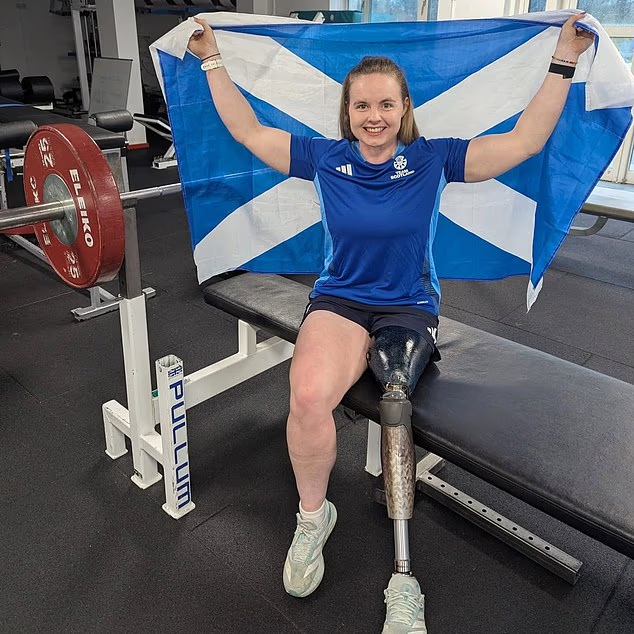
Hope Gordon will compete in the Para Powerlifting at the Glasgow Commonwealth Games
‘Imagine the barbed wire near prisons, wrapped around your leg,’ she told Daily Mail Sport. ‘It was like this on a daily basis.’
Hope, from Rogart in Sutherland, had always thrown herself into living life to the full; highland dancing, riding ponies, playing the bagpipes.
Her diagnosis changed everything. By the time she was 16, she was exhausted.
A life of pain and a lack of sleep making the joy increasingly difficult to muster.
The Dornoch Academy pupil had mulled over the consequences regularly. A life limited, every touch, every graze against her, a constant reminder of something that had no cure and which brought excruciating results.
Eventually, she told her parents that something had to give.
‘I’m going to ask to get my leg amputated,’ she told them, bluntly.

Gordon suffered from Complex Regional Pain Syndrome and had her leg amputated in 2016
Sat in Glasgow’s Silverburn shopping centre, over a lunch of BBQ chicken pizza, the teenager had been quite unequivocal.
If Rona and John Gordon were shocked, they did not exhibit it outwardly. They had developed, perhaps, an innate sense of understanding about the life their daughter had led over the previous four years.
‘It was the first time I’d really said anything to my parents,’ said Hope.
‘I had been thinking about amputation for several years. I knew it was against NHS guidelines, though, and I was still quite optimistic about my leg.
‘I also didn’t want people to think I was giving up, as I always just cracked on with things.
‘The pain, however, was always there. It was like being trapped in barbed wire 24/7. Or in the board game ‘Operation’, where I’d be trying to avoid anything that bashed against me. Everything was a danger.
‘I tried all sorts of medication, but because of the nerve pain, there was nothing that helped. Sleep deprivation was also a major hurdle,. For years, I had less than two hours sleep a night.
‘When I eventually spoke out about it, it was just before an outpatient appointment in Glasgow, and we’d gone to Silverburn shopping centre for some food. It’s a conversation I will never forget.
‘When you’re young and in a children’s hospital, the doctor often speaks to the parent and not the child, so my mum said to me: “If that’s what you think, then that has to come from you. I’m not going to ask for you”.

Gordon competed in the Paracanoe World Championship in 2024
‘It’s probably the first time I’d spoken up myself, but I just knew it was the right thing to do.’
She didn’t get her wish straight away. In fact, it took years of wrangling with the NHS and multiple stints in hospital before she eventually found a private surgeon willing to help. The downside? A cost of £10,000 for the operation. Gordon took matters into her own hands, and launched a crowdfunder to access some cash.
On August 2, 2016, the day finally arrived.
‘The response to the crowdfunder was so much better than expected,’ admitted Hope. ‘I was kind of overwhelmed by the support. It was a bit of an odd request on my part, but if it wasn’t for all of those random people who donated a fiver or a tenner, I don’t know how my life would have panned out.’
Did she ever have second thoughts?
‘No, there was never any point where I thought that. I was admitted the night before surgery and the consultant put a marker on my leg to where he thought he would get the best results.
‘I wanted to try and keep as much of my leg as possible, but when they marked it out, I spent the whole night thinking it wasn’t in the right place.
When I was taken to the anaesthetic room, I told him it would be too low. I didn’t want any of the sensitive part left over.
‘So he passed me a pen and told me to put a marker on where I thought the best result would be. I can’t tell you how I knew, but I just did. There’s now about 16cm left of my left leg, and I haven’t had any pain since.
‘Genuinely, there was absolutely no sadness when I woke up from the operation. It was all extremely positive. I couldn’t even lie in a bed properly beforehand, I couldn’t have a blanket over me.
‘I remember waking up with a blanket over me after the op, and there wasn’t any pain. I quickly realised this was absolutely the best decision.

Gordon brought home gold and silver medals from the 2026 Paracanoe European Championships
‘Now, every time I stand on a podium, I remember those who helped get me there. If I could break up my medals and give everyone a piece of them, then I would. I hope that everyone who helped me to get the op can see now that it was the right thing to do.’
Now, there aren’t many things that Hope Gordon cannot do. Paralympic canoeing? Tick. Para Nordic skiing in the Winter Paralympics? Tick. Elite level swimming? Tick again.
She is now set to make history again as the first athlete to compete at a Summer Paralympics, Winter Paralympics and Commonwealth Games across three different sports.
Gordon will represent Team Scotland in Para Powerlifting this summer, fulfilling a lifelong ambition to compete for her country in a Commonwealth Games.
The event, which kicks off in Glasgow on July 23, will showcase six para disciplines alongside a programme of ten sports for able-bodied athletes, with 74 nations taking part. Para-powerlifting will be the first event of the Games where medals are awarded.
‘This is the first team that I’ve been a part of where there’s a mix of able-bodied and para athletes,’ she said.
‘I don’t really think about making history there, but it’s pretty cool that I’m Team Scotland’s first female para-powerlifter. It’s great that girls will be watching and seeing the benefits of being strong. The Commonwealth Games in Glasgow also has the biggest para programme we’ve ever had, so to showcase everything in such an inclusive environment with our able-bodied counterparts is brilliant.’
Whether Gordon, who recently won gold at the ICF Canoe Sprint and Paracanoe World Cup in Montreal, makes the podium for the para-powerlifting in Glasgow is not a given.
The athlete – who has won eight World championship medals in paracanoeing, and took silver in Paris at the 2024 Paralympics – is realistic about her chances, given her relative inexperience in the sport.
‘Realistically, I shouldn’t be anywhere near the medals, because the standard is very high. I’ll just do the best I can.
‘The whole project has never been about getting medals, it’s about taking part and being part of Team Scotland.
‘I probably underestimated how hard it would be in terms of making progress, given that I’m also in training for para-canoeing events at the moment, but it’s thanks to canoeing that I was strong enough to qualify in the first place. The fact that this is back in Glasgow, where I spent a lot of time in hospital, is also a great full circle moment. It’s really cool just to be within that.’