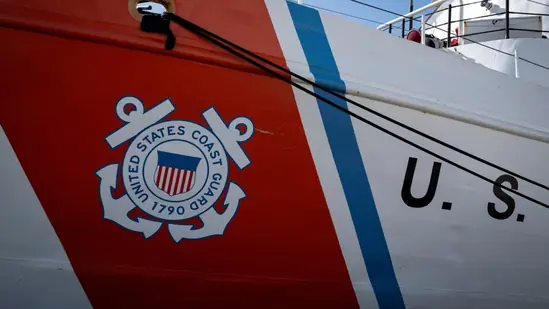
SINGAPORE—U.S. Coast Guard ships previously deployed in the Middle East are now operating out of Singapore and the Philippines to help challenge China’s assertion of power in the Pacific.
The six 154-foot fast-response cutters are part of the Coast Guard’s reimagined “expeditionary cutter squadron,” which can be sent anywhere in the world. Their first deployment is the western Pacific, where tensions have run high for years as China escalated a so-called gray-zone campaign to project control around Taiwan and the disputed waters of the South China Sea.
The cutters—the Coast Guard’s name for ships 65 feet in length or greater with onboard living accommodations—are approved to operate from Singapore and Subic Bay on the Philippine island of Luzon at least through September, a Coast Guard spokesperson said. While the U.S. has previously deployed larger Coast Guard cutters to Subic Bay, a former U.S. military base that faces the South China Sea, it is the first time the smaller, fast-response cutters are operating from there.
The Coast Guard deployment is the latest step in Washington’s efforts to deter Beijing from moving on Taiwan or South China Sea features that are also claimed by other countries, including the Philippines and Vietnam. The U.S. is dispersing its military footprint, upgrading austere airfields, testing advanced missile systems and training with more allied nations in increasingly complex exercises, all in an effort to convince Beijing that any military action would be too risky.
The Coast Guard spokesperson said the command and logistics for the cutters are handled out of Singapore and that the vessels are rotating through Subic Bay.
The U.S. military has been expanding its presence in the Philippines, a U.S. treaty ally that would likely be a key operating base in any war over Taiwan, the island democracy that China claims as its own. With Singapore, the U.S. has a longstanding agreement to use its naval facilities to support certain U.S. activities.
Beijing has also been leaning on its coast guard as it seeks to enforce control over an area through which trillions of dollars of trade passes each year. Chinese coast guard ships have intercepted Philippine vessels seeking access to military outposts or local fishing grounds, at times using water cannons and other pressure tactics to ward them off.
Analysts said the U.S. Coast Guard ships could help make up for U.S. Navy vessels that were moved to the Middle East to support U.S. operations during the Iran war.
“The Coast Guard is one way of maintaining a U.S. presence when the U.S. Navy is clearly much in demand in the Strait of Hormuz and the Middle East,” said Euan Graham, a nonresident senior fellow at the Australian Strategic Policy Institute think tank.
The Coast Guard, whose missions include law enforcement and search-and-rescue, may also be a more palatable partner for some nations who might be wary of an overt U.S. military presence, including Vietnam and some Pacific island countries that don’t have their own militaries.
It “allows the U.S. to play on a broader spectrum than would be the case if it was only using the U.S. Navy,” Graham said.
The Coast Guard already bases ships in Guam and Hawaii, including what it calls an Indo-Pacific support cutter. That cutter has visited Papua New Guinea, Vanuatu and other small island nations, where the U.S. and China are competing for influence. On these missions, the Coast Guard crew often works with local law enforcement to patrol for illegal fishing or drug smuggling, and will board vessels for inspections.
Having ships in Singapore and the Philippines puts the Coast Guard much closer to South China Sea hot spots. The cutters are operating in support of U.S. Pacific Command, which oversees a vast area from India to beyond Hawaii.
Still, deterring China in its backyard will remain a challenge for the U.S.
Beijing has invested heavily in its coast guard, which now has bigger ships with bigger guns that can spend more time out at sea, including the world’s longest patrol vessels. The coast guard integrated more with the Chinese navy and receives support from China’s maritime militia, groups of fishermen who on occasion conduct missions for Beijing.
The U.S. Coast Guard, meanwhile, has struggled with outdated ships, slower-than-expected production of new vessels, and a manpower shortage. To keep up, it will also need more bases in the Pacific, where distances are vast, some analysts say.
A new strategy called Force Design 2028 aims to boost the Coast Guard’s military workforce by 15,000, from about 46,000 active-duty and reserve personnel in 2024. There has been some progress: Recruitment in 2025 was the highest in decades, and Congress authorized a roughly $25 billion investment into the Coast Guard, including funding for new vessels and aircraft.
Coast Guard ships were sent to the Middle East to support the U.S. invasion of Iraq after the Sept. 11, 2001, attacks. They stayed on to assist with maritime security and infrastructure protection; in recent years the cutters intercepted drug and weapons shipments around the Gulf of Oman and the Arabian Sea. The ships, which aren’t equipped with missile defense, had to be moved out of Bahrain as hostilities between the U.S. and Iran escalated earlier this year.
Write to Mike Cherney at mike.cherney@wsj.com