
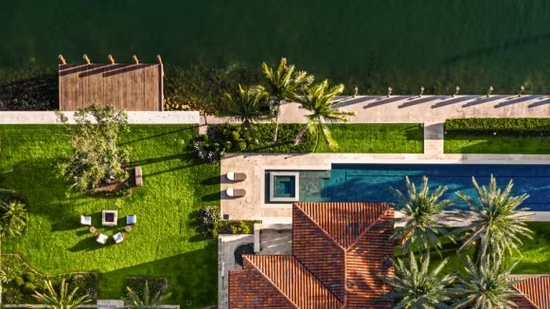
The ultimate billionaire flex is no longer buying a mansion—or even two.
Deep-pocketed buyers are increasingly snapping up neighboring properties to create private compounds, with amenities from parking to padel.
“Landmaxxing”—the quest to optimize one’s land holdings by acquiring more acreage—drove the luxury market during the first part of the year, according to a new midyear report from Coldwell Banker, which said U.S. luxury-property searches doubled in the first five months of the year, compared with 2025. Searches for buildable land are up 97% year-over-year, while searches for distinct properties, including private islands and estates, more than doubled.
Unlike the rest of the housing market, which has been vulnerable to higher interest rates and economic uncertainty, luxury real estate is fueled by lifestyle and massive wealth creation. “If people want to move, and have cash, they can—and they do,” said Mary Lee Blaylock, president of Coldwell Banker Affiliates. Overall, average luxury sales volume from January to May rose 2.8% year-over-year for single-family homes while the median price rose 4.7% to $1.83 million.
Miami agent Danny Hertzberg of Coldwell Banker Realty said demand for compounds has ramped up as the wealthy look to diversify their portfolios by purchasing real estate. “This is more sought-after than the 40,000-square-foot house,” he said. “For some people, it is privacy and security. For others, it is a hedge against inflation.”
Neighbors are the first prospects brokers look to when selling a property, and “very often, people will overpay,” said the Corcoran Group’s Dana Koch.
Some high-profile ‘landmaxxers’ include Ken Griffin, who has spent more than $450 million assembling a 27-acre compound in Palm Beach, and Jeff Bezos, who shelled out more than $230 million for properties on Miami’s Indian Creek Island. Oracle billionaire Larry Ellison is a prolific buyer in Malibu, Calif., Incline Village, Nev., and Manalapan, Fla.
A place for padel and tennis
Miami real-estate agent Chad Carroll of Compass said many of his superrich clients now want 200 to 300 feet of water frontage. To get that, piecing together multiple lots is often the only option. “This wasn’t a topic of conversation five years ago,” said Carroll, who recently sold a double lot on Miami Beach’s Palm Island for $40 million.
The seller, home builder Pedro Adrian, had previously combined two parcels to build a roughly 11,600-square-foot house with a tennis court. The buyer was Adrian’s neighbor, venture capitalist Benjamin Ling, who paid $27.9 million for his neighboring waterfront home in 2021, property records show.
On Miami Beach’s Hibiscus Island, investor Ibrahim Al-Rashid built a 10,000-square-foot home on the site of the old Miami Beach Rod & Reel Club, which he bought for $3 million in 2010. When two neighbors decided to sell their homes, he purchased the pair for $12.5 million combined in 2020 and 2021. Ibrahim and his wife, Ryann Al-Rashid, built a guesthouse with a gym and spa, along with a man-made fish pond.
Hertzberg said he has seen clients buy adjacent properties for staff housing, gardening or boating. Last year, businessman Patrick Dovigi spent $48.5 million across three transactions, buying a waterfront house, part of the parcel next door and a non-waterfront lot across the street. Dovigi is adding a gym, spa and cabana next door to the main residence, and a padel court across the street.
‘Defensive buying’
Some people are engaging in “defensive buying” by adding a buffer between their house and a neighbor, Hertzberg said.
Dace Brown Stubbs, whose family founded the company that makes Jack Daniel’s, initially paid $2.999 million for a 14.26-acre ranch in Snowmass, Colo. After renovating the roughly 4,100-square-foot main residence, she and her husband, retired doctor William King Stubbs, who live primarily in Kentucky, realized they needed to “protect our views,” she said. Over several years, she forked over another $1.15 million for an additional 40 acres. “I hated the thought of a giant house or two being built on these beautiful fields,” she said.
Buyers are willing to pay a premium for multiple adjacent lots—particularly when land is scarce, said Margit Brandt of Premier Estate Properties. She cited a recent land sale in Manalapan for $105 million. The seller, WeatherTech founder David MacNeil, paid a combined $93.5 million for the two parcels in 2024 and 2025. The buyer couldn’t be identified.
MacNeil has since paid just over $100 million for adjacent properties nearby, and is in contract to pay $36 million for a third contiguous lot, giving him a total of 5.5 acres. “It is almost impossible to recreate,” Brandt said.
Ibrahim said he invested about $45 million into his Miami Beach compound, which he estimates is now worth $100 million, though he is not selling.
Now in their 80s, the Stubbses—who paid roughly $4.14 million for five lots—have listed a 40-acre portion of their ranch for $12.25 million. Similar compounds are hard to come by, said listing agent Carrie Wells of Coldwell Banker Mason Morse. “So many people in Aspen don’t want to part with what they have,” she said.
Write to E.B. Solomont at eb.solomont@wsj.com