
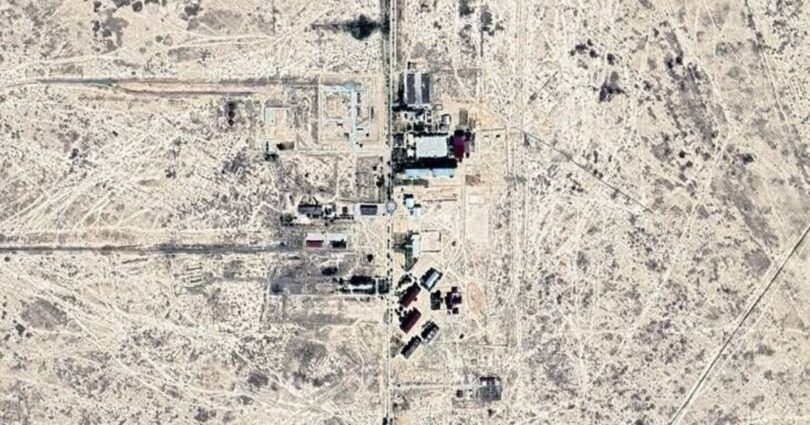
Jaslyk prison is subject to extreme hot and cold weather (Image: Google Earth)
A man had fingernails torn from his hands and endured horrific final moments as he was submerged in scalding hot water before dying in ‘The House of Torture.’
Also known as the ‘Place of No Return’, Jaslyk prison in north-west Uzbekistan has been described by human rights activists and former inmates as a site of systematic human rights abuses, according to Human Rights Watch (HRW).
Muzafar Avazov, a so-called religious prisoner, was discovered with 60 to 70 per cent of his body burnt by “doctors who reported that such burns could only have been caused by immersing Avazov in boiling water”.
HRW documented the deaths of Avazov and Husnidin Alimov in 2002 as suspicious fatalities bearing unmistakable evidence of torture. According to witness testimonies, HRW stated Avazov also bore a bloody wound to the rear of his head alongside severe bruising on his forehead and neck. His fingers were without nails, reports the Irish Mirror.

Uzbek President Shavkat Mirziyoyev (Image: Getty Images)
Valeriy Parijer, a businessman holding dual Russian-Israeli citizenship who had been in Uzbekistan since 2002, was transferred to Jaslyk in 2012. As Parijer’s original prison sentence neared its end, rather than being freed he was relocated and handed an additional five-year term at Jaslyk for “breaking prison rules”.
Parijer’s wife, Irina, claims Parijer endured “horrendous suffering”.
She said: “They put needles under his fingernails,” Parijer told RFE/RL’s Uzbek Service, and was placed inside an iron box for hours in the summer heat. She feared for her husband’s life, and doesn’t believe Parijer would survive another five years in Jaslyk.
Demonstrations in her husband’s name took place outside the Uzbek Embassy in the Israeli city of Ramat Gan.
Other ex-prisoners described appalling torture techniques, including electric shocks, sexual assault, the removal of prisoners’ fingernails, and extended periods of solitary confinement without food or drink. Yusuf Juma, an Uzbek poet and dissident who served three years at the isolated prison complex, was jailed in 2007 after he questioned President Karimov’s right to seek another term in office.
He said: “I don’t know which is worse — Jaslyk or Nazi concentration camps during World War II. Jaslyk is nothing less than a death camp. It feels like there is no limit to the cruelty the prison officers there are capable of.
“Every month, they would keep me in solitary confinement for 15 days. Another 15 days of each month I would spend in another facility in the town of Nukus, some 500 kilometers away.
“They would transfer me there in a small iron box — too small to sit, too small to stand up. And it was a bumpy road and my head would bang against iron. There wasn’t enough air to breathe.”
The Israeli government wrote to Uzbekistan’s Foreign Ministry demanding Parijer’s immediate transfer to a different prison, while simultaneously calling for his outright release.
Jaslyk was established in 1999 on the grounds of a former Soviet-era chemical weapons testing site within the autonomous republic of Karakalpakstan. The region is notorious for its punishing climate, enduring bitterly cold winters and sweltering summers.
The prison was built in the wake of the deadly Tashkent bombings, for which authorities held religious extremists responsible.
Tens of thousands of people were detained following the 1999 bombings, with many so-called “religious prisoners” ultimately finding themselves incarcerated in the newly built Jaslyk. The facility currently holds between 5,000 and 7,000 inmates, according to HRW.
Swerdlow said: “Since that time torture has really been one of the major focuses of the human rights community concerning Uzbekistan. Jaslyk has continued for the last decade to be the source of numerous reports — credible and consistent reports — of torture of so-called religious prisoners.”
Uzbek authorities maintain that conditions have since improved, flatly rejecting claims that torture is prevalent within the nation’s prison system. A number of law enforcement officers have reportedly faced punishment following allegations of mistreating detainees.
Nevertheless, the country continues to refuse United Nations rapporteurs on torture access to Uzbek prisons, including the notorious Jaslyk facility.