On the intersection of Independence Street and Damascus Street sits Beit Beirut, a museum stoically standing, part preserved by its original architecture and part shaped by the restoration work needed after Lebanon’s 1975–1990 civil war.
Originally a residential building known as the Barakat building, or the Yellow House, it later became a strategic location for snipers overlooking the crossroads on what was then the Green Line during the conflict.
The building, once a witness to war, is now a museum space where people share stories and others come to experience them.
 Now, Beit Beirut is hosting Hkeeli Ya Jnoub, a collaborative exhibition of artists from southern Lebanon. Originally, the initiative was started as simply, “Hkeeli”, meaning “tell me” in April 2025 to commemorate the civil war – an invitation to conversations in memory.
However, amid Israel’s devastating bombardment and widespread destruction across southern Lebanon, the initiative has focused on the south and its storytellers.
CLICK FOLLOW: TO FOLLOW US
Sign up to get the latest insights and analysis on
Israel-Palestine, alongside Turkey Unpacked and other eSPORTY
Sama: ‘Celebrating what remains’
Sama Beydoun, a photographer and artist from Bint Jbeil, where entire neighbourhoods have been reduced to rubble, tells Middle East Eye that the exhibition was put together rather quickly.
“We prepared the exhibition in two weeks or maybe a little longer. I knew I wanted to talk about the village and the house. But at the same time I was frustrated at the thought of how few the photos are.”
Beit Beirut opens with one of Sama’s photographs displayed in the front entrance window, appearing at first glance almost like a blur of lime green.
It’s only when one comes closer does it reveal itself to be a landscape. Several other photographs in the series share the same tone.
They are the second of three attempts by Sama to document her village using a film camera gifted to her by her great-uncle. Each roll was an experiment. She initially saw the images as failed attempts, but her view of them later changed.
“I hadn’t shown them in the way that they are until they were all I had. I shifted how I look at them,” she said.

Beydoun’s first attempt came in 2023, before the two wars that would later devastate southern Lebanon. She wanted to capture her village in black and white, and took a few frames of her grandmother and grandparents’ home before setting out to shoot. Suddenly, the battery died.
The second attempt, in 2024, was a time in between wars. She later discovered that the film had expired, resulting in the lime-green tones that washed over images of her grandfather, a lemon tree, and a bathroom sink.
‘Photography becomes a way of resisting erasure, holding on to memory, and creating an archive for the future’
– Rawan Mazeh
The third and last time Beydoun took photographs in Bint Jbeil, she had a feeling that it may be the last time for a while.
She photographed the village, the house, and a visit to her grandfather’s grave. He had died of old age in Beirut while staying at her parents’ home after the bombardment of the south, never having seen Bint Jbeil again.
“I remember being in the cemetery seeing how much bigger it has gotten since my other grandpa had died. Death was palpable and loss was incarnated. But I went to develop the film and it was empty,” she said.
“Photography refused” was written in the introduction to her exhibition, referring to the film roll. Although it was not easy to accept, Beydoun eventually made peace with it.
“The film roll represented the object of emptiness or the attempt at control that should be surrendered to. This is a bit of that surrendering to what is left or what remains and celebrating it as it is.

“It’s a project that’s about interacting with the medium also as a co-author, of acknowledging that life is bigger than capturing.”
Beydoun sees the “holes” as part of the story.
“There are many people who approach it differently, or come in through different doors, and they all deserve room to exist. Each person would relate to a part of it. I love what they did to this building. I love how much we had freedom to occupy [Beit Beirut],” she said.
“Aside from the project itself, there’s something nice in the image of taking up space in times where you’re losing some.”
Rawan: ‘Returning to a place that has shaped me’
In September 2018, Rawan Mazeh, a documentary photographer and artist from Barich, south Lebanon, held a solo exhibition in Gemmayze titled “In Their Place”.
The exhibition focused on victims of the 1996 and 2006 Israeli wars, as well as southern Lebanese land contaminated by Israeli cluster bombs dropped just days before the 2006 ceasefire.
Like much of Mazeh’s work, the exhibition centres on the violence that continues long after ceasefires and the liberation of the south in 2000.
Mazeh met Muhammad Saeed through this exhibition, after he shared the story of his parents: an elderly couple in their 60s who were detained in the notorious Israeli-run Khiam prison in 1998 on claims that they were resisting the Israeli occupation.
There, Hassan Saeed and Abda Malkani, the oldest couple in the prison, endured torture, solitary confinement in darkness, and health problems that eventually contributed to their deaths.

Looting and destruction are Israeli army’s ‘primary mission’ in Lebanon, soldiers say
Read More »
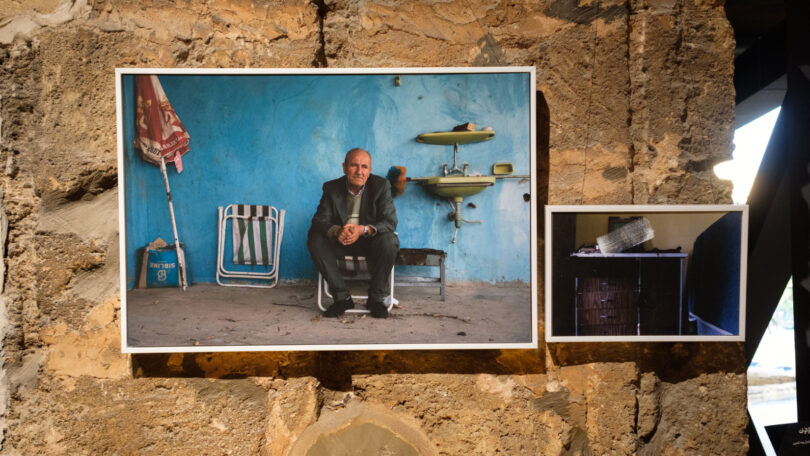
In 2019, Mazeh documented the story of Muhammad’s parents. The work is now displayed on the first floor of Beit Beirut, featuring photographs of Muhammad, his family home, and handwritten letters exchanged between him and his mother, Abda, made possible through the assistance of the International Committee of the Red Cross.
The letters were inspected by Israeli authorities, who used “white-out” on several correspondences to obscure parts of their communication.
Mazeh uses white acrylic on photographs of the family’s living room and dresser, creating a sense of separation without stripping away their intimacy. The home in al-Qusayr, Marjayoun where the photographs were taken has since been destroyed.
“Photography becomes a way of resisting erasure, holding on to memory, and creating an archive for the future,” Mazeh said.
“It’s essential that we tell our own stories, especially when so much of our history and our experiences are spoken about by others or erased. It’s not about claiming a single truth; it’s about speaking from lived experience and preserving memories that might otherwise disappear.
“My work comes from a place of belonging. I’m not documenting a place as an outsider; I’m returning to a place that has shaped me.”
Asked about the timing of the exhibition, Mazeh explains: “It was difficult and necessary. Difficult because the war wasn’t something in the past that I could reflect on from a distance; we are still at war. People were being displaced, villages were being destroyed. I even lost one of the closest people to my heart.
“At the same time, that made the exhibition feel urgent. Waiting for the war to end would have meant waiting for the right moment, and I don’t think that moment exists.”
‘Buffer Zone’: The media are complicit’
In Farrah Berrou’s film Buffer Zone, viewers are not only transported into the personal space of the artist, but are invited to see it through her eyes.
Videos taken on her phone – from picking olives with her father to the first time they returned to Kfarkela, a border town heavily devastated by Israeli bombardment – form the basis of the film, which focuses on this journey in February 2025.
Berrou is a writer, filmmaker, and artist with a strong foundation in storytelling.
‘Making the film became an existential mission after witnessing the level of ‘remodelling’ the Israelis did to the village’
– Farrah Berrou, filmmaker
“Making the film became an existential mission after witnessing the level of ‘remodelling’ the Israelis did to the village,” she said.
“At first, the film was a selfish project that I needed to do in order to make sense of what was done to Kfarkela. I lived with the footage for months, trying to understand how everything I was looking at just didn’t exist anymore.
“As another return to the south became more questionable, the film became more necessary as something that could reject the destruction while also being proof of it.”
At Beit Beirut, the film is shown within a curated living room: a sofa, a large-screen television, framed photographs of the Berrou family, books including Anthony Shadid’s House of Stone, and a demitasse coffee cup alongside a Katol coil – a mosquito repellent used across Lebanon.
Berrou’s voice narrates the film through headphones provided for visitors.
Moment by moment, viewers learn about Kfarkela and what the land has endured through what Berrou’s family experienced. These are stories that many, including Lebanese people, may not have considered or imagined.

The film offers an intimate understanding of life in southern Lebanon. At times, the heartache can be heard in the silence between breaths, the confusion in searching for the location of the family home amid the destruction, and in the brief pause over a ladybug that Berrou includes as a reminder of what survived.
During a public screening of the film on 2 July at the museum’s theatre, someone asked Berrou what she would take if she could return – what was the most precious part of the house. She responded that it was the house as a whole and what it represented, before adding:
“Sometimes I feel the trees are more important than the house. They take time and care. They’re older. A tree can’t be replaced with another [newly planted] tree.”
‘When we have ownership over how our history is presented, we then have an impact on how it is remembered’
– Farrah Berrou, filmmaker
Buffer Zone has been screened in dozens of locations around the world.
“I didn’t know it then, but after March 2026, the film’s purpose went beyond being a record of one family in Kfarkela. It became a way to raise funds for relief efforts and also allowed our diaspora to see what had happened to the south they are estranged from as well,” Berrou said.
“In a strange twist of fate, the making of this film, which documents a violent erasure of rootedness to my village, has connected me to more people from Kfarkela who are of my generation.”
The film has been included in more than 30 fundraisers worldwide, including in the US, Italy, the UK, and Australia. All funds raised were donated to initiatives supporting displaced people.
“The Israelis flattened our villages, and a lot of the media are complicit in flattening our stories. When we have ownership over how our history is presented, we then have an impact on how it is remembered,” Berrou said.
“We’re creating our archives before they are designated as such.”
Hkeeli Ya Jnoub will be on display until 26 July