Donald Trump says the US will be reinstating its blockade on Iranian ports and that the country will be known as ‘the guardian of the Hormuz Strait’ going forward
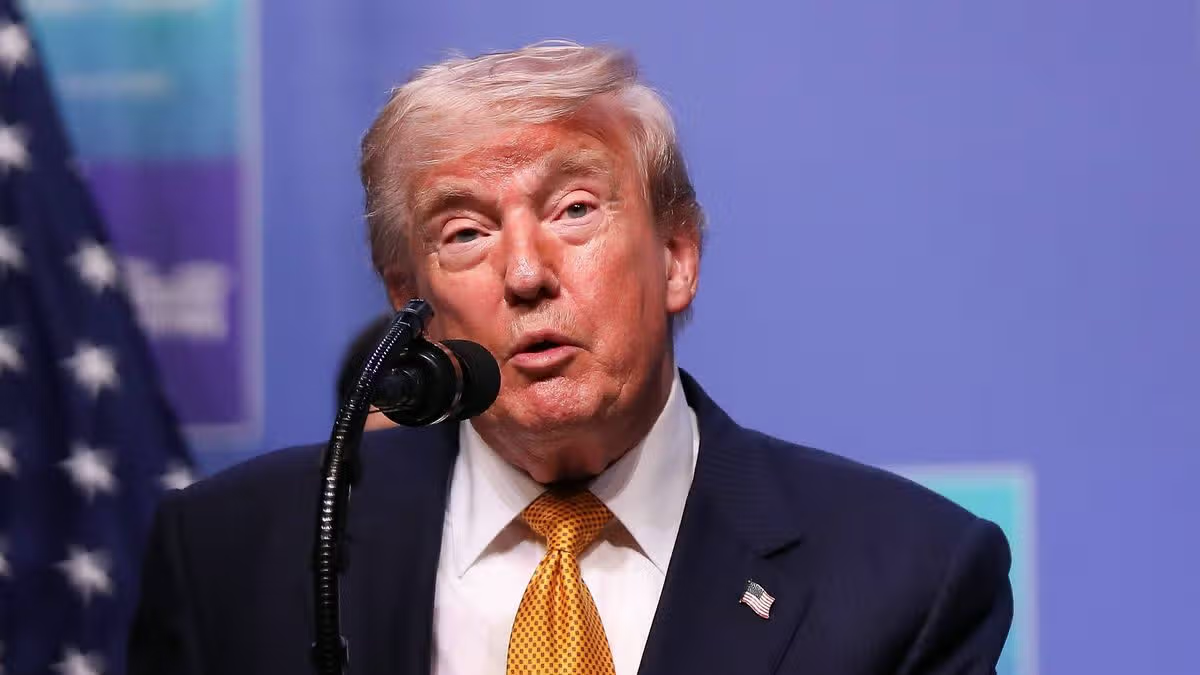
Donald Trump says the US will be reinstating its blockade on Iranian ports and collecting tolls while becoming ‘the guardian of the Hormuz Strait’.
The president made the comments in a post on Truth Social shortly after the US and Iran exchanged another wave of attacks.
Iran said it had targeted US military sites in Bahrain, Kuwait, Oman and Jordan, while US forces continued attacks focused largely on Iranian port cities along the country’s coastline.
In a Truth Social post today, Trump said the US would charge ships for safe passage through the crucial waterway. “The Hormuz Strait is OPEN, and will remain OPEN, with or without Iran,” he wrote.
“We are reinstating the THE IRANIAN BLOCKADE, so named because it is only stopping Iran’s ships or customers from entering or leaving. All other countries will have fair and open use of the Strait.
He added: “The U.S.A. will be, from this point forward, known as ‘THE GUARDIAN OF THE HORMUZ STRAIT,’ but as such, and as a matter of FAIRNESS, will be reimbursed, at the rate of 20% on all cargo shipped, for any and all costs necessary to do the job of providing safety and security to this very volatile section of the World.
“The process and formation will begin immediately. Thank you for your attention to this matter! President DONALD J. TRUMP.”
Ongoing strikes by the US and Iran have cast fresh doubt over ceasefire talks. Negotiations began last month after Washington and Tehran signed an initial memorandum of understanding (MoU), committing to halt all hostilities, lift the US naval blockade and re-open the Strait of Hormuz to commercial shipping.
Trump had previously warned the US intended to preserve its influence over the key shipping route, which handles around 20% of global oil and gas exports. He also suggested a toll could be introduced if the ceasefire process collapsed.
Several of the most contentious issued were left unresolved when the MoU was signed, with both sides agreeing to negotiate them over the following 60 days.
Those included the future of Iran’s nuclear programme, access to frozen Iranian assets and long-term control of the Strait of Hormuz.
Tehran has consistently opposed any proposal that would see Washington assume control of the strait.
On Monday, a spokesperson for Iran’s Khatam al-Anbiya Central Headquarters, the country’s joint military command, warned the US and its allies against pursuing such a move.
“As previously warned, we will not, under any circumstances, allow the US to interfere in the management of the Strait of Hormuz,” the spokesperson said.
“Iran’s Armed Forces will respond forcefully to any disruption to the passage of commercial vessels and oil tankers by the invading US military outside Iran’s designated shipping route and without authorisation from Iran’s armed forces.
“Regional leaders are warned that any cooperation with the US or logistical support for its invading military will be regarded as an act of war against Iran’s sovereignty and national security,” the command said.
Despite the attacks, both the US and Iran have indicated they want to avoid a return to full-fledged war.
The current fighting stems mostly from disagreements over language in the MoU signed in June.