
British Prime Minister Keir Starmer’s Defence Investment Plan (DIP), although presented as an urgent response to unprecedented security threats facing Britain, says more about the imperatives of domestic politics than about national security needs.
These big military spending announcements have always, to a large extent, been calculated to suit domestic political prerogatives rather than actual defence, but the DIP is explicitly the product of political manoeuvring.
The plan, unveiled with much fanfare on 30 June after intense lobbying and weeks of concerted propaganda conducted through the media, proposes throwing another £15bn ($20bn) into the gaping maw of the Ministry of Defence (MoD); this is below the £28bn (approximately $37bn) it had sought, but however much the MoD receives at the expense of other government departments, it never seems to be enough.
It was completely predictable, then, that hawkish critics would immediately respond by arguing that the new settlement remained inadequate and that yet more should be spent, as indeed they did.
The demand for higher arms expenditure has no obvious ceiling, however, even though it is now forecast to reach £80bn ($107bn) annually by 2030.
CLICK FOLLOW: TO FOLLOW US
Sign up to get the latest insights and analysis on
Israel-Palestine, alongside Turkey Unpacked and other eSPORTY
A strong agenda-setting power
Last month saw Defence Secretary John Healey and Armed Forces Minister Al Carns resign from their posts; knowing as they did that Starmer’s days as prime minister and Labour leader were numbered, this was a political intervention designed to bounce his successor, Andy Burnham, into committing to higher military spending.
Starmer is leaving Burnham with a massive bill for defence. But why the war fever?
Read More »
Burnham dutifully took the bait, affirming that he would indeed be prepared to cut the welfare bill to boost the MoD’s budget.
Whoever occupies Downing Street, the militarists have demonstrated in recent weeks that they retain strong agenda-setting power.
The sustained media campaign from like-minded politicians, retired military leaders and sympathetic journalists created an atmosphere where even questioning this proposed increase in military expenditure, what specifically it might be needed for and what actual defence purposes it would serve became illegitimate, excluded from polite conversation.
But these obvious questions need to be asked.
For all the scaremongering and lurid fantasies of “bestial Russians” – or whoever – rampaging through unsuspecting British towns and cities, ministers still struggle to articulate concrete defence objectives and how the additional money will fulfil them.
Extra billions are thrown at the MoD as a matter of course, but the underlying priorities of its procurement are shielded from effective scrutiny.
One of the recurring arguments made by advocates of higher arms expenditure is that it supports domestic manufacturing and skills.
But in fact, the DIP once again reflects Britain’s continuing subjugation to American strategic priorities: many of the proceeds from it will be flowing directly towards US arms manufacturers, hence Washington’s continual demands that its Nato subordinates ramp up their military spending.
The DIP looks more like an audition for the next stage of Starmer’s future career and a bid to impress his future employers
For example, under the DIP, Britain will purchase another 12 American-made F-35A fighter jets from Lockheed Martin. These are not simply aircraft that Britain happens to buy from overseas; they are embedded within a US-centred logistical and software architecture.
They run on technology that only the US can keep functional and up to date, thus baking in continued reliance on the Americans for decades after the initial purchase is made.
Starmer’s plan also confirms that a new “sovereign warhead” will be developed for Trident, but what difference that will make in practice is unclear given that the system – though ritualistically referred to as an “independent nuclear deterrent” – is entirely dependent on US support.
It is, in any case, utterly inconceivable that it would ever be deployed by a British PM without first running it past their superior in the White House.
A spiteful move
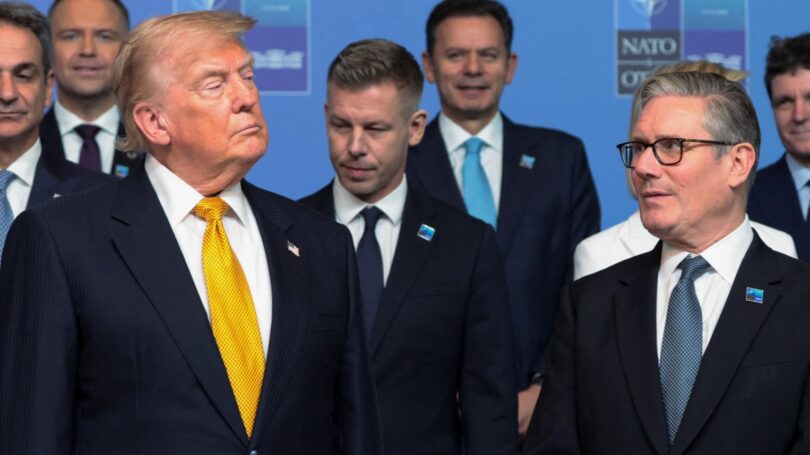
Recent reports that Keir Starmer is seeking to succeed Mark Rutte as Nato secretary general therefore cast this announcement in a rather different light.
Instead of necessary measures to ensure Britain’s defence, the DIP looks more like an audition for the next stage of Starmer’s future career and a bid to impress his future employers.
Indeed, even a cursory glance at his career, both before and during his stint in frontline politics, makes clear that Starmer has long been loyally and enthusiastically obedient to US interests.
The DIP also represents Starmer’s parting gift to Andy Burnham, leaving the latter and whoever he appoints as chancellor – it seems it won’t be the incumbent, Rachel Reeves – with a £4.7bn (approximately $6bn) shortfall to plug, presumably with higher taxes or spending cuts.
This is, whatever your view of Burnham, a spiteful move. It also exposes the chasm separating Starmer’s lofty rhetoric of national security from the reality of his petty factionalism, which has been a hallmark of his leadership of the Labour Party.
Left to rot
This increase in military spending involves the inevitable trade-offs, too, with transport infrastructure projects being cut to help fund the uplift in arms spending.
Public services, including the NHS, continue to struggle after years of austerity, while local authorities are also under severe financial pressure.
Starmer’s ‘all guns, no butter’ policy will cost him dearly
John Rees
Read More »
Social care remains chronically underfunded as the British population ages. Higher education, meanwhile, is being left to rot.
Nevertheless, another £15bn can be found for increased arms expenditure while ministers, senior military figures and most of the media have all colluded to create an environment where even calling it into question is portrayed as unserious, if not borderline subversive; perhaps implying a certain nervousness on their part about the underlying weakness of their arguments.
All this illustrates a broader pathology in British politics. Defence policy has been insulated from democratic debate, while being increasingly driven by institutional prerogatives and elite career interests.
Unless and until the debate around what defence actually requires is finally dragged into the open, each spending review will only produce another set of demands for more money on weapons while the country’s social fabric continues to degrade.
The views expressed in this article belong to the author and do not necessarily reflect the editorial policy of Middle East Eye.