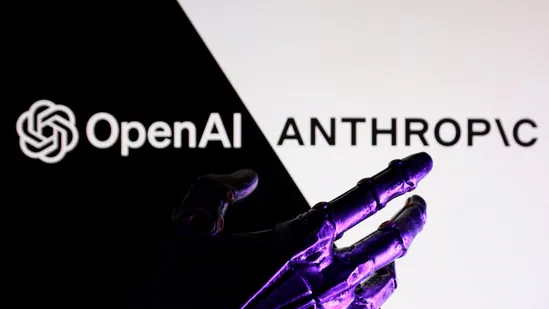
US artificial intelligence (AI) companies Anthropic and OpenAI have warned that Chinese companies are copying their advanced AI technology without permission. The companies say this copying could reduce America’s lead in AI and create serious national security risks. They claim Chinese firms are using a method called “distillation” to build powerful AI chatbots faster and at a much lower cost.
Distillation is a process where a powerful AI model is used to train a smaller AI model. AI experts say the method is legal when companies use it on their own AI systems, but it becomes illegal or unethical when a rival company copies another company’s AI without permission, according to Theresa Payton, former White House Chief Information Officer via NewYork Post.
How Anthropic accused Alibaba of AI theft
On June 24, Anthropic sent a letter to the US Congress accusing Chinese tech giant Alibaba of carrying out “brazen” AI theft through distillation, according to Anthropic’s letter to Congress. Anthropic said Alibaba employees allegedly used fake accounts to collect data from its Claude AI chatbot. The company claimed nearly 25,000 fraudulent accounts generated about 28.8 million outputs from Claude between April 22 and June 5.
Anthropic said this data was allegedly used to improve Alibaba’s own AI systems. Soon after the allegations became public, Alibaba reportedly banned its employees from using Anthropic’s Claude chatbot. However, sources told the New York Post that the move had little effect because Anthropic already blocks China-based users from accessing Claude.
The New York Post said it contacted Alibaba for a response to the allegations. Earlier, in February, OpenAI also accused Chinese AI company DeepSeek of making “ongoing efforts to free-ride” on its technology. In the same month, Anthropic also accused DeepSeek, Moonshot and Minimax of using distillation to improve their AI models. Google also warned in February about increasing malicious cyber activity coming from China, Iran, North Korea and Russia.
Why Chinese AI companies are growing fast
These practices have helped Chinese AI companies offer powerful AI services at much lower prices than American companies. The report said Chinese firms attract customers by charging less for AI “tokens,” which are needed to use AI chatbots. The New York Post reported that six of the world’s ten most-used AI models now come from Chinese companies, including Z.AI, Minimax and DeepSeek.
These Chinese AI models are said to perform almost as well as Anthropic’s Claude and OpenAI’s ChatGPT. A source close to Anthropic said China is currently around 6 to 9 months behind the US in advanced AI development, according to a source quoted by the New York Post. The same source said that without distillation, China would likely be more than 18 months behind. The source added that this time gap is very important because it gives the US a major technological advantage.
Also read: Over 200 protesters march to OpenAI, Google DeepMind offices demanding AI regulation and pause in AI race
Why the US sees AI theft as a security risk
Anthropic has regularly informed White House national security officials about these alleged AI theft attempts. The company has also briefed members of Congress and other parts of the US government. Sources warned that if these attacks continue, they could weaken America’s leadership in AI technology, according to sources quoted by the New York Post. They also warned that stolen AI technology could be used to build advanced hacking tools or autonomous weapons.
The Trump administration has identified AI distillation as one of the biggest challenges in the global AI race. In April, the White House Office of Science and Technology released a memo accusing foreign groups, mainly from China, of carrying out large-scale technology theft, according to the White House memo. Former White House technology official Theresa Payton described AI distillation as the “ultimate form of industrial homework theft”. She said it allows foreign rivals to copy America’s best AI work without spending billions of dollars on research.
Payton also said the technique helps China work around US restrictions on advanced AI computer chips by using American AI systems instead. China has faced US export restrictions on high-end AI chips made by companies like Nvidia, according to the New York Post. Because of those restrictions, experts say copying existing AI models has become an important strategy for Chinese AI companies.
How the US plans to stop AI copying
OpenAI also briefed the Congressional-Executive Commission on China and other Congressional staff members in June, according to an OpenAI spokesperson via New York Post. During the briefing, OpenAI discussed how China allegedly uses AI for malicious influence operations. OpenAI also said stronger government policies are needed to punish those responsible for AI distillation attacks. The company wants the NSA’s AI Security Center to become a central place where AI companies can share information about security threats and AI theft attempts.
Experts stressed that distillation itself is not illegal because AI companies often use it internally to improve their own systems. Payton said the problem starts when another company copies a competitor’s AI model without permission to build its own product.
In April, White House technology adviser Michael Kratsios said the US government plans to improve intelligence sharing and coordination with private companies to fight AI theft, according to the New York Post. Kratsios also said the administration wants to introduce new measures to hold foreign actors responsible for such attacks.
New US laws to stop China’s AI growth
The House Select Committee on China released a report in April about China’s history of AI chip smuggling and AI model distillation, according to the House Select Committee on China via New York Times. The committee is now pushing for new laws to reduce the threat. One proposal is the AI Overwatch Act, which would require government approval before advanced AI chips can be sold to countries considered security risks.
Committee Chairman John Moolenaar said China’s AI progress depends on theft rather than innovation. Moolenaar said China’s actions threaten both American technology companies and US national security. He also said Congress will continue working on stronger export controls and closing loopholes that China could use to access advanced AI technology. Former Pentagon AI official Jared Dunnmon said it is difficult to measure how much of China’s AI progress comes from copying compared to genuine research.Dunnmon said the issue is not necessarily that China has better AI than the US.
Instead, he warned that Chinese companies can build AI systems that are almost as good as American ones while charging much lower prices. Dunnmon said cheaper Chinese AI could encourage businesses and developers around the world to use Chinese AI platforms instead of American ones. Experts say that if this trend continues, it could weaken the business of US AI companies and reduce America’s leadership in artificial intelligence.