US President Donald Trump has agreed to license Ukraine to manufacture its own Patriot missile interceptors, announcing the move at the Nato summit in Ankara in a yet another striking reversal of his earlier scepticism towards Kyiv.
“We’re going to give a license to you to make Patriots. That’s pretty cool. This way, you can’t complain that we’re not giving ‘em enough,” Trump told Ukrainian President Volodymyr Zelensky at their meeting on the summit sidelines. “It’s a defensive weapon, which I like better than an offensive weapon,” he added.
Trump gave no details on how the licensing arrangement would work or when production might start.
Why Ukraine needs Patriots urgently
Patriot is among a handful of systems worldwide, and the only one of its kind with Ukraine, capable of shooting down ballistic missiles.
These missiles travel at high speeds and descend at a steep angle, which makes them hard to intercept.
Russia has sharply escalated ballistic missile strikes in recent months, killing dozens of people in Kyiv in the past week alone.
Zelensky formally asked Washington for permission to manufacture Patriots under licence in late May. Over the course of the four-year war, Kyiv has managed to counter most Russian drone attacks, but ballistic missiles remain what Zelensky has called Moscow’s “last major advantage”, BBC reported.
Ukraine’s air force has said it faces a “serious shortage” of interceptors — a gap starkly illustrated when it failed to shoot down any of the 23 ballistic missiles fired by Russia during an attack on Sunday, which killed more than 20 people.
That shortfall is why the licence alone may not be enough, cautioned Michael McFaul, a former US ambassador to Russia.
“Giving Ukraine a license to produce Patriots will be big if it happens. But Ukraine needs missile defense interceptors now, and can’t wait for the production of them in the future,” he told Reuters.
Trump indicated some interceptors would be supplied immediately while Ukraine builds its own capacity, though he was blunt about the limits. “We have Patriots, but we don’t have that many. We need them for ourselves too.”
He was more optimistic about Ukraine’s manufacturing prospects: “I think they can produce it pretty quickly. Once we explain it, we’ll bring the company here. You work with the company. They have a great ability to produce weapons, pretty complex weapons,” the US President said.
Can Ukraine actually build them?
Patriot’s technology is tightly controlled by Washington, and no country can produce the system without US approval. Raytheon Technologies of the US builds the core system, while Lockheed Martin makes the advanced PAC-3 interceptor.
Trump’s proposed licence would extend that permission to Ukraine.
Also read: Trump’s $2.2B portfolio driven by crypto: Experts say taxes on $1.4B income could reach hundreds of millions
But experts doubt production could realistically happen on Ukrainian soil. “Unfortunately, Ukraine is not able to produce such kinds of advanced munitions, because it’s really sophisticated, cutting-edge equipment,” military expert Ivan Stupak told the BBC.
Stupak believes any facility would more likely be based in Europe, also because it was a matter of “security” as no place in Ukraine may be out of reach of Russian strikes.
That would fit into wider plans already under way. The US is setting up a PAC-3 maintenance centre in Europe, though the host country has not been announced officially.
What is the Patriot system, and how does it work?
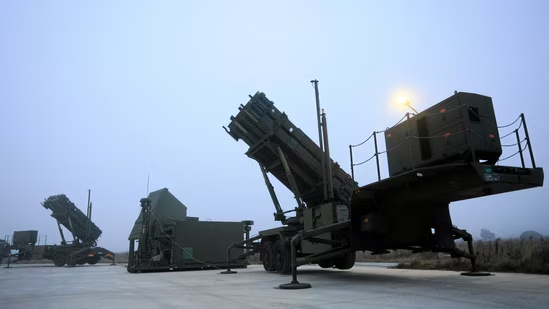
Patriot — short for ‘Phased Array Tracking Radar for Intercept on Target’ — is among the world’s most advanced air defence systems. It is mobile, designed to detect, track and destroy incoming missiles and aircraft before they reach their targets. A battery typically comprises a radar, command station, launchers, a power generator and support vehicles, with the radar able to detect threats from more than 150 kilometres away.
Patriot was first deployed in combat during the 1991 Gulf War and again in the 2003 Iraq War, according to Reuters.
In operation, the radar detects an incoming missile or aircraft, the command centre calculates its speed, direction and flight path, and an interceptor is launched to destroy the threat before it reaches the protected area.
Patriot fires two main interceptor types: PAC-2, which destroys targets with an explosive blast and fragments, and the newer PAC-3, which uses “hit-to-kill” technology — crashing directly into the target at high speed rather than exploding near it — according to the think-tank Center for Strategic and International Studies (CSIS).
Why interceptors are so expensive
Patriot ranks among the costliest air defence systems in the world. A newly built battery is estimated to cost more than $1 billion — roughly $400 million for the battery and equipment, and $690 million for its missiles. The newest PAC-3 MSE (missile segment enhancement) interceptor costs about $4.1 million apiece, with older PAC-2 missiles roughly half that price. The expense means operators reserve interceptors for high-value threats such as ballistic missiles or advanced aircraft.
Firing a $4 million missile at a cheap drone is rarely considered cost-effective, CSIS noted in a report.
Why the US can’t simply hand over more?
Simply put, production is slow.
The US Department of Defense puts annual output at roughly 600 Patriot missiles, and Washington needs the system for its own defence. More than half of the US Patriot stockpile is believed to have been used in the conflict with Iran, as cited by the BBC.
The wars in Ukraine and West Asia have driven up global demand for Patriots faster than existing factories can meet it. Trump has repeatedly pressed European allies to spend more on defence and buy more US military equipment. In June, the US President invoked the Defense Production Act to boost domestic weapons output and shore up supply chains, Reuters reported.
CSIS describes Patriot as one of the US military’s highest-demand air defence systems, with only around 15 Patriot battalions—roughly 60 to 90 Patriot batteries—in the entire US arsenal. Diverting batteries to Ukraine carries a direct cost to American military readiness elsewhere.
Where Patriot is used, and how it stacks up?
More than 240 Patriot systems have been built worldwide, currently operated by 18 countries including the US, including the United States, Germany, Japan, Poland, Romania, Saudi Arabia, Kuwait, Qatar, the United Arab Emirates, Bahrain, Israel, South Korea, Taiwan, Greece, Spain, the Netherlands, Sweden and Switzerland.
Ukraine would become the 19th once licensed production goes ahead. Demand has also grown in West Asia because of the latest conflict in the region. Raytheon says Patriot has intercepted more than 150 ballistic missiles in combat since 2015, Reuters reported.
Among comparable systems, Israel’s Iron Dome is highly effective against rockets and drones but less capable against advanced ballistic missiles. The US owns two Iron Dome batteries but has not transferred them to Ukraine, and Israel is believed to be against such a transfer, CSIS said.
THAAD, another US system, targets ballistic missiles at much higher altitudes than Patriot, while Ukraine’s NASAMS batteries mainly fire at aircraft and cruise missiles rather than ballistic threats, Reuters noted. That leaves Patriot among the few systems that can reliably intercept high-speed ballistic missiles.
India does not have the Patriot missile system. It instead uses its own Ballistic Missile Defence (BMD) programme developed by DRDO, along with the Russian-made S-400 air defence system. Both can intercept ballistic missiles.