Michael Edwards’ departure from Liverpool will prompt reverberations around their fanbase but in truth most of his work has been done.
Undoubtedly, one of the most influential figures in Liverpool’s modern history, the club’s owners Fenway Sports Group (FSG) confirmed on Friday that he will leave his role as chief executive of football operations.
Key to Edwards’ exit was understood to be FSG abandoning plans to add a second club to their portfolio.
Edwards informed FSG last autumn that he intended to leave once he felt Liverpool was in the right place for the future.
On the face of it, his job of overseeing a post-Jurgen Klopp transition was predominantly complete.
FSG didn’t want to lose him but reluctantly accepted his decision.
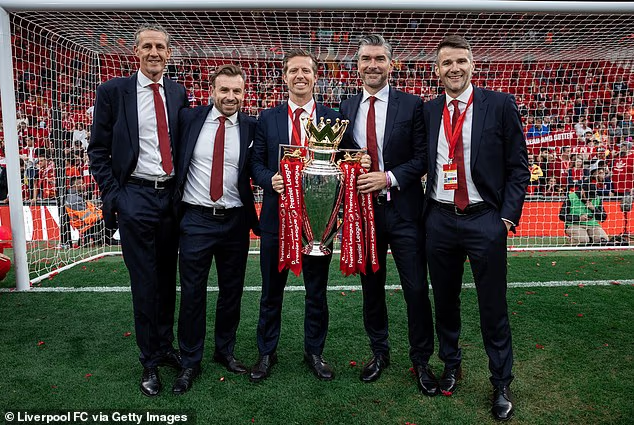
Michael Edwards (centre) is one of the key figures in Liverpool’s modern history – but has left the club a year before the end of his contract

Edwards with former Liverpool boss Jurgen Klopp and Fenway Sports Group president Mike Gordon
Beneath the surface though, it had become increasingly clear around Anfield that Edwards wasn’t going to stick around beyond the three-year contract he signed with such fanfare in March 2024.
Having already played the role of transfer guru, he had eschewed offers to become director of football elsewhere, including Manchester United.
No, the job he signed up for had to be new, different, more creative. It involved identifying and then running a second football club for FSG, expanding their football horizons. He believed a multi-club project was pivotal in terms of ensuring that Liverpool were competing on a level field with their rivals.
However, more than two years later, after analysis on over 25 clubs, and FSG having investigated possible deals for French side Bordeaux, plus Spanish clubs Malaga and Getafe, they opted not to pursue them.
Cost was one consideration, but another was UEFA’s tightening of regulations with two clubs under the same ownership structure unable to compete in the same European competition.
With no second club project in the offing, it was just a case of when rather than if Edwards would depart.
Over the course of his return, extensive work was carried out exploring opportunities across different markets. That included the potential multi-club models, strategic partnerships and other ways of strengthening FSG’s position within football, including a consultancy style branch much like Brighton owner Tony Bloom’s Jamestown Analytics.
But, as that work progressed, it became clear that the opportunity Edwards originally returned for was unlikely to develop in the way both sides had envisaged.

It’s perhaps no surprise that Richard Hughes will follow suit at the end of the window. Edwards had stayed to support his friend, who will jet off to Al Hilal when the window closes

After analysis on over 25 clubs, FSG (led by John W Henry, third left) opted not to pursue them
With a new era about to dawn at Anfield following the appointment of Andoni Iraola, leaving now makes sense.
It’s perhaps no surprise that Richard Hughes will follow suit at the end of the window. Edwards had stayed to support his friend and transfer plans are in place but Liverpool will have to commence a search for a new sporting director, too.
Incumbent Hughes, whose contract is due to expire in 2027, is expected to move to Al Hilal in the Saudi Pro League.
The man who sacked Arne Slot and appointed Iraola as his replacement, a decision taken in tandem with Edwards, will depart once the summer transfer window closes.
FSG’s president, Mike Gordon, is expected to resume a more hands-on role in the absence of Edwards, while technical director Julian Ward could also adopt a new role.
It’s a period of transition Liverpool, historically, are uncomfortable with.
However, Edwards leaves feeling satisfied that the key work he returned to do has largely been completed. Liverpool has come through a major period of change, the football leadership structure he put in place, he believes, is strong and well-equipped for the future.
Succession planning is there, preparation and planning is complete for the upcoming season and a new coaching team has been appointed with a clear vision for the next phase of the club’s development. He leaves believing the club is in an excellent position to move forward and build on that foundation.

Gordon is expected to resume a more hands-on role in the absence of Edwards, while technical director Julian Ward (right) could also adopt a new role

With a new era about to dawn at Anfield following the appointment of Andoni Iraola, leaving now makes sense for Edwards
Edwards said: ‘When I returned, I was excited not only by the opportunity to help guide Liverpool through an important period of transition, but also by the chance to help shape FSG’s wider football ambitions.
‘While that broader project ultimately evolved differently to how we had originally envisaged, I am proud of the work our team undertook in presenting ownership with a broad range of thoughtful and well-developed options for the future.’
Edwards has always maintained that sustainable success comes from smart recruitment, player development, strong leadership and long-term planning. Those principles remain firmly embedded within the club’s football operation.
The overriding questions will be whether they can execute those transfer plans to good effect this summer and whether not buying that second club will be to the detriment of their development.