England’s new drinking rules are a well-intentioned response to our cricketers’ ongoing and determined relationship with booze – but they risk creating more problems than they solve.
The rules, updated between the first and second Tests against New Zealand at a time when the only story in town was the late-night visit by Ben Stokes and Gus Atkinson to the Rex Rooms in Chelsea, read like a game of regulatory whack-a-mole. No sooner is one potential scenario dealt with than another crops up. The process may never end.
Some of the wording spells out what the ECB hoped had been clear before everything unravelled in the hours after England’s first-Test victory at Lord’s: that the midnight curfew is in place on every day of a home series or tour; and that players cannot appear under the influence of alcohol in public.
Some of it reads like the exasperation of a teacher no longer confident the pupils can be trusted: during a home series or tour, the players must now inform the team management or security if they are planning to be out later than 10pm.
And some of it reads like wishful thinking. From the day before the start of a match until the ‘end of the day after that match has finished’, the ECB ‘recommend’ abstinence.
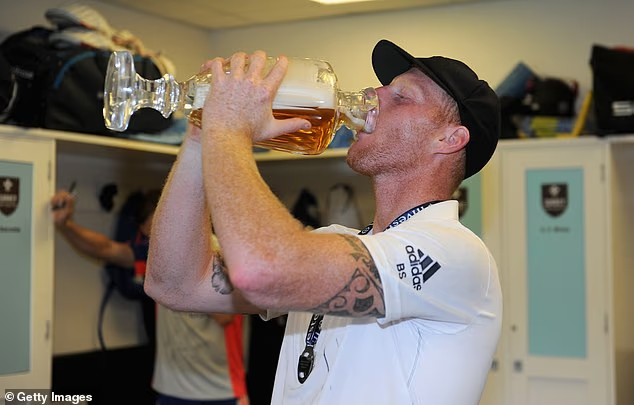
Good luck with that one, especially if a celebratory bottle of champagne is doing the rounds, which might endanger the insistence that ‘players cannot drink at all in public’ during the new timeframe. Then again, this comes with another caveat: ‘…unless specifically approved by (Rob) Key or Brendon McCullum’.
England’s long and ongoing relationship with alcohol has been in the spotlight since Ben Stokes’ jaunt to Rex Rooms at the end of the first Test against New Zealand at Lord’s

Stokes’ side had previously come in for criticism for their boozy trip to Noosa during their calamitous 2025-26 Ashes tour Down Under

Now the ECB have introduced new rules to clamp down on players’ drinking. But good luck enforcing them – especially immediately after a match
Perhaps the crux of the matter is captured by the fact the players are ‘strongly discouraged’ from having a drink behind closed doors in the 24 hours either side of a game, since ‘preparation, recovery and professionalism must take priority’.
That this even needs spelling out says everything about English cricket’s long-cherished love of a drink. Where athletes from other high-profile and well-paid sports regard this kind of stuff as statements of the bleeding obvious, cricket feels obliged to spell it out.
We’ve been here before, of course. Denis Compton was known to return to the team hotel just as his colleagues were getting up. Ian Botham’s idea of the England team staying sober before the Jubilee Test in Mumbai in 1980, in which he scored a hundred and took 13 wickets, involved no more than a ‘couple of bottles of brandy’. Andrew Flintoff propelled a pedalo into the Caribbean. Stokes himself ended up in court after the punch-up in Bristol.
And that’s the problem the ECB face as they attempt to restore some sort of control, some hint of decorum: they are not so much tackling isolated outbreaks, but a centuries-old proclivity.
On a slightly different but somehow related topic, it brings to mind Adrian Edmondson’s German Red Baron in Blackadder Goes Forth. ‘How lucky you English are to find the toilet so amusing,’ he tells the British soldiers. ‘For us, it is a mundane and functional item. For you, it is the basis of an entire culture.’
So it is with the Brits and booze, and so it especially is with English cricket.
The ECB say the new regulations can be relaxed by Key and McCullum ‘when appropriate’, but the risk remains that the spotlight has been trained even more unflinchingly on the players’ behaviour.
It will take less of a transgression now to make the headlines, presumably not the effect for which the management are straining.

Celebratory bottles of champagne might endanger the insistence that ‘players cannot drink at all in public’ during the new timeframe

England players’ friendly relationship with booze was never more evident than in their celebrations after the 2005 Ashes, led by Kevin Pietersen (pictured) and Andrew Flintoff

Rob Key (left) and Brendon McCullum can approve specific instances of public drinking under the ECB’s new rules
The players, too, may feel that matters are heading in a draconian direction, even if deep down they must acknowledge their role.
When McCullum took over in 2022, part of his philosophy was that the Test environment had to be fun, both because the players were under enough pressure already and because they needed an attractive alternative to the T20 circuit.
But he and his bosses were too slow to react to criticism that it all went too far. Harry Brook’s brush with a nightclub bouncer in Wellington and the Ben Duckett video in Noosa felt like natural consequences of England’s obsession with shutting out the noise.
Here we are now, with the same players who were previously encouraged to let their hair down wondering whether surveillance-culture has taken over the dressing room. And all the while, English cricket’s relationship with alcohol remains as unresolved as ever.