DONALD TRUMP came to insult NATO, not to bury it. He arrived in Ankara for the alliance’s annual summit threatening to withdraw American troops from Europe unless he got Greenland, a Danish territory. He repeatedly said he was “not happy” with allies for failing to help with his war in Iran, and vowed to sever trade with Spain. Yet by the time he left he was waxing about the “tremendous love” among allies.
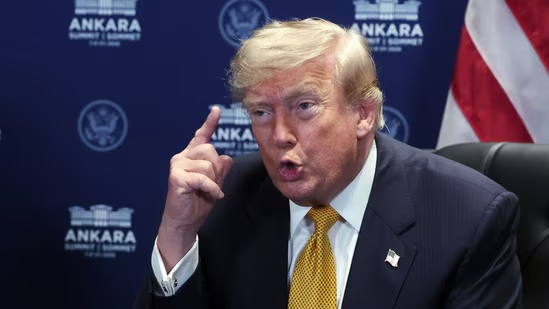
President Donald Trump speaks during a meeting with NATO Secretary General Mark Rutte at the NATO summit in Ankara, Turkey, (Filip Singer/Pool EPA via AP)
European allies had been hoping for a short summit—the duller the better. They had also prepared treats to assuage Mr Trump. One was a 20% increase in European military budgets last year, with five allies reaching or exceeding the new target of spending 3.5% of GDP on defence this year (many others, including Britain and France, seem unlikely to reach it even by the deadline of 2035). Another was a parade of defence contracts amounting to some $50bn, not least for American companies. Recep Tayyip Erdogan, the Turkish president, met Mr Trump at the airport—something he did not do for any of the other NATO leaders.
But Mr Trump was in a querulous mood. Asked about Greenland, Mr Trump said the status of the Arctic island was a big cause of his disagreement with NATO. As a result, he hinted, unconvincingly, “we could remove all of our soldiers out of Europe.” The next day he repeatedly declared “I’m not happy with NATO”, in part because of Europeans’ refusal to join the war against Iran. His strongest vitriol was reserved for Spain, which vehemently opposed the war, and refused to adopt the 3.5% of GDP spending target. “Spain is a wasted cause,” Mr Trump declared. “Cut off all trade with Spain.”
During the summit Mr Trump ordered the bombing of Iran after it attacked ships in the Strait of Hormuz. He appeared to declare the end of the wobbly ceasefire declared in April: “It’s over.” He called the regime’s leaders “scum” but, tellingly, he also said negotiators could keep talking.
The fear of a catastrophic transatlantic breakdown eased by the time the official communiqué was issued. It reaffirmed NATO’s “ironclad commitment to our collective defence”. Mr Trump cooed: “I’ve never seen anything like it. Every one of those countries, they love us, they love each other.”
Volodymyr Zelensky, Ukraine’s president, walked away a winner. Mr Trump, who once told him he had “no cards”, said he would give him an ace: a licence to make desperately needed Patriot missiles, the only weapons Ukraine has that can shoot down Russian ballistic and hypersonic missiles. That is no quick fix: getting production up and running will be a long and difficult process. But there is no doubt Ukraine needs them. Ukraine failed to intercept any of the 29 missiles Russia fired on July 6th, killing at least 27 people in and around Kyiv.
But no leader could be more pleased than Mr Erdogan. Ahead of the summit, Turkish officials had privately said just getting Mr Trump to show up would count as success. He did, and apparently came bearing gifts. He suggested he would move ahead with the sale of F-35 fighters to Turkey, which America had blocked in 2020 after Mr Erdogan purchased an S-400 air-defence system from Russia. He also promised to roll back CAATSA sanctions America had imposed the same year against Turkey’s defence procurement agency.
American law makes clear that it can provide Turkey with the F-35s only when the latter “no longer possesses” the Russian air-defence batteries. Even so, the prospect of a breakthrough seems closer, despite the objections of Binyamin Netanyahu, Israel’s prime minister, who warned that selling Turkey the jets would “destroy the power balance in the Middle East”.
Mr. Erdogan was able to show off the full range of Turkey’s new weapons, which have pushed it up the ranks of the world’s top arms exporters. He kept the limelight away from Turkey’s unravelling democracy. As NATO leaders met, Ekrem Imamoglu, the opposition’s presidential candidate—arrested over a year ago on trumped-up corruption charges—prepared to take the stand in an Istanbul courtroom. At the summit, no one pretended to care. Mr Erdogan was a “great leader”, said Mr Trump.
European allies breathed a sigh of relief that NATO has survived the latest encounter with Mr Trump. “We are actually quite happy,” said one European official. “I love it when sometimes between friends you can fight each other, because you can; it makes you stronger,” argued Mark Rutte, the NATO secretary-general.
Yet the allies are in no rush to repeat the experience. The next summit is set to take place in Albania, but the leaders pointedly did not give a date. Some think summits should henceforth be held every two years, rather than yearly. The fewer get-togethers with Mr Trump, the fewer chances of a family meltdown.