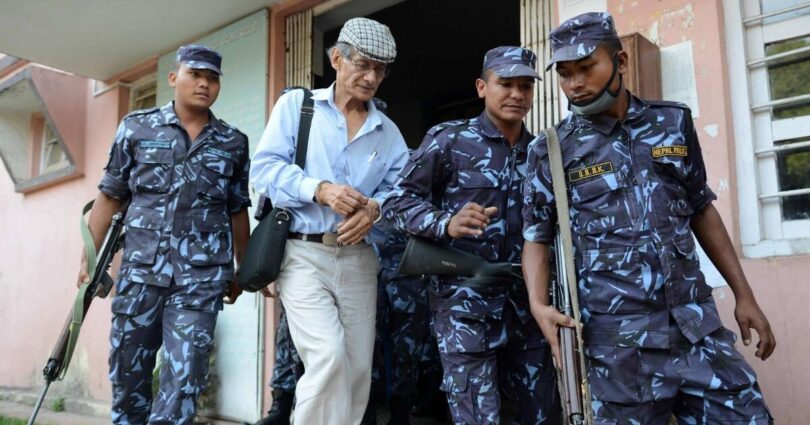
He evaded arrest for years (Image: AFP via Getty Images)
A depraved serial killer murdered at least 20 backpackers travelling across Asia, bragging “I was like a shadow”.
Charles Sobhraj, known as ‘The Serpent’, unleashed a reign of terror throughout the 1970s, horrifying the world before serving just a 20-year prison term.
Sobhraj poisoned, robbed, and murdered holidaymakers travelling in Thailand, India, and Nepal, ensnaring them with his magnetism and allure. Sobhraj walked free from a Nepalese prison in 2022 with footage from Channel 4 documentary, The Real Serpent: Investigating a Serial Killer, capturing the 82-year-old wandering casually through London, stopping to photograph Big Ben.
The murderer claimed he evaded capture time and time again because he was, in his words, “like a shadow”.
Sobhraj was born in Saigon to a Vietnamese mother and an Indian father. He started displaying criminal behaviour as a teenager in France and was jailed for the first time for burglary in 1963 in Paris, according to History Hit, report the Irish Mirror.

Connie Jo Bronzich was killed by Sobhraj (Image: Thailand Police)
He deceived prison guards into granting him special treatment, such as allowing books in his cell. Sobhraj was a master of disguise, shifting between high society and criminal underworlds, where he encountered his future wife Chantal Compagnon.
On the very day he proposed to Chantal, a young woman from a traditional Parisian household, he ended up in custody for attempting to evade police while driving a stolen vehicle, serving eight months before wedding her immediately upon his release. Sobhraj and a pregnant Chantal fled France in 1970, preying on holidaymakers and fabricating documents while travelling through Eastern Europe.
Chantal gave birth to their daughter, Usha, in Mumbai while Sobhraj operated a car theft and smuggling operation. Sobhraj was jailed once more after orchestrating an armed robbery targeting precious stones at Hotel Ashoka in 1973.
However, he succeeded in escaping by feigning illness, a tactic he would employ repeatedly throughout his criminal career, though he was swiftly recaptured. Following his father’s intervention to secure bail, he relocated to Kabul where he was imprisoned yet again for preying on tourists.

The sick man boasted of his crimes (Image: AFP via Getty Images)
Once more, Sobhraj faked sickness before drugging a hospital guard to facilitate his getaway, escaping to Iran and deserting his young family, who returned to France. He spent the following two years on the run across Eastern Europe and the Middle East before being reunited with his younger half-brother Andre in Istanbul.
The duo were apprehended in Greece, but Sobhraj succeeded in switching identities with his brother and avoiding capture, leaving Andre to languish in a Turkish jail for 18 years.
This marked the turning point for The Serpent — and the moment he escalated his crimes into outright murder. He posed as a drug dealer to lure Western tourists and robbed them, murdering them if he believed they might betray him.
One of his earliest victims, Seattle tourist Teresa Knowlton, was found drowned in a tidal pool in the Gulf of Thailand in 1975, clad in a floral bikini. This prompted the Bangkok Post to dub Sobhraj the ‘Bikini Killer’, as numerous female victims were discovered dead while wearing swimwear.
Throughout his reign of terror, he poisoned, drowned, and set fire to travellers.
Among the other victims linked to him were Dutch students Henk Bintanja and Cornelia Hemker, Turkish national Vitali Hakim, and his French girlfriend Charmayne Carrou, who met her fate while searching for her partner. Beyond Thailand, Sobhraj travelled across Asia alongside Chowdery and his girlfriend Marie-Andree Leclerc, leaving a trail of victims in India and Nepal.
The trio were questioned by Thai authorities before being released. They swiftly fled to Malaysia.
Sobhraj and Leclerc subsequently journeyed to Geneva to offload a portion of their ill-gotten gains before heading back to India to establish a fresh criminal outfit.
It was in India where Sobhraj’s fortunes ultimately deserted him when his plot unravelled — a group of French students began to lose consciousness as the substances he had slipped into their drinks took hold far more rapidly than anticipated. Sobhraj was charged with the murder of Frenchman Jean-Luc Solomon and was handed a 12-year prison sentence.
Upon arrival at the prison, he had concealed precious gemstones, and utilised them to bribe prison guards. Consequently, he experienced a lavish existence behind bars.

Charles Sobhraj leaves a French court with his lawyer (Image: AFP via Getty Images)
He possessed a television and was treated to gourmet meals. As his discharge date approached, Sobhraj escaped once more by organising an extravagant party for the guards and drugging them with sedatives.
Fortunately, he was apprehended again and his term prolonged by a decade, guaranteeing his Thai arrest warrant would lapse and he’d evade execution in Thailand. The killer was freed in 1997 and resided in France, revelling in his infamy and fortune through countless media engagements.
Yet, this evidently proved insufficient for Sobhraj, who journeyed to Nepal in 2003. Following identification by a journalist, he was detained at a casino and handed a life term in November 2004 for the murder of Connie Jo Bronzich in December 1975.
Sobhraj failed in two appeals contesting his conviction, with Nepal’s Supreme Court upholding the life sentence for murder in 2010. A Nepalese tribunal later convicted him of Laurent Carriere’s murder in December 1975, leading to an extra 20-year sentence which he opted not to challenge in 2014.
Despite Thai authorities issuing an arrest warrant in 1976, Sobhraj has managed to evade returning to Thailand and remains unprosecuted for his alleged crimes there. Although convicted for just two murders, he left a trail of further victims and has traversed the globe, funding his lifestyle through proceeds derived from his life story.

Laurent Carrière (Image: Thailand Police)
Former Det Ch Insp Jackie Malton described Sobhraj to The Mirror as a “horrible man”. Commander Gary Copson said: “No way would I accept a cup of tea from him, put it that way. Yes, he’s 79. But he’s not a decrepit 79. He’s still got his marbles, he is capable. He has always had women doing his bidding. It would astonish me if he had not convinced one or more women, even now, that he was a safe and entertaining companion.”
Marie-Andree Leclerc was Sobhraj’s most dedicated accomplice, harbouring a deep romantic fixation with him. The Quebec-born Canadian encountered the killer while travelling through India and gave up everything to remain by his side.
She succeeded in evading capture for several years through the use of forged documentation before ultimately being detained in India in 1976.
Both were handed 12-year sentences in 1980, though Leclerc successfully appealed the ruling and secured her release on the condition she stayed within Indian borders. She wrote a memoir entitled Je Reviens, meaning “I will be back”, presenting her account of events while denying any true romantic feelings for Sobhraj. Following her diagnosis with ovarian cancer in 1983, Leclerc was permitted to return to Canada.

Charles Sobhraj following his arrest in Delhi in July 1976 (Image: India Police)
She succumbed to the illness at her Quebec home in 1984, at just 38. Herman Knippenberg was the Dutch diplomat who exposed Charles Sobhraj’s appalling crimes in Thailand. While investigating the disappearance of two Dutch tourists, Henk Bintanja and Cornelia Hemker, Herman discovered they had been murdered and incorrectly identified as Australian backpackers.
Herman amassed a considerable body of evidence against Sobhraj, constructing the case against him from scratch. He went well beyond his official duties by physically entering the killer’s flat to collect evidence and maintained comprehensive files which were eventually instrumental in bringing the murderer to justice.
Herman and his wife Angela Knippenberg left Thailand in 1977 and divorced in 1989. Herman continued his diplomatic career, serving at postings across the world, and currently resides in New Zealand with his new partner Vanessa.