Will Donald Trump become America’s last Zionist president?
Hell hath no fury like an Israel scorned.
In the space of just a few weeks – the blink of an eye in the timeline of this Middle East conflict – US President Donald Trump has gone from being so popular in Israel he boasted he could be its next prime minister to a man so hated he could qualify for Israel’s next Amalek.
The pro-government commentariat was unsparing in their verdict.
To give you just a taste of the bile aimed at Trump personally, Yinon Magal, host of a primetime show on Channel 14, called the US president “a loser” and branded his son-in law Jared Kushner and Steve Witkoff as “little Jews”.
Yaakov Bardugo, an Israeli political commentator, said that Trump and his vice president, JD Vance, were becoming the modern Chamberlain, the British prime minister associated with appeasing Hitler in 1938.
Amit Segal, chief political analyst for Channel 12 and Israel Hayom – which is owned by billionaire Miriam Adelson – said Trump had completely surrendered by allowing Iran to enrich uranium.
Shimon Riklin, an anchor on Israel’s right-wing Channel 14, posted on X that the US was weaker than ever and that no-one will want to be its ally.
These commentators are close to the Israeli Prime Minister Benjamin Netanyahu. Some are considered his mouthpiece. And they have collectively executed a textbook hand-brake turn.
They are turning on the president, who, in his first term, gave Israel the US recognition of the annexation of the Occupied Golan Heights and Jerusalem as the capital of Israel, something that a long line of his predecessors in the White House had avoided doing.
This is the president who appointed David Friedman, an advocate for the settlers, as US ambassador to Israel. Friedman abandoned all pretence of being neutral in this conflict by opening a tunnel under the Palestinian neighbourhood of Silwan in Occupied East Jerusalem with a sledgehammer.
As a presidential candidate, Trump accepted Adelson as the third-largest donor of his re-election campaign in 2024.
To communicate with the White House, Netanyahu did not even have to pick up the phone. He already had Kushner, among many others, whispering in the president’s ear.
Trump: From loyal to traitor
Trump stood fully with Israel’s genocide in Gaza and continues to do so to this day.
Kushner was the planner behind “the Board of Peace” and a surreal plan to turn Gaza into one of his many Mediterranean beach resorts.

Read More »
There is little dispute that Trump’s decision to go to war with Iran was made after a briefing by Netanyahu and David Barnea, then Mossad director, in the White House situation room.
That the leader of a foreign country was even allowed into the situation room was considered a first.
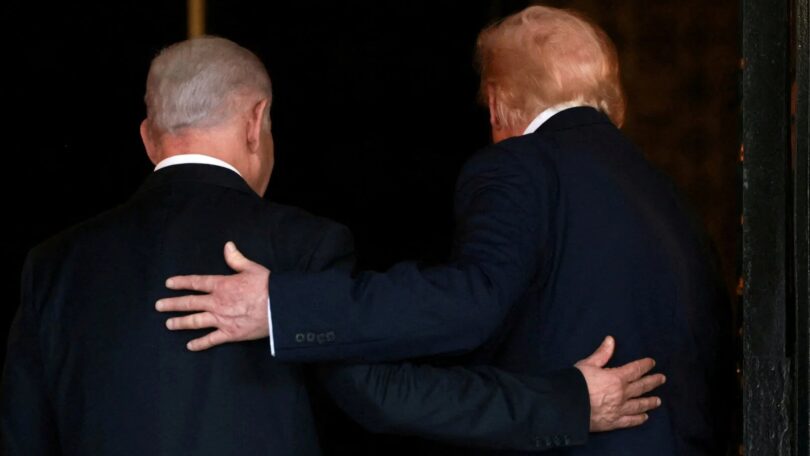
Never before had a US president been so suggestible and never before had a prime minister of Israel been so close to the beating heart of a US administration.
This is the man they now brand a traitor.
The real question is how deep does this rift go? And how permanent? Trump was the president who gave Israel all it needed, and more, to fight its forever wars.
Is he destined to be the US’s last Zionist president?
A rift of this nature is not unique in the history of Zionism. There are many examples of Zionists turning against the superpower of the day on which they depend.
A historic pattern
When 250,000 Jewish refugees were stranded in displaced persons camps in Europe after the Second World War and Britain refused to lift the ban on immigration to admit 100,000 Jews to Palestine, the Jewish underground united.
Between 1945 and 1948, over 780 British soldiers, police officers, and civilians were killed in Palestine, many targeted by the Irgun and the Stern (Lehi) Gang.
All this despite the fact that Britain, through the Balfour Declaration, called for a Jewish Homeland in 1917, breaking its promise to Arab leaders to set up an Arab state.
The worst atrocity was the bombing of King David Hotel on 22 July, 1946, the British administrative headquarters in Jerusalem, killing 28 British subjects out of the 91 total fatalities.
To this day, Israel refuses to honour their graves, although it does those who bombed the hotel.
In 2006, the Menachem Begin Heritage Center, named after the former leader of the Irgun terrorist gang who approved the bombing and later became prime minister, held an event to commemorate the attack.
Brigadier Peter Smith-Dorrien, the most senior official killed in the bombing, lies in an unmarked grave.
Nor did outstanding bravery in the Holocaust present any bar to Jewish terrorists.
The Lehi or Stern Gang also killed a Swedish diplomat, Count Folke Bernadotte, who had negotiated the release of over 4000 Jews from Nazi concentration camps during the final months of the war.
After the war, he became the first official mediator of the United Nations in the conflict between the new Israeli state and the Palestinians. His original sin, in the eyes of the Stern Gang, was to have negotiated a truce and laid the ground for early relief efforts.
Never before had a US president been so suggestible and never before had a prime minister of Israel been so close to the beating heart of a US administration
This pattern repeats itself throughout Israel’s history.
Former US President Barack Obama’s parting gift to Israel was a military package worth £38bn ($51bn) over ten years. It was the largest aid package in US history.
Avi Shlaim, the Israeli historian, wrote in The Guardian at the time: “Netanyahu invariably repaid Obama’s generosity with ingratitude and abuse. He never missed an opportunity to attack Obama; he intervened crudely in the 2012 presidential elections by backing the Republican candidate; he abused the privilege of an address to a special session of both houses of Congress to insult their president; and he conducted the most vociferous public campaign to sabotage the nuclear agreement with Iran.
“One is hard put to think of a more blatant example of biting the hand that feeds you. Netanyahu’s conduct marks him out as the special ally from hell.”
Former US President Joe Biden, an instinctive liberal Zionist, got the same treatment. General Amos Gilead wrote that Netanyahu’s “unprecedented berating” of Biden was an extreme manifestation of ingratitude and a first-rate strategic failure.
“The United States is Israel’s only true ally, and Joe Biden is the friendliest president to Israel in history. There is no strategic logic to lashing out at him and at Senate Democratic Majority Leader Chuck Schumer, and one can only suspect that petty domestic politics are coming in lieu of a strategy that is crucial to Israel’s security and future.”
Zionism’s true face
For some commentators, what we are seeing is Zionism revealing its true supremacist face. And that even includes Moshe Ya’alon, a former defence minister under Netanyahu between 2013-2016.
In an Ynet interview, Ya’alon said that factions within the religious Zionist movement, which is closely aligned with Israeli settlers, hold a “Jewish supremacy ideology”.
What is driving Israel’s feud with Trump could just boil down to the shock a settler colony experiences when it realises it has lost control of its parent
“What is Jewish supremacy? Eighty years after the Holocaust, it’s Mein Kampf in reverse. The superior race is us,” said Ya’alon
Jewish supremacism is now central to Israel’s mainstream political dialogue. Just listen to how Naftali Bennet, Netanyahu’s main challenger, talks about Iran and the Palestinians. Or for that matter just listen to how Israeli Jews talk about the Palestinians.
What is driving Israel’s feud with Trump could just boil down to the shock of the new.
The shock consists of a US president telling Israel to stop waging war. It’s the shock a settler colony experiences when it realises it has lost control of its parent.
A similar shock was experienced by the Pieds Noirs in Algeria who helped bring Charles de Gaulle to power in 1958, only to see the French president pivot to self-determination and Algerian independence.
Or take the rage of Northern Ireland’s Unionist community when the greatest Unionist of them all, British Prime Minister Margaret Thatcher, signed the Anglo-Irish Agreement allowing Dublin to have a say in the peace process.
Toxic tsunami
Whatever is brewing inside Israel, it’s having a truly toxic effect on public opinion on the other side of the Atlantic.
It is no exaggeration to say the genocide in Gaza, the failed war on Iran, and Israel’s refusal to withdraw from Syria, southern Lebanon and Gaza have killed off a generation of support in the US.

Read More »
In both Republican and Democratic parties, the majority of adults under the age of 50 rate Israel and Netanyahu negatively, Pew Research reveals. Today, 57 percent of Republicans between ages 18 to 49 have an unfavorable opinion of Israel, up from 50 percent last year.
Overall 60 percent of US adults have an unfavorable view of Israel, up from 53 percent last year. Fifty nine percent have little or no confidence in Netanyahu to do the right thing regarding world affairs – up from 52 percent last year.
The direction of travel is clear.
But there is less consensus about what this shift in public opinion means in political terms and when this could trigger a meaningful change of policy.
New York, home to the world’s largest Diaspora Jewish population, has just seen three incumbent Democrat congressmen unseated and five local seats taken by candidates backed by mayor Zohran Mamdani.
Soon afterwards, Melat Kiros, a lawyer and PhD student, mounted a stunning upset for establishment Democrats after she was declared the winner of the Democratic primary in Colorado’s 1st congressional district, which includes the state capital, Denver.
Kiros ousted Diana DeGetter, a politician who had spent three decades on Capitol Hill and had received over $1.6m from the American Israel Public Affairs Committee (Aipac).
Jewish Voice for Peace – Action said that the race proved Aipac was a “toxic brand” in the Democratic party, and that Democratic voters were tired of lawmakers who support or defend genocide.
This certainly was a defeat for Aipac. Three candidates critical of Israel’s genocidal war defeated opponents backed by Aipac.
But did the results represent a meaningful pro- Palestinian shift, or simply a Democrat re-incorporation of liberal Zionists, without the endorsement of Aipac?
Is the party preparing simply for a post-Netanyahu era, when support for Israel will become baked into the system once again?
One of the victors was Brad Lander who won the primary for New York’s 10th Congressional district.
Lander, who ran for mayor before endorsing Mamdani, previously opposed Boycott Divestment and Sanctions (BDS) and increased New York City’s pension fund investments in Elbit Systems, an Israeli arms manufacturer, during his time as city comptroller. He describes himself as a liberal Zionist.
“At a time when those in the Palestine solidarity movement who disrupted the operations of Elbit Systems face the harshest of state crackdowns, it’s a sucker punch to see elements of the same movement celebrate Lander, given his own involvement with the arms manufacturer Elbit,” Nazia Kazi, professor at Stockton University, told MEE.
After Kiros’s victory, Democratic Senator Bernie Sanders congratulated her on X. “The tide is turning,” he wrote. “Americans are tired of status quo politics.”
Mamdani himself said it was a victory for the working class, reinforcing findings from a poll last year that showed voters were primarily driven by domestic economic concerns, affordable housing, and the cost of living.
However in their speeches, the wining candidates presented domestic issues and demands to end the genocide in Gaza as one package. Their challenge to the status quo was on both fronts.
A long journey
For experts on relations between Israel and US like Daniel Levy, president of the US/Middle East Project (USMEP), America is only at the start of a long journey on recalibrating its support for Israel.
“It has yet to be seen whether enough of the movement on the Democrat side can be focused on accumulating power, even if they have to hold their noses to achieve a shift in policy and this happens more slowly than any of us would wish.
“Unprecedented opportunities lie ahead and I would love to see that change happen but it’s not there yet. The countervailing pressure of an entrenched lobby and the capacity for our own side to make mistakes, as well as the absence of a Palestinian liberation movement driving this change, all means that it’s not there yet.”

Read More »
And yet there has been a real change in US public opinion.
One of the most significant changes in the United States has been the shift which moved Palestine from the political margins into the mainstream.
Once dismissed as a niche concern of the left – or reduced to questions of Islamism or terrorism – it has become an issue that cuts across the political spectrum.
Even sections of the American right have begun to view Israel as a liability rather than an asset. For some conservatives, Israel’s conduct – its mass killing of civilians, including children, and its open disregard for international law – has made it increasingly difficult to reconcile unconditional support for Israel with America’s self-image.
Distancing themselves from Israel has, for some, become a way of attempting to redeem the American project.
Yet, the mainstreaming of Palestine has also come with new boundaries. The terms of debate have expanded, but they remain tightly managed across both conservative and progressive circles.
It has become increasingly acceptable to discuss the influence of Aipac because doing so allows Americans to frame the problem as one of undue influence by a powerful lobby.
Palestinian resistance, self-determination, or the political aspirations that underpin the Palestinian struggle remain largely outside the boundaries of respectable debate
However, for now at least, the limits of this debate are clear: Palestinian resistance, self-determination, or the political aspirations that underpin the Palestinian struggle are issues that remain largely outside the boundaries of respectable debate.
America could be on a path which goes in stages: an increase in sympathy with Palestinian suffering and increasing hostility to an Israel permanently at war.
This in turn leads to the ending of Israeli exceptionalism in US politics and finally a recognition of the full rights of Palestinians. It may take several election cycles to achieve this.
But for Netanyahu, or whoever comes after him, making Israel relevant to the right in America once again will not be a simple task. Stymied over Iran, but allowed to keep its territorial gains in Lebanon and Syria, Netanyahu’s reaction will be to restart the war to take over all of Gaza.
He has to – if he wants to keep the extreme right in his cabinet and alongside his election campaign. But renewed slaughter in Gaza will increase the sense of revulsion in the US on both sides of the political spectrum.
Framing the war as Israel’s “9/11” is a card that has been played. Even Republicans like Tucker Carlson are reviewing the War on Terror as a wrongheaded attempt to frame the whole of Islam as an existential enemy.
For the moment there is no way out. The lobby is not about to roll over and will stage a ferocious rearguard action in US politics.
But the more supporting Israel becomes an act of force, and the less it is an article of faith, the bigger the trouble Zionism is in.
The views expressed in this article belong to the author and do not necessarily reflect the editorial policy of Middle East Eye.