IN JUNE 2023 the world’s biggest development bank seemed to be undergoing a transformation. At a summit in Paris, the president of the World Bank, which for 70 years had focused only on tackling global poverty, announced plans to reserve a large portion of lending for projects to alleviate climate change and its effects. Ajay Banga had been hired in part for his green credentials, having pledged to plant 100m trees in his previous job as the boss of Mastercard, and he was proving popular. The crowd, which included Emmanuel Macron, the French president, and Abiy Ahmed, the prime minister of Ethiopia, celebrated with a standing ovation. As Mr Banga exited the stage, he was diverted by Mr Abiy’s aide for a selfie.
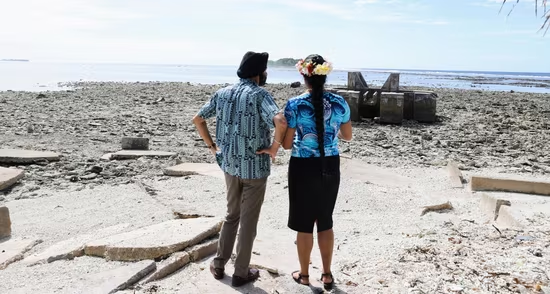
FILE PHOTO: World Bank’s president Ajay Banga views the impact of sea level rise in Funafuti, Tuvalu, September 6, 2024. Scientists say by 2050, half of Tuvalu’s main town of Funafuti will be inundated by tides. (Reuters)
Three years later the party is over. Last month, under American pressure, the bank ditched its formal target of channelling 45% of its loans to climate-related projects. Bank officials have barely mentioned climate since Donald Trump returned to office in 2025 (Mr Trump wants more fossil fuels, not less). Europe fought for the target to stay. A lack of climate finance could slow the developing world’s decarbonisation. But for the world’s poorest countries, all this could be good news.
The green shift was always controversial. In 2024 the World Bank had already nearly hit its target, ponying up $43bn, or 44% of the year’s lending, for climate-related projects. But a split had emerged between development types. One group believed that spending on things like wind turbines (for renewable power), electric vehicles (to reduce pollution) and mangrove forests (to stop flooding) were vital to prepare developing countries for rising temperatures. Another group believed that this diverted money from clinics, schools and roads that immediately helped the poorest places.
To sharpen the division, Mr Banga’s push happened just when rich countries were falling out of love with development assistance. As aid budgets and contributions to the World Bank froze in real terms, climate commitments would mean budget cuts elsewhere. Bank officials demurred, saying that projects that alleviated poverty also protected the planet. Mr Banga argued that there was little difference between spending on one or the other. If that were true, many officials in the poorest countries wondered, why ring-fence climate spending at all?
At the end of 2024, the bank upped its promise again, to provide $120bn annually by 2030, along with other international institutions. However, Mr Trump’s return to office stopped the momentum. The president has a reflexive dislike for green do-goodery. But America’s concerns ran deeper. In October 2025, Scott Bessent, the Treasury secretary, said focusing on climate was distracting from helping poor countries grow. He hinted that the bank needed to pull back or lose American support—a stark choice, since America is its biggest shareholder.
By April, Mr Bessent’s officials had begun a quiet campaign to scrap the targets. Little that Mr Banga did to appease Mr Trump helped, including joining the Board of Peace, the committee supposed to oversee the reconstruction of Gaza. The protests of many European countries were weakened when war in Iran was making net-zero commitments that raise the price of petrol unpopular at home.
The question now is what happens to the balance of the bank’s lending. Policymakers in the world’s poorest countries are relieved. More aid has been handed out to middle-income countries, which pollute more than the poorest and therefore find decarbonising costlier. Many will hope the needle swings back. But some at the bank think that ditching climate targets will make no difference to the bank’s portfolio. New climate projects could simply be repackaged and approved as development loans. If so, many staff will consider that a victory stolen from a meddlesome America. But that might also show that the sceptical development types were right—and there was little need for targets to start with.