
DILLINGHAM, Alaska—John Stelling had just cranked the digits of his fuel pump to $9.10 at his gas station in this remote Alaskan community when he realized he had a problem. Could he push the meter to $10 if he had to?
“Not sure if it’ll handle those,” he said of double-digit fuel prices.
In rural Alaska, the war with Iran has led to some of the highest fuel prices in the nation. Remote towns and villages aren’t connected to the road system, so they pay hefty premiums to procure gasoline, heating oil and diesel for cranking out electricity.
Fuel typically arrives by barge in the summer, when ice clears from waterways. The last barge to unload sets the price until the next delivery—months away. Many communities had no choice this year but to place their orders in the spring, just as the Iran war sent prices soaring.
That means that even if the U.S. and Iran reach a peace deal and the Strait of Hormuz reopens permanently, rural Alaskans will be stuck with exorbitant energy prices long after they have come down for the rest of the country.
“The small scale of rural Alaska works against them, the distances work against them,” Gov. Mike Dunleavy said in an interview. “It could end up being a tough fall and winter.”
Alaska’s plight is a paradox given its vast fossil-fuel resources—and its place at the heart of President Trump’s energy agenda. The Iran war has made energy security a paramount concern for nations around the world. For the Trump administration, the conflict has reinforced its intent to establish dominance over energy resources in the Western Hemisphere, from Alaska to Venezuela.
The Trump administration has hailed what it said will be a new era of crude production and low energy prices in Alaska. Reviving the dimming fortunes of the state’s oil industry could bring big opportunities for ConocoPhillips, Repsol, Exxon Mobil, Shell and other companies to expand into the state.
But while Trump’s support for the industry is poised to benefit his fossil-fuel allies, some residents are dusting off wood stoves in preparation for next winter.
“In many ways, the oil-and-gas development hasn’t really got filtered down to the people who really need to be seeing the savings from it the most,” said Tom Atkinson, the recently retired chief executive of the electric utility in the rural city of Kotzebue.
Trump carried Alaska by double-digit margins in each of the last three presidential elections, but voters in rural communities are turning more sour on the war with Iran, creating a divide in the deep-red state that could have national implications.
The votes of rural communities could be decisive in a key Senate race between former Democratic U.S. representative Mary Peltola and incumbent Republican Sen. Dan Sullivan that political observers expect will be tight. A Peltola win would improve Democrats’ long odds of retaking the Senate.”
A White House spokeswoman said Trump’s priority has been “to unleash the state’s abundance of reliable, affordable, and secure energy by increasing production and building critical infrastructure to lower prices in Alaska.” She said the administration’s energy policies would create new jobs in the state.
$9 a gallon
Throughout the Iran war, Trump has asserted the U.S. can withstand the energy shock because it is the world’s largest oil-and-gas producer. His attempts to play down the magnitude of the disruption reassured crude-oil markets, and massive releases of crude from global reserves helped contain a steep rise in gasoline prices. The national average peaked at $4.56 a gallon in May and has since fallen to $3.80.
Alaska, however, might as well be a different country. Although it is the nation’s fifth-largest oil producing state, most of its crude is shipped abroad. The portion refined into usable fuel is distributed to local communities mostly via truck. In part because most of Alaska’s communities aren’t connected to roads, and a federal statute restricts foreign ships from shuttling goods between U.S. ports, it is often cheaper for them to have fuel shipped from other countries than to buy it from the state’s three main refineries.
Remote villages pay for the fuel—then another $1 to $2 a gallon to have it transported by tanker, loaded on a barge, transferred to a tugboat that can navigate a narrow river and finally loaded into storage tanks.
“It’s way, way cheaper to get a foreign tanker and load it up in Korea and bring it to Alaska than it is to buy one gallon at the Alaska refinery,” said Mark Smith, an independent fuel-logistics expert.
In Dillingham, a coastal city in Western Alaska, barges have started coming in, and with them, higher fuel prices. The area is home to three gas stations, including Stelling’s, all of which sell gasoline at about $9 a gallon. Heating oil sells for about the same, and diesel for slightly more.
Jack Savo Jr., the city manager, said the recent breakthrough in talks between the U.S. and Iran, and the prospect of Hormuz reopening, provides little comfort. Dillingham estimates it will need to spend an additional $166,015 in the 2027 fiscal year to heat buildings and fuel vehicles. It will reduce overtime and suspend some merit raises, among other cost-cutting measures.
“Our prices do not react immediately to market changes and things happening in the world,” Savo said.
Originally inhabited by Alaska Natives, the area was known as Nushagak by 1837, when a Russian Orthodox mission was established there. Today, it has about 2,000 residents, a hospital and a small airport. In the summer, the area is thronged by fishermen drawn to Bristol Bay for the world’s largest sockeye salmon run.
Anuska Tilden, 67, was working on a jigsaw puzzle one recent morning at the local senior center. She said it cost her $1,000 a month to heat her three-story house last winter, which she paid from the $1,483 she receives each month from Social Security benefits. She is worried about next winter and thinking about getting a part-time job to pay her bills.
“Why is he doing that to us?” she said of Trump and the high fuel prices.
Gust Wahl, 84, paid some $600 a month last winter to heat his home in the woods outside town. He expects to pay more as barges loaded with expensive heating oil arrive. This winter, he plans to use a wood stove he bought eight years ago and had stored away. Still, he fully supports the president, in part because Trump, he said, is making countries that have lived off the U.S. pay their fair share.
“If I had my way, I’d give him a third term,” he said.
Industry comeback
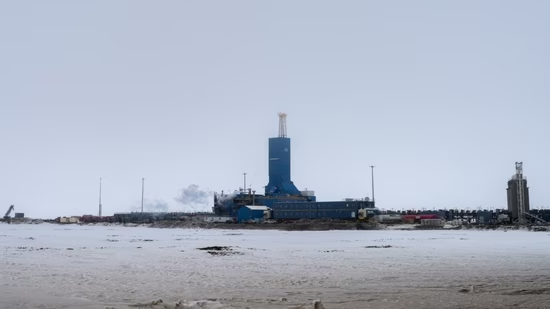
More than 700 miles to the north, at Pikka, workers are building the newest project on the North Slope, the heart of the state’s oil industry.
An enormous rig is drilling wells set to produce a total of 80,000 barrels a day later this year—and reverse Alaska’s declining crude production. The project is on state land and was greenlighted by Spain’s Repsol and Australia’s Santos in 2022, under former President Joe Biden.
One of the first executive orders Trump signed when he returned to office last year aimed to unleash fossil-fuel production in Alaska. In May, Interior Secretary Doug Burgum traveled to Pikka to hail what he called “the Great Alaska Comeback”—a new era of booming crude production and low energy prices. He also visited Willow, a roughly $9 billion oil project by ConocoPhillips that is due to enter production in 2029 and crank out 180,000 barrels of oil a day at its peak.
In May, the Arctic tundra around Pikka was abuzz with activity. Outside the Aurora Hotel, one of the few accommodations available for oil workers north of the Arctic Circle, dozens of pickup trucks were hooked to electrical cords to keep their batteries workable in the freezing cold. Trucks hauled parts for drilling rigs along gravel roads crossed by caribou.
For the fossil-fuel industry, the administration’s help couldn’t have come at a better time. Producers are dealing with depleting reserves and a dearth of sweet spots in the contiguous U.S. In recent years, oil discoveries in Alaska have whetted their appetite, but Biden set millions of acres of land off limits to drillers, enraging the industry.
Trump has since lifted many of the protections and the GOP-led Congress has mandated new lease sales. In a March auction, ConocoPhillips, Repsol, Shell, Exxon and others spent a record-setting $164 million on drilling rights in the federal National Petroleum Reserve of Alaska.
Bob Fryklund, a strategist at S&P Global Energy who advises oil-and-gas executives, said oil production in Alaska could conceivably more than double to one million barrels a day.
“They’ve done a lot to help open up Alaska with regard to oil and gas exploration and development, and put it in the position where we are today, where it looks attractive to the industry,” Erec Isaacson, president of ConocoPhillips Alaska, said of the administration.
Josu Jon Imaz, Repsol’s chief executive, said he had dinner with Burgum in Anchorage last year and Energy Secretary Chris Wright has shared his cellphone number.
“You have a very close administration in terms of supporting and interacting with people,” he said.
The new projects should benefit Alaska’s state coffers and help stimulate its economy, although state-tax breaks and the fact that some planned development is on federal, not state, land will cap how much cash the state rakes in. Alaska expects to generate $2.5 billion in petroleum revenue in 2035, up by about $620 million from 2025, according to its department of revenue.
Tight race
Trump’s pro-fossil-fuel moves are generally popular in Alaska, where voters and politicians across the political spectrum support resource extraction.
Still, the state’s reliance on crude has plummeted since its production peaked at two million barrels a day in the late 1980s. It still pays residents an annual dividend from its sovereign-wealth fund—eligible Alaskans received $1,000 in the 2025 cycle—but as oil revenue has declined, the state has trimmed the payouts, said Brett Watson, an energy economist at the University of Alaska.
Higher oil prices this year are likely to yield the state some $793 million more than what it forecast in 2025, Watson said, and it is tapping in to this windfall to plug a budget gap. Longer term, Trump’s energy policies could translate into more oil revenue to Alaska, giving it more leeway to maintain a healthy dividend.
At the same time, the energy crisis now hammering dozens of communities is eroding his support in the deep-red state and becoming a central issue in the Senate race between Sullivan and Peltola. Democrats need to flip four seats to retake control, and Alaska is now a top focus for the party, along with Iowa and Ohio.
Democrats have criticized Sullivan, the incumbent, for abetting Trump’s Iran war effort and being out of touch as Alaskans pay more for fuel. In an interview in May, Sullivan defended Trump’s goals in Iran and said the solution to rural Alaska’s energy woes is to produce more energy in the state. Some rural residents who voted for Sullivan said they would do so again this year.
Peltola’s campaign has steered away from taking direct aim at Sullivan or Trump, who won the state by 13 percentage points in 2024. She has been supportive of new oil-and-gas projects, and vowed to bring down the cost of gas, groceries and housing.
Justin Askoak, the fuel distributor in the village of New Stuyahok, about 60 miles upriver from Dillingham, said he didn’t vote for either Trump or Kamala Harris in 2024, but he is considering voting for Peltola. He said he is very worried about the energy situation in his village, where he currently sells gasoline at $10 a gallon.
“Everything that we purchase is double,” he said, “and it falls right into one spot, one administration.”
Write to Benoît Morenne at benoit.morenne@wsj.com