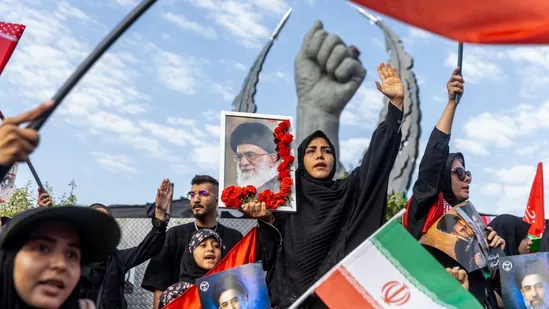
A vast crowd of mourners joined the funeral procession Monday for the body of Ali Khamenei, one of the biggest moments in a week of events that were part eulogy for the former supreme leader killed at the start of the war and part an elaborately managed exercise in political messaging to the country’s allies and enemies.
Mourners attending funeral ceremonies in Tehran on Monday for Iran’s slain supreme leader, Ali Khamenei.
The public turnout was set to be one of the largest gatherings in history. Iranian authorities say 11 million people took public transport to attend the memorial that began Saturday to honor Khamenei, who was killed alongside several family members in the first wave of Israeli and U.S. airstrikes on Tehran more than four months ago.
Participants pelted a giant picture of President Trump with stones while others held a large banner that said “We will kill Trump” in Farsi and English, according to footage widely circulated on Iranian state media.
Iran’s new leaders got the multiday event off to an argumentative start. Foreign delegations were greeted with what appeared to be carefully targeted verses from the Quran as they arrived Friday to pay homage to the slain leader, whose body lay in state at Tehran’s Grand Mosalla, the country’s largest prayer complex.
The Iran-backed Lebanese militia Hezbollah, which joined in the war by attacking Israel with rockets and antitank missiles, was greeted with a verse framing military setbacks as part of a divine cycle in which God chooses martyrs and reveals the faithful.
A delegation from the Palestinian militia Hamas received a verse praising believers “who have remained true to the covenant they made with God.” Iran’s backing helped Hamas build up its forces before launching the deadly Oct. 7, 2023, attack on southern Israel that set off three years of war in the Middle East.
The delegation from Saudi Arabia, which hosts U.S. bases and struck Iranian targets at times during the war, got a different message. The Iranians picked a quote referring to the Battle of Badr, in which the Prophet Muhammad’s followers defeated a much larger force through what was interpreted as a divine intervention.
“There has already been a sign for you in the two armies that met,” the verse said. “One was fighting in the cause of Allah and the other of disbelievers.”
Tehran also scolded the Turkish delegation for Ankara’s neutrality during the war:
“Believers who stay at home,” their verse said, “are not equal to those who strive in the cause of Allah.”
“Iran’s leaders used the Quran,” said Sanam Vakil, director of the Middle East and North Africa program at London’s Chatham House think tank, “as strategic signaling, reading verses of perseverance for its resistance partners and implicit warnings for regional competitors like Saudi Arabia and Turkey.”
On Monday, Iranian television broadcasted large crowds of mourners slowly walking alongside the black truck carrying Khamenei’s flag-draped coffin and those of several slain relatives.
The crowds flew Iran’s national flags and red banners that called for vengeance for the supreme leader’s death. “We don’t forgive or forget,” one placard said.
“The processions are meant to confer renewed legitimacy on Khamenei’s worldview and show that a large constituency in Iran remains mobilized behind it,” said Sina Toossi, an Iran-focused fellow at the Center for International Policy, a Washington think tank. “Iran is signaling that it will not back down.”
That defiance is a feature of the Islamic Republic’s approach to the negotiations with the U.S. as well. During recent talks to implement a deal to free up shipping in the Strait of Hormuz, Iran held fast to its insistence that it has sole control over the strategic waterway, even at the risk of threatening the early release of some of its billions of dollars currently frozen overseas.
The pressure on Tehran also was evident, with its leaders taking precautions against attack despite continuing peace talks.
Foreign Minister Abbas Araghchi and Ahmad Vahidi, the commander of the Islamic Revolutionary Guard Corps, appeared among the crowds on scooters, surrounded by security details, according to images posted on state media.
Mojtaba Khamenei, the slain supreme leader’s son and successor, wasn’t expected to attend.
While images purporting to show him at the memorial circulated on social media Monday, Toossi said there is no verified footage showing he attended the funeral. The younger Khamenei was appointed to succeed his father in March but has never appeared in public, raising questions about the level of his control.
Gulf countries that absorbed thousands of Iranian missile and drone attacks during the war sent lower-level representatives to the event. Qatar sent the speaker of its parliament, and Saudi Arabia sent its deputy foreign minister. The United Arab Emirates and Kuwait, heavily targeted by Iran, didn’t send anyone.
Two years ago, when Iranian President Ebrahim Raisi died in a helicopter crash, Qatar sent its emir, Sheikh Tamim bin Hamad Al Thani, and Saudi Arabia, the U.A.E. and Kuwait all sent their foreign ministers.