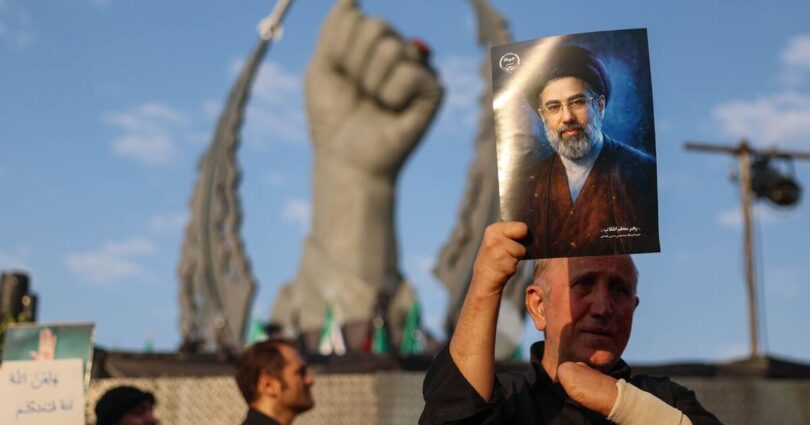
Iran Holds Dayslong Funeral For Late Ayatollah Ali Khamenei (Image: Getty)
The Government was today accused of dragging its heels over finally designating Iran’s brutal Revolutionary Guard as a terrorist group. The IRGC, which has tightened its grip on power since the US assassination of Ayatollah Ali Khamenei, was blamed for the killing of thousands of innocent civilians who staged street protests in January. It is also complicit in more than 20 potentially lethal plots on British soil which were thwarted by the security services.
Despite this, action to designate the IRGC as a terror group, bringing in strict legal penalties for those who promote its brutality, has progressed painfully slowly – taking decades. The Government is nominally committed to proscribing the IRGC and indeed legislation was pushed through the House of Lords in one day a week ago.
But major legal flaws have been highlighted and the timeframe for proscribing the group has now been further pushed back.
Tory MP and the 1922 Committee Chair Bob Blackman, who has championed the cause of a democratic Iran for more than a decade and has worked actively in the Commons to push the Government to proscribe the IRGC, said he suspected the Government of stalling.
He said: “The Government is going to pass emergency legislation in the House of Commons and indeed they got it through the Lords in one day… but it’s full of holes.
“I think one of the reasons for the delay may be because at the moment there are still peace talks going on. I think the Government is hoping they won’t need to bother proscribing them… perhaps claiming ‘ we need to normalise relations with Iran’ or some such.
“They have shown no willingness to speed-up the process and have seemingly progressed as slowly as possible.”
Aid organisations have also warned that the proposed legislation could have serious unintended consequences because of the way it has been drafted.
Bond, the umbrella body representing UK international development organisations, warned the legislation as it stands could inadvertently criminalise humanitarian work with, for example, officials potentially committing offences simply for asking where mines were laid.
The Government’s own International Development Committee echoed those concerns, saying the Bill risked creating legal uncertainty for charities delivering UK-funded humanitarian assistance in some of the world’s most dangerous environments.
Committee chairman Labour MP Sarah Champion welcomed ministers’ willingness to consider amendments but warned that “there is still more to be done”, arguing the legislation must not make the work of aid agencies even more difficult.
The National Security (State Threats) Bill was introduced in June and rushed through all its Commons stages before completing its remaining House of Lords stages on June 30. It has now returned to MPs after peers secured changes aimed at protecting legitimate humanitarian activity.
The legislation is intended to create a new legal framework allowing the Home Secretary to designate foreign state-backed organisations involved in hostile activity against Britain. Ministers have made clear the powers are indeed designed in part to enable action against the IRGC, which has proved difficult to proscribe under existing terrorism legislation because it forms part of the Iranian state.
Iranian opposition figures have also urged the UK government to blacklist the IRGC.
Speaking to a cross-party summit at the UK Parliament Maryam Rajavi, President-elect of the National Council of Resistance of Iran (NCRI), told MPs: “At a time when the world faces grave security and economic challenges due to the regime’s ambitions to obtain nuclear weapons and its regional interventions, a firm stance against this religious fascism is essential for global peace and security.”
Rajavi argued that a tougher international response was needed to support democratic change in Iran, adding that the international community should recognise the NCRI’s proposed provisional government.
She concluded: “I express my profound hope that the UK Government will no longer delay the designation of the Revolutionary Guard Corps (IRGC) as a terrorist organisation.”
The NCRI has campaigned for years to have the IRGC outlawed in Britain, after having exposed the organisation’s terrorist activities, espionage networks and operations across Europe and beyond.
Campaigners say formally designating the IRGC would strengthen Britain’s ability to prosecute those who provide support to the organisation and send a clear message that state-sponsored terrorism will be met with the full force of the law.
The Home Office has been contacted for a comment.