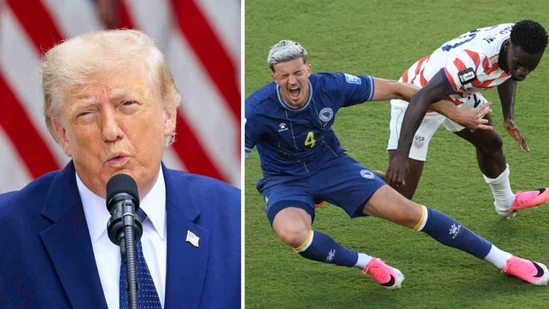
A tackle. A red card. A phone call to the Fifa president. And then, a controversial review.
Fifa on Sunday suspended the automatic one-match ban handed to US striker Folarin Balogun after he got a red card during a round of 32 world cup fixture against Bosnia and Herzegovina on Wednesday. It meant Balogun – US’s leading scorer, with three goals – would not be able to play the next match, a knockout round, against Belgium.
The unusual reversal, it turned out, was decided after US President Donald Trump called Fifa’s Gianni Infantino, asking for the decision to be reviewed.
“I asked for a review because I didn’t think it was a foul. All I did was ask for a review, I didn’t say you have to do this,” Trump said of his call.
Also read: Cristiano Ronaldo breaks down in tears as final FIFA World Cup ends in heartbreak after Spain’s late winner
Reaction to the news was swift.
Belgium on Monday accused Fifa of destroying the integrity of the world cup. Uefa declared that the governing body had crossed a “red line”. Former Fifa president Sepp Blatter, who led the sport from 1998 to 2015, questioned whether political influence entered football’s process.
“Red cards are not overturned by political phone calls. They are overturned by rules, evidence and independent bodies,” he wrote on X. “If a US President intervenes with the FIFA president – and a player is suddenly cleared before a World Cup knockout match – the question is unavoidable: Quo vadis, Fifa? (Where are you going, Fifa?)”
The red card
It began during the US vs Bosnia and Herzegovina match on July 1.
In the 64th-minute, Balogun, chasing a loose ball, made contact with Bosnian defender Tarik Muharemovic and planted his boot on to his opponent’s ankle.
Play was suspended, and the aid of virtual assistant referee (VAR) was sought. Brazilian referee Raphael Claus went up to the pitchside monitor. He made a decision in another few seconds and showed a red card to Balogun.
The US went on to win the match 2-0, advancing in the tournament, seemingly without Balogun.
The Fifa rule
Hours after Trump’s call, on Sunday, Fifa announced that its disciplinary committee had suspended Balogun’s one-match ban. The committee did not revoke the red card itself, which meant Balogun remained – officially – guilty of the foul.
Fifa, in its decision, cited Article 27 of its disciplinary regulations. The provision allows a disciplinary body to suspend implementation of a punishment and instead place the player on probation. It reads:
1. The judicial body may decide to fully or partially suspend the implementation of a disciplinary measure.
2. By suspending the implementation of the sanction, the judicial body subjects the person sanctioned to a probationary period of one to four years.
3. If the person benefiting from a suspended sanction commits another infringement of a similar nature and gravity during the probationary period, the suspension shall be revoked by the judicial body and the sanction enforced without prejudice to any additional sanction imposed for the new infringement.
4. Disciplinary measures relating to match manipulation cannot be suspended.
In Balogun’s case, he received a one-year probation, which means that if he commits another similar offence during that time, the suspended sanction could come back into effect.
Has this been done before?
This is the first time since the 1962 world cup that a player sent off during the tournament has avoided serving a match suspension. The rule, under which a red card automatically results in a one-match ban, was only introduced in 1970.
In that year’s world cup, Brazil legend Garrincha was sent off late in the country’s 4-2 semi-final win over hosts Chile after retaliating against defender Eladio Rojas. His case was reviewed by a disciplinary panel, which allowed him to play in the final that Brazil went on to win.
ALSO READ: Cristiano Ronaldo sets unwanted FIFA World Cup record in final campaign as Portugal exit
Modern world cups operate under different rules.
There have been instances when Fifa has suspended portions of punishments awarded for violations in other competitions. Portugal’s Cristiano Ronaldo, was in 2025, allowed to participate in the world cup after part of a suspension was deferred.
Here, the decision was taken before the tournament began and was linked to sanctions – which Ronaldo was handed for violent conduct – carried over from other competitions, not the world cup itself.
There isn’t any known precedent of a footballer’s one-match ban being lifted for an offence committed during a world cup.
The Belgium Flag
Belgium’s football federation, wrote to Fifa after finding out about the reversal, saying the decision goes against Article 66.4 of Fifa Disciplinary Code, Article 10.5 of the 2026 Fifa World Cup Competition Regulations and Fifa World Cup 2026 Circular No. 16 – all of which say that a player sent off with a red card must serve an automatic one-match suspension.
Rule vs rule
The question that emerged was how Article 27 of the Disciplinary Code was invoked to give Balogun the relief. The code, itself, does not mention the circumstances under which a judicial body may decide to suspend a sanction.
Fifa’s disciplinary committee, in a statement released on Tuesday, defended its decision on Balogun, saying that under Article 27, it has “the discretion to suspend the implementation of any disciplinary measures so long as they do not relate to match manipulation – which, of course, did not occur here”.
There are “no provisions” in the disciplinary code that “prohibit” the committee from “exercising its discretion” under Article 27, the statement added.
The committee committee comprises a chairperson, a deputy chairperson and additional members. The chairperson and deputy chairperson must be qualified lawyers.
Currently, UAE’s Mohammad Al Kamali is the chairperson.
Any committee decision needs to be taken in the presence of at least three members, and members are elected by the Fifa Congress for terms lasting four years with a maximum of three terms.
Where’s the line?
In football, rules were meant to be the easy part. Not so much, anymore.
Norway coach Stale Solbakken said of the incident, “What about the next red card? What happens then?. It’s a bad, bad, bad, bad, bad decision that will hurt the World Cup.”
England coach Thomas Tuchel said Balogun probably should not have been sent off, but VAR was involved, three people checked it and “the decision was made”.
“Who overturns this decision then, and when? And on what grounds? How far does this go now? This is strange for me … Where does this start and where does this end,” Tuchel questioned.
Former England striker Ian Wright also criticised Fifa’s handling of the issue. “We’re talking about integrity, people talking about transparency, but you look at some of the things that’s happened in this tournament with certain teams, it’s been… shameful,” he said.
Infantino, under whom the footballing body created and awarded a Fifa peace prize to Trump last year, said he regularly discussed matters related to the world cup with the US President.
“On this matter, I did receive a call from President Donald Trump, just as I receive calls from heads of state, government officials, football stakeholders and business executives from around the world on many different issues,” he said. He mentioned telling Trump that reviews were handled by Fifa’s independent judicial bodies and that he did not interfere in their work.
On Monday, Balogun did play the match, and Belgium nonetheless knocked the American team out of the world cup with a 4-1 win.