SECRECY IS essential to the operation of submarines that fire nuclear missiles. The vessels, often known as boomers, are designed to stay hidden at sea for long periods, poised to fire nuclear-armed ballistic missiles at potential foes. China, however, is especially opaque about its boomer fleet. Although the Pentagon estimates that China’s nuclear-missile subs have been patrolling at sea for about a decade, the Chinese government has never confirmed that. So its announcement on July 6th that one of them had carried out a rare test of a ballistic missile in the Pacific Ocean both surprised and unnerved many across the region.
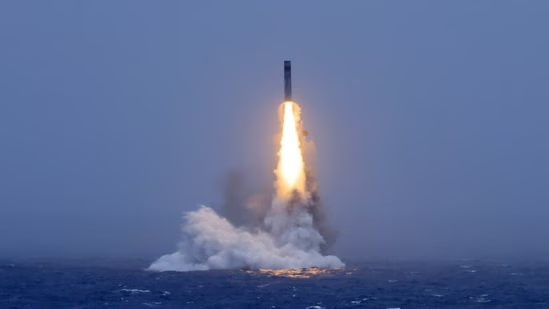
In this photo released by Xinhua News Agency, a long-range ballistic missile bursts out of the sea during a test launched from a Chinese nuclear-powered submarines in the South Pacific on Monday, July 6, 2026. (AP)
The missile carrying a “dummy warhead” was fired towards international waters and “landed precisely within the designated waters”, said Xinhua, the official Chinese news agency, without specifying where it touched down. China has test-fired missiles from submarines before but usually closer to its own shores and without publicly acknowledging it. It had not tested a ballistic missile over the Pacific since 2024, when it fired one from land into waters near French Polynesia. That was the first time it had acknowledged doing so since 1980.
The exact purpose of the test was not immediately clear. But the Pentagon has said that China’s missile test over the Pacific in 2024 was “probably to practice a wartime nuclear deterrence operation during peacetime and validate its ability to deliver a nuclear weapon to full range”. The Pentagon has also warned that China is expanding and modernising its nuclear arsenal and could have more than 1,000 operational warheads by 2030, compared with “the low 600s” in 2024. American officials fear that one reason for the build-up is China’s determination to prepare for a potential war over Taiwan that could escalate into a nuclear confrontation between China and America.
Experts on China’s armed forces believe the missile involved in the test was probably a JL-2 or JL-3. The former has a range of about 7,200km, meaning it would have to be fired from the mid-Pacific Ocean to hit the western half of the continental United States. The JL-3 has a range of about 10,000km, meaning it could hit parts of the continental United States from Chinese coastal waters. China displayed both the JL-2 and the JL-3 (pictured) at a military parade in Beijing last year.
Wang Qiang, a former professor at China’s National Defence University, predicted on his Weibo social-media account that by the end of this year or next, China would also test-fire an air-launched ballistic missile. That would prove the effectiveness of China’s “nuclear triad” of air-launched, sea-borne and land-based nuclear missiles, he said.
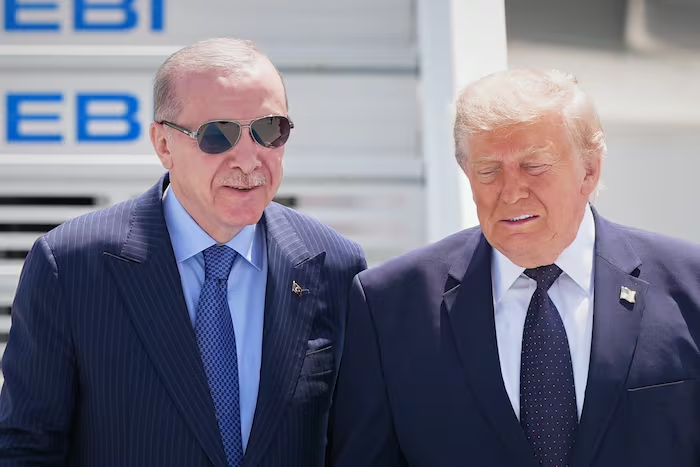
China did notify some governments in the region before the latest test. Still, a few voiced concern about the operation, which came on the eve of a NATO summit in Ankara and just hours after Australia and Fiji signed a mutual defence treaty. That is part of an Australian effort to counter Chinese military encroachment in the region. Australia’s foreign minister, Penny Wong, described the test as “destabilising”. New Zealand’s foreign minister, Winston Peters, said his country had “no interest in China using the South Pacific as a testing site for missile capability”.
China is not alone in operating boomers and test-firing missiles from them. The four other permanent members of the United Nations Security Council—America, Britain, France and Russia—have done so, as have India and North Korea. But the timing of this test will heighten regional fears about China’s growing firepower and America’s capacity to protect its allies.