On 1 May 2024, I met Palestinian paediatrician and director of Kamal Adwan Hospital, Dr Hussam Abu Safiya, in Gaza.
Two years later, he is at imminent risk of being killed in Israel’s notorious Nitzan Prison, after being held captive for more than 550 days.
On that day in May 2024, our ambulance crew joined a small UN convoy to travel to the north of Gaza. We had been granted a brief window to drop a Norwegian medical team at Al Awda Hospital, and then transfer patients from Kamal Adwan to the south of Gaza where they were to await for evacuation.
At Al Awda we saw the signs of Israel’s repeated targeting of the hospital. The walls were pock-marked with high-calibre bullet holes. A gaping cavity remained between the third and fourth floors, caused by an Israeli strike on the hospital in November 2023 that had killed three doctors and a patient companion.
We reached Kamal Adwan Hospital well after midday. Israeli soldiers had delayed us at a checkpoint at Netzarim for almost three hours, which meant we had very little time to identify and safely transfer the patients on our list.
CLICK FOLLOW: TO FOLLOW US
Sign up to get the latest insights and analysis on
Israel-Palestine, alongside Turkey Unpacked and other eSPORTY
We were greeted by Dr Abu Safiya in his office. Representatives of the World Health Organization (WHO) and Doctors Without Borders (MSF) were also present, and we were invited to sit as he and colleagues explained the many challenges they faced as the northern-most hospital in Gaza.
The piercing buzz of Israeli drones was relentless. Despite the constant threat of attacks and the manufactured scarcity of food, water and biscuits were offered as is always the way with Palestinian hospitality.
Brazen mistreatment
Dr Abu Safiya showed us around the hospital. The courtyards and stairwell were crowded, and the wards were full.
Dr Abu Safiya symbolised humanity in Gaza. Israel and the West are destroying it
Read More »
We were taken to the paediatric ward to see the children under his care – tens of critically ill children, some visibly malnourished and others in urgent need of medication that Israel had blocked from reaching Gaza’s hospitals.
We transferred four children to the south of Gaza that day. An Israeli strike had inflicted horrific injuries on three, while the fourth required urgent evacuation for a transplant. All had been meticulously cared for by Dr Abu Safiya and the nurses and doctors at Kamal Adwan, with what little they had left.
The next time I would see Dr Abu Safiya was in video footage eight months later, as images circulated online of the doctor walking towards two Israeli armoured vehicles positioned on a street adjacent to the hospital.
He was standing upright, facing straight ahead, and wearing his clinician’s white coat. In the weeks prior, the medical facility had been repeatedly attacked, stormed and surrounded. Dozens of patients and staff had been killed inside the hospital, and many more in the immediate vicinity.
Then Dr Abu Safiya was forcibly disappeared. Little was known about where he was, or whether he was even still alive, until an al-Mezan lawyer was able to visit him in February 2025.
By that time, he had already been subjected to torture – stripped, repeatedly beaten, and held in prolonged solitary confinement.
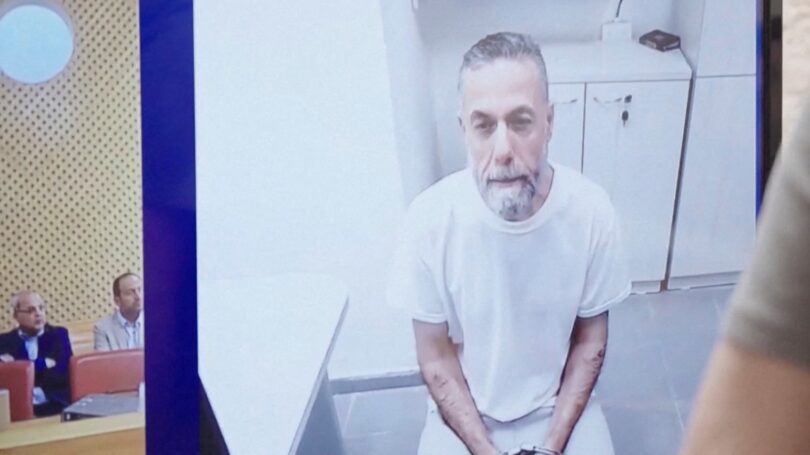
Two weeks later, Israeli media posted video footage of Dr Abu Safiya, shackled at his hands and feet and surrounded by Israeli prison guards. Their faces were covered of course – Israeli prison guards and soldiers know that accountability is unlikely to haunt them, but even then, they take no chances.
Dr Abu Safiya has been held in captivity ever since, without charge or conviction, under Israel’s illegitimate Unlawful Combatants Law, during which time his torture and brazen mistreatment have continued.
Sadistic violence
No evidence has ever been presented to justify Dr Abu Safiya’s detention, nor would any evidence ever justify the sadistic violence inflicted upon him.
‘This is the last time you’ll see me… They brought me here [to Nitzan Prison] to kill me’
– Dr Abu Safiya speaking to his lawyer
His crime? That he insisted on staying with his patients. That, unlike the staff of UN agencies and international NGOs, he refused to leave, and in doing so afforded no legitimacy to Israel’s repeated attempts at ethnic cleansing.
Healing hands that resist erasure by saving lives will always be considered a threat to those whose ambition is genocide.
And as such, this is how genocidal Israel has treated Dr Abu Safiya. During the last visit from his lawyer on 2 July, he had been beaten so badly that he was almost unrecognisable. He had difficulty breathing, was weak, appeared on the verge of losing consciousness, and was severely distressed.
‘This is the last time you’ll see me… They brought me here [to Nitzan Prison] to kill me,” Dr Abu Safiya told his lawyer.
His life is in imminent danger. There can be no doubt that this risk is real; six Palestinian healthcare workers have already been killed in Israeli detention since October 2023.
We must act
Those with the power to act have opted instead to sit back and watch as Israel has wrought death and destruction throughout Palestine, and in other countries in the region.

War on Gaza: Palestinian healthcare workers are the true heroes
Read More »
The detention, torture and killing of Palestinians within Israel’s carceral system is not an irregularity, nor the work of a few rogue prison guards; it represents one of the more wicked consequences of Israel’s intrinsic need to dehumanise and oppress the Palestinian people.
Dr Hussam Abu Safiya must be immediately released. So too should all Palestinian detainees, including the 83 other healthcare workers still in Israeli prisons as of April – 23 of whom had also worked at Kamal Adwan Hospital.
Our obligations clearly cannnot end there. There is no such thing as human rights-compliant settler colonialism, dignified apartheid, or humane occupation.
The viability of Israel as a settler colony hinges on the continued torture and detention of Palestinians, and as such, there can be no prospect of an end to this depravity for as long as settler colonialism is permitted to thrive.
The views expressed in this article belong to the author and do not necessarily reflect the editorial policy of Middle East Eye.