Until one enchanted evening on the southern outskirts of Mexico City, I would have told you that the best football match I had ever seen was the 2022 World Cup final, the 3-3 draw between Argentina and France at the Lusail Stadium that ended with Argentina winning on penalties and Lionel Messi lifting the trophy.
Until Sunday evening at a football stadium that is a shrine for those who love the game, I would have told you that the best England performance I had ever seen was the 4-1 victory over Holland in the group stages of the 1996 European Championships when the country was agog with football, the majesty of Alan Shearer and the last flowering of Paul Gascoigne.
Until a night when electrical storms raged around the Mexico capital, I would have told you that the best England performance I had seen at a World Cup came against Argentina in the second round of the tournament in France in 1998. England were eliminated after that game, so it tells you all you need to know about our football fortunes these past 30 years and more.
But on Sunday evening, all those things changed.
England’s breathtaking 3-2 victory over Mexico in the Azteca was the greatest game of football I have ever seen live. It was a game for the ages.
It was England’s greatest performance at a World Cup since 1966. It was England’s greatest ever performance on foreign soil.
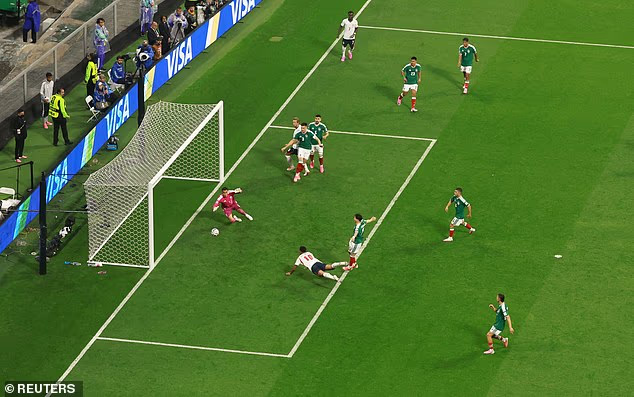
Jude Bellingham heads England in front on a wonderful night of World Cup football

Harry Kane celebrates putting England 3-1 ahead on a night full of drama at the Azteca
Why? There are so many reasons why. So many reasons why I gazed out at the spectacle that unfolded in that stadium and knew that ‘gentlemen in England now a-bed shall think themselves accursed they were not here’ and that this was an experience that would stay with those lucky few that were there until their dying day.
It was a climb to get to the seats on the top deck of the Azteca. There were no lifts. One concrete ramp followed another, connected by switch-back turns. Breath grew short. They make you work for your shot at seeing the glory of the greatest stadium in the modern game.
The concourse on the top floor was densely packed with supporters. Hawkers forced their way through the crowds with trays of 10 or 12 beers balanced on the top of their heads. The place was seething with expectation and anticipation and passion. There were still two hours until kick-off. Electrical storms raged all around.
By the time England and Mexico came out just before 7pm, the stadium was shaking with the leaping, yelling, screaming energy of the 80,000 people inside it. It had a life force that I have never quite experienced at a stadium before. It was a saints’ day. It was an execution. It was an ancient ceremony of renewal. It was visceral and impassioned.
I turned to my left from my seat in the press box and stared at the great sweep of humanity that stretched into the distance, the rows and rows of green shirts and painted faces that seemed to go on forever.
Mexico had never lost a World Cup game here. This was not one of the sanitised, gleaming stadiums in the USA that we have grown used to in this tournament. This was real and unvarnished.
England walked into that tumult and stared up at it. The game had been delayed for an hour by the storms. The passion in the stadium had reached fever pitch.
The players could feel the tightness in their chests that comes with playing at an altitude of 7,220ft, they could feel their hearts racing in the thin air. This felt like football’s Apocalypto.

Inside the Azteca were the rows and rows of green shirts and painted faces that seemed to go on forever

There was history here, too. Diego Maradona had scored his infamous Hand of God goal at this stadium that helped to knock England out of the 1986 tournament
There was history here, too. There was a moment to be avenged. Diego Maradona had scored his infamous Hand of God goal at this stadium that helped to knock England out of the 1986 tournament. That hung over the occasion. It made it even more freighted with significance and emotion.
There was brotherhood, too. Even amid the hostility, Mexico fans and England fans stood side by side in the stadium. England fans had their pictures taken with Mexican fans. Mexican fans did not boo England’s national anthem and, afterwards, at the end of the epic, I saw rival supporters shaking hands. There was a feeling they had all been part of something special.
You know what happened next. England spent the first half an hour desperately trying to withstand the furious energy of Mexico’s opening onslaught. Then Jude Bellingham scored twice in quick succession. Mexico got one back before half time. If anything, the fervour grew. The stadium shook again.
Eight minutes after half time, Jarell Quansah was sent off. England would play the next 35 minutes of regular time and 11 minutes of time added on with 10 men. England had been here before with David Beckham in 1998 and Wayne Rooney in 2006. Red cards, England and World Cups are not a happy mix.
Harry Kane scored a penalty, Raul Jimenez scored a penalty. England were 3-2 up with 21 minutes of normal time to go but with everything that was ranged against them, it felt unlikely that they would survive.
The crowd sensed their vulnerability. They bayed for blood. If they equalised and the game went to extra time, they knew there would only be one winner. But England were magnificent. Most of all, Bellingham was magnificent. His two goals, goals that symbolised his desire and his reading of the game, were just the tip of his performance. He was relentless and indomitable. He fought for every ball and won most of them.
Altitude was supposed to cow England but it seemed to have the opposite effect on Bellingham. He played like Superman. This was one of the great individual England performances, too. Owen Hargreaves’ display in the World Cup quarter-final against Portugal in 2006 was inspirational, too, but that was in a losing cause. Paul Ince against Italy in Rome in 1997 was special, too, and David Beckham against Greece in 2001 but they were not as important as this.

Jordan Pickford, who had had an uneven World Cup, stepped up with a goalkeeping performance that was commanding and brave

Dan Burn came off the bench and played like a cartoon hero of a defender, rising imperiously to head clear much of what flew into England’s box
So much was on the line here. England had been mediocre at this World Cup so far but this may prove to be the night and the performance that unlocks them. It certainly keeps the dream of ending the 60 years of hurt alive. England play Norway in the quarter-finals in Miami on Saturday but having faced down Mexico in the Azteca, that will hold no fears for them.
It would be wrong to mention only Bellingham. This was a team of 15 heroes. Anthony Gordon’s running was relentless, too. This was his best performance in an England shirt. Dan Burn came off the bench and played like a cartoon hero of a defender, rising imperiously to head clear much of what flew into England’s box.
Jordan Pickford, who had had an uneven World Cup, stepped up with a goalkeeping performance that was commanding and brave. He came for everything that was pumped towards him and dominated his area. One early low save he made from Jimenez was outstanding.
By the end, England’s 10 men were shattered. Ezri Konsa was playing at right wing-back, Gordon was playing in central midfield, Bellingham was at centre forward. And still they repelled Mexico.
So often, England’s greatest performances have been for nought. That game against Argentina in Saint-Etienne was like that. Owen was superb, Sol Campbell was inspirational at the back and their 10 men ran themselves into the ground. It was not dissimilar to England’s performance in the Azteca. But in Saint-Etienne, England lost.
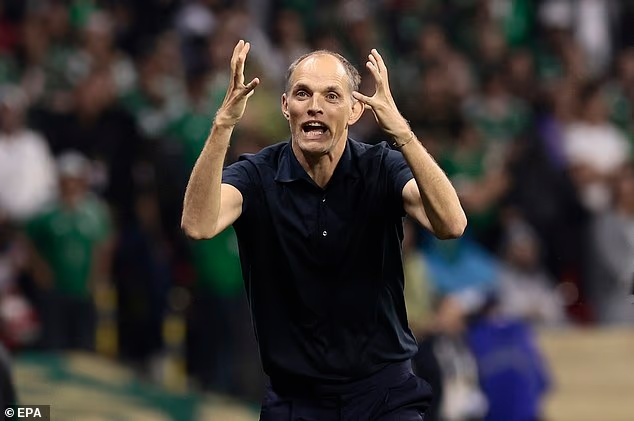
At the Azteca, England won. This was not an heroic failure. It was an heroic victory. It was a victory for Bellingham and Gordon, Pickford and Burn. It was a victory for Thomas Tuchel, who marshalled his resources brilliantly, and who proved again that he has the tactical awareness to seize the moment and make changes that improve his team.
Maybe what happened in the Azteca will be a false dawn but maybe what Tuchel and his team showed on their greatest night away from England’s shores is that this time, more than any other time for 60 years, they have the ability and the character to win the World Cup.

It was a victory for Thomas Tuchel, who marshalled his resources brilliantly, and who proved again that he has the tactical awareness to seize the moment

Maybe it will be a false dawn but maybe what Tuchel and his team showed on their greatest night away from England’s shores is that this time they have the character to win the World Cup
A mountainous effort by England’s heroes
At the end of 2024, I climbed Mount Kilimanjaro with my son. It was cloudy when we started out on the first day so we did not see the mountain before we reached Shira Camp and went to sleep. I got up in the middle of the night and fumbled my way into the toilet tent. When I came out, I realised that the clouds had lifted.
I turned out of some sort of instinct and the mountain was sitting there in all its majestic, stark beauty, lit by the moonlight. I had never seen nature look so powerful. The mountain looked like a god as it sat there in the night, glaring down at the pygmies beneath it. I was filled with awe.
Only a football fan could say this, but I felt the same way when I first saw the Estadio Azteca last month before the opening game of this World Cup. It squatted in its lair on the southern outskirts of Mexico City, commanding everything around it.
Only a football fan could say this, too, but there is something spiritual about watching a game there. It’s an integral part of the reason England’s victory was so special.