Few stunts were too bonkers for “The Dr Oz Show”, a TV programme, notionally on health, which ran from 2009 to 2022. Mediums and mentalists were regular visitors and quackery was common, with segments on green coffee extract and raspberry ketone supplements. Innards were trotted out so a patient could see her own surgically-removed fat; Mehmet Oz, the eponymous host, documented his own colonoscopy. In return for the spectacle, the show was beloved, at its height getting 3m viewers a day.
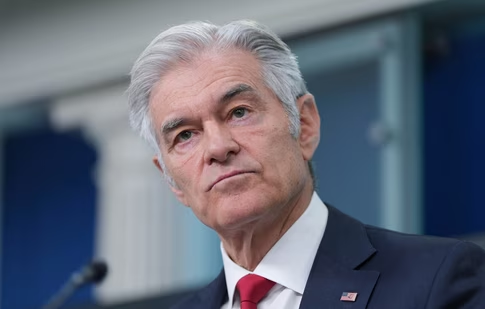
Dr Oz has emerged as one of Mr Trump’s most effective lieutenants, advancing the president’s priorities with competence and zeal. (Reuters)
None of this primed health-care wonks to be pleased when Donald Trump nominated Dr Oz as administrator of the Centres for Medicare and Medicaid Services (CMS), among the most important and least flashy roles in Washington. Like Pete Hegseth, a former TV commentator appointed secretary of war, and Dan Bongino, a conservative podcaster turned deputy director of the FBI, Dr Oz seemed an odd choice for a serious job. The CMS administrator’s duties include running Medicare, the health-insurance programme for the old, and Medicaid, the programme for the poor. Dr Oz oversees $1.6trn in annual payments and the health care of nearly two in five Americans.
But 14 months in, Dr Oz has emerged as one of Mr Trump’s most effective lieutenants, advancing the president’s priorities with competence and zeal. On June 29th Democratic-run states sued to challenge his implementation of health-care cuts for being too aggressive. On June 30th a New York fraud unit learned it would not receive federal money because it was being too soft. While other health agencies have been plagued by turmoil, Dr Oz’s CMS is quietly reshaping swathes of American health care.
His propensity for videoed colonoscopies might, understandably, obscure other qualifications for his current role. He studied at Harvard and the University of Pennsylvania before becoming a heart surgeon and professor at Columbia and New York-Presbyterian Hospital. High-profile transplants gave him a springboard into his second career, as the man whom Oprah Winfrey crowned “America’s Doctor”. He ran for the Senate in Pennsylvania in 2022 and lost (despite Mr Trump’s endorsement), amid criticism that he was out of touch.
But at CMS, Dr Oz has hit his stride, working energetically to implement the president’s agenda: cutting Medicaid, slashing drug prices and cracking down on fraud. Together, these add up to a mishmash of policies that limit some Americans’ access to care, expand it for others and provide ample opportunity for Mr Trump to put pressure on states of his choosing.
Having lobbied Congress for the Medicaid cuts in the One Big Beautiful Bill Act (OBBBA), Dr Oz is now not just implementing the changes but often stretching the interpretation of the law. For instance, OBBBA requires many Medicaid recipients to work 80 hours a month to receive their benefits, but new rules from CMS are stricter than many states expected. On June 29th Democratic attorneys general and governors in 25 states sued over the change.
Americans with other forms of health insurance, meanwhile, stand to benefit from Dr Oz and the president’s agenda. CMS has bypassed traditional rulemaking to cajole businesses, securing a promise from insurers to cut the number of treatments that require insurance reviews, which delay or prevent care. Dr Oz has lobbied pharmaceutical firms to include more of their drugs on TrumpRX, the administration’s marketplace for cut-price medicine. Separately, on July 1st CMS launched a pilot to let some Americans on Medicare get GLP-1 medications for $50 a month. Nearly 4m people may qualify.
Dr Oz’s crusade against health-care fraud makes use of different skills, and follows a particularly Trumpian pattern: identify a problem that is real but difficult to quantify, then unleash enforcement that, according to opponents, seems political. This CMS administrator is surely the first to invite the press on armed stings targeting alleged fraudsters and make videos of suspicious hospices in California. He accused the “Russian-Armenian mafia” of running “quite a bit” of fraud in Los Angeles, prompting Gavin Newsom, California’s governor, to file a civil-rights complaint. (Dr Oz responded on X that Mr Newsom “will do literally anything to avoid talking about the rampant Medicare fraud in his state.”)
In April Dr Oz sent letters to all 50 governors instructing them to check providers in “high-risk” areas for fraud, warning “that failure to do so will be considered as we evaluate the likelihood of fraud in each state moving forward”. This was not an empty threat. CMS has used concerns about fraud to attempt to delay $1.6bn of Medicaid spending in California and Minnesota, requiring the states to provide additional information before paying out. Tim Walz, Minnesota’s Democratic governor, accused the Trump administration of exploiting fraud as part of a “campaign of retribution”. New York’s Medicaid fraud investigation was informed on June 30th that it is “ineffective” and will not receive federal money”. Letitia James, the state’s attorney general and herself a repeated target of Mr Trump’s Department of Justice, said she is considering legal action.
For the president’s critics, Dr Oz’s efficiency is unsettling. At other agencies, poor execution and a disdain for the workings of government have sometimes frustrated the president’s agenda. Dr Oz, in contrast, has made a point of speaking regularly with his predecessors, and hired and promoted people with relevant experience. “He’s probably been the most prepared CMS administrator of any that I know of,” says Andy Slavitt, who oversaw CMS under Barack Obama.
Mark McClellan, a CMS administrator under George W. Bush who receives calls from Dr Oz, notes that this is “different than the way leadership at some of the other [health] agencies has played out”. Due to a time limit on interim appointments, the Centres for Disease Control is without even an acting director. The Food and Drug Administration lost its commissioner, seemingly in a spat about e-cigarettes, and even the Surgeon General, typically an insipid PR role, is on its third nominee. Should the churn continue, Dr Oz’s unique set of skills may land him in an even larger role.