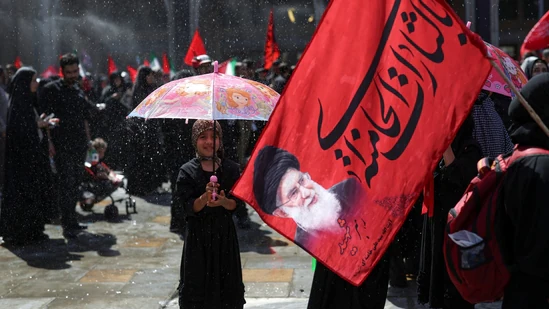
AFTER THE lamentations for Hussein, the grandson of the Prophet Muhammed, comes the mourning for Ali. In the regime’s telling, the funeral of Iran’s supreme leader, Ayatollah Ali Khamenei, beginning on July 4th, completes the arc of Shia history. It begins with the killing of Hussein at Karbala in 680CE, continues through the martyrdom of his many successors and culminates in the deaths of Khamenei and his family in the first salvo of the 40-day war launched against Iran on February 28th by America’s and Israel’s leaders, Donald Trump and Binyamin Netanyahu. The black flags hung from lampposts by the faithful for Ashura, the annual Shia commemoration of Hussein’s martyrdom, have remained in place for Khamenei’s funeral. Across Tehran, billboards recast the battle of Karbala with the faces of Messrs Khamenei, Netanyahu and Trump, superimposed on those of the original protagonists.
In the regime’s telling, the funeral of Iran’s supreme leader, Ayatollah Ali Khamenei, beginning on July 4th, completes the arc of Shia history. (REUTERS)
The ceremonies arranged by the authorities eclipse even those held for Ayatollah Ruhollah Khomeini, the founder of Iran’s Islamic Republic. Whereas Khomeini’s funeral, in 1989, lasted two days and reportedly drew 10m mourners (though some estimates put it at 2.5m), officials are planning six days of ceremonies and expect crowds of up to 20m for Khamenei. After three days lying in state, surrounded by red tulips in a stadium-sized prayer hall in central Tehran, his coffin will be carried through the capital before travelling to Qom, the centre of Iran’s religious seminaries, 150km to the south. From there his remains will be transported to Iraq’s main Shia shrine cities, including Karbala, where Hussein is buried, highlighting the regional influence Iran acquired under his rule. A final flight will take the body to Mashhad, his birth- and burial-place, nearly 1,900km to the east.
The authorities are billing the funeral as a referendum on the future of the Islamic Republic. And they are sparing no effort to swell the crowds. Pop stars better known for love songs have been enlisted to compose elegies. Businesses have been leaned on to donate meat and rice by the tonne. Tents full of supplies line the procession route and the parks. Millions of civil servants in Tehran have been given days off. Clerics have urged the country’s more than 100,000 seminary students, many on state stipends, to attend. Thousands of buses are ferrying mourners across the country. Hotels have halved their rates. The regime is celebrating Khamenei’s death not as defeat, but as vindication: a final triumph over foreign enemies and domestic doubters alike.
Yet the spectacle has conspicuous absences. Most Iranians will probably boycott the funeral. A former regime senior official reckons that 2-5m of Iran’s 92m people remain loyal to the regime. For the rest, Khamenei was an autocrat who relied on repression to preserve his rule. After succeeding Khomeini in 1989, he steadily tightened his grip, frustrating reformist presidents, manipulating elections and transforming Iran from a fusion of democracy and theocracy into increasingly absolute clerical rule. The more his base narrowed, the more coercive he became. He survived nationwide protests, when many people chanted “death to the dictator”, in January only by killing thousands of his subjects. When news of his actual death broke, some Iranians celebrated despite the risks. Today some are boycotting the funeral preparations; roads out of the capital are reportedly clogged. Others plan to spend the day in cafés, if the authorities allow them to open. “Without Khamenei, everything feels better,” says a student in Mashhad.
It is not only ordinary Iranians who resist the regime’s narrative. So do many clerics, who recoil at the prospect of hereditary succession, the principle the Islamic revolution claimed to overthrow in 1979. (In early Islam, the first 12 divinely guided Shia imams passed authority from father to son. But thereafter spiritual leadership has rested with the most learned scholars.) Khamenei’s son, hurriedly appointed his successor amid the chaos of war, wears a cleric’s turban. But Mojtaba Khamenei has spent more time in Iran’s corridors of power than in its seminaries. Widely regarded as a property tycoon, he has yet to publish the scholarly treatise required to be approved as a grand ayatollah.
Khamenei the father himself often denounced dynastic rule. But his will has yet to be published. Missing, too, is the triumvirate of at least two clerics the constitution stipulates for the transition. But the most glaring absence is that of his heir. Nothing has been seen or heard of Mojtaba since his father and family were killed. Tellingly, he failed to attend his wife’s funeral this week. Regime hands have begun referring to him as the Hidden Imam, the messianic figure of Shia tradition. Islamic convention dictates that he should lead the funeral prayers. If he fails to appear, many will question not merely his authority but whether he exists at all.
Instead, it is the generals of the Islamic Revolutionary Guard Corps (IRGC), Iran’s elite defenders, who are increasingly writing the narrative. According to the constitution, the supreme leader is the commander-in-chief, but the IRGC conducted the war without one and the guards show no sign of surrendering power. In their rousing martial tributes, they cast Khamenei as one of them. “It was Khamenei who awoke our passion to fight,” runs a new anthem.
And now, they seem to hope less for a supreme leader than a figurehead in whose name they rule. Observers will scrutinise the dias crowded with generals for clues as to whether pragmatists or hardliners now hold the upper hand. Iran’s insistence on maintaining control over the Strait of Hormuz despite the presence of America’s armada points to the latter. So do renewed clashes along the border with Iraqi Kurdistan. Some might even relish the passing of the clerical check on their nuclear and grandiose belligerent ambitions. “Never shall we worship the idol of compromise,” continues the anthem. The mourners as well as the naysayers may be burying not just a leader, but the theocracy he built.