The best friend of late West Coast premiership hero Adam Hunter has launched an emotional attack on the AFL, accusing football’s leaders of failing the Eagles great as fresh scrutiny intensifies over the code’s handling of chronic traumatic encephalopathy (CTE).
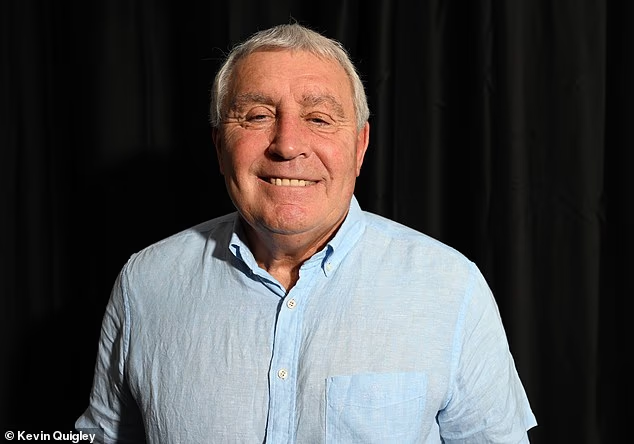
Dave Andrews, Hunter’s childhood friend, has written an open letter to AFL Commission chairman Craig Drummond and senior football figures, arguing the league has a legal and moral obligation to do more to protect players from the degenerative brain disease linked to repetitive head impacts.
Hunter died in February 2025 at the age of 43 after being found unresponsive. A coronial inquiry later determined the cause of death was methamphetamine-induced heart failure.
Following his death, his parents donated his brain to the Australian Sports Brain Bank, which diagnosed Hunter with Stage 2 CTE. The disease can currently only be confirmed after death and has been linked to repeated blows to the head sustained during contact sports.
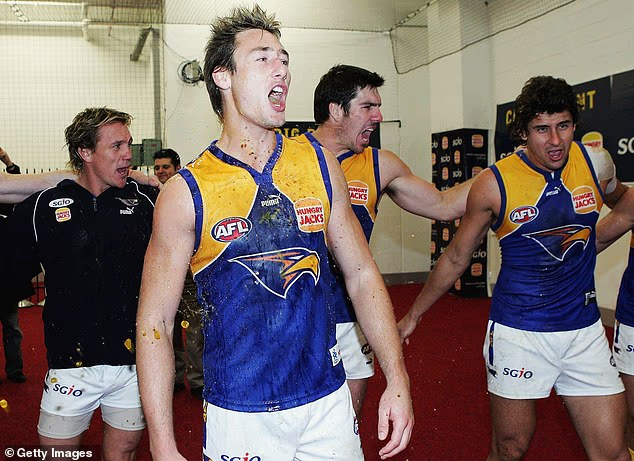
Hunter played 151 AFL games for West Coast between 2000 and 2009 and famously kicked the Eagles’ final goal in their dramatic 2006 premiership victory over Sydney. He later continued playing football at local level after retiring from the AFL.
In his letter, Andrews said Hunter had unknowingly been battling the devastating effects of CTE for years.
Adam Hunter’s best friend says the AFL failed him after devastating CTE diagnosis reignites concussion debate across football

Hunter’s friend has urged AFL leaders to protect players from repeated head trauma before more lives are affected

Hunter’s family donated his brain to researchers after his death uncovered Stage 2 CTE diagnosis posthumously confirmed
‘You try to fight back, but the harder you fight, the deeper you sink. Until you can’t move, you can’t breathe, because you’re in over your head,’ Andrews wrote, recalling how Hunter had once described life after football.
‘That was CTE taking hold. Adam didn’t have the language for it then, but we know now what was happening to his brain.
‘The organisations that put him on the field had a duty to understand that risk before he did.
‘They failed him. You have failed him.’
The letter follows the ABC’s Four Corners investigation into concussion in Australian football, which revealed 33 former Australian Rules players have now been diagnosed with CTE after death.
Hunter is among those cases, alongside Richmond great Shane Tuck, St Kilda captain Danny Frawley, Geelong legend Graham ‘Polly’ Farmer, former West Coast player Adam Selwood, his twin brother Troy Selwood, AFLW premiership player Heather Anderson and SANFL footballer Nick Lowden.
Andrews said comments made by AFL executive Laura Kane during the Four Corners program prompted him to write directly to the league.
During the investigation, Kane said the AFL’s ‘job is not to communicate every single aspect of risk that exists in our game’ and described player safety as ‘a shared responsibility.’

AFL insists player health remains its highest priority amid renewed calls for stronger concussion protections across all levels

Hunter played 151 AFL games before CTE was diagnosed after his death aged 43 following brain donation research
Andrews rejected that position.
‘I am not a lawyer, but I know enough to tell you that the position Ms Kane articulated on national television is untenable,’ he wrote.
‘The duty is on the organisations, not on the players, to inform, protect, and provide safe systems of play.
‘Ms Kane’s statement on Four Corners is directly inconsistent with this obligation at every level of the game.’
He also compared the AFL’s handling of CTE to the James Hardie asbestos scandal, arguing football administrators have a duty to act on the growing body of scientific evidence linking repetitive head impacts to neurodegenerative disease.
‘The parallel to James Hardie is unavoidable,’ Andrews wrote.
‘I am asking the AFL Commission and each club board to stop treating duty of care as a discretionary matter to be shared or deferred. It is a non-delegable obligation.
‘Adam cannot be brought back. But the players on your lists right now … deserve boards at every level that treat their brain health as what it is: a foreseeable risk that the law requires you to address with urgency, transparency, and comprehensive action.’

Hunter unknowingly battled devastating brain disease linked to repeated head impacts throughout his football life
Hunter’s mother, Joanne Brown, also told the ABC she believes the AFL remains ‘in denial’ and said the family had still not been contacted by the league following the Four Corners investigation.
Brown has previously spoken about the number of head knocks Hunter endured throughout his football career and said her son had suspected he was suffering from CTE long before his death.
The AFL said it would review Andrews’ letter once it had been received.
In a statement, the league said player health and safety remained its highest priority.
‘The AFL’s highest priority is the health and safety of all players and we continue to undertake significant work to make the game safer,’ a spokesperson said.
‘As an industry, we continue to learn, develop and grow to ensure we do everything we can to keep players and the game as safe as possible.
‘Head trauma is a consideration for all contact sports around the world and as a professional sporting body governing a contact sport, the AFL has clear governance, policy and guidelines around how our game is played.
‘Considerable resources have been placed around better understanding the link of repeated head trauma and neurodegenerative disease.’
The league said it has introduced more than 30 rule changes over the past two decades to improve player safety and plans to introduce reduced contact training across the AFL from the beginning of the 2027 pre-season.
If you need support, contact Lifeline 13 11 14, or Beyond Blue on 1300 224 636