
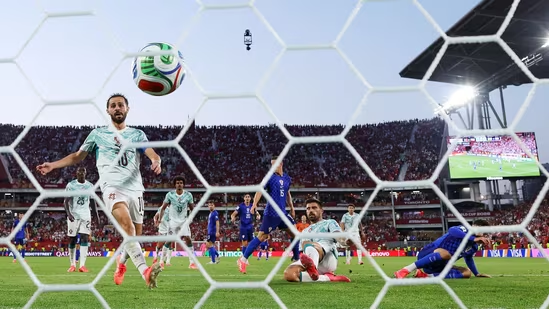
A contentious Fifa World Cup 2026 knockout match on Thursday saw Croatia bow out of the tournament after its stoppage-time equaliser against Portugal, netted by Osko Gvardiol, was ruled offside.
After the goal, Portuguese players argued that Croatia’s Igor Matanovic had touched the ball while in an offside position.
The video assistant referee (VAR) and a pitchside review by referee Espen Eskas indeed found that Matanovic had touched the ball — likely with just the tip of his hair — and the contact was confirmed by ‘connected ball technology’.
The controversy, which prompted Croatia coach Zlatko Dalic’s warning that the use of technologies risked “taking the joy out of football”, has once again pivoted focus to VAR and connected balls.
Also read: Croatia fans throw trash onto pitch after VAR rules out Josko Gvardiol’s goal and Portugal advances in FIFA World Cup
The balls used in Fifa matches are embedded with tech that detects its movement, position and any contact, however faint, using a 500Hz motion sensor chip.
What is the the tech?
Developed by Fifa in collaboration with Adidas, the connected ball technology was introduced to aid referees and facilitate semi-automated offside decisions.
According to Fifa, “It involves embedding advanced sensors within the match ball to provide precise, real-time data about its movement and position. This technology enhances decision-making processes, particularly for video assistant referees (VARs), by offering extremely detailed insights into ball dynamics, such as the exact moment of contact (for offside determination) and speed and trajectory information.”
In each ball, there’s embedded a small inertial measurement unit (IMU) sensor, which typically operates at around 500Hz. This unit is also called ‘trionda’ and it records data, such as the ball’s acceleration and granular movements in three dimensions around 500 times a second. It is battery powered, which means that the ball needs to be charged to last the game time of around six hours.
The data collected by this chip is used to compute when there has been a touch, key to deciding off-side claims.
Also read: Lionel Messi incomparable, but Argentina rely too much on him as Cape Verde provide blueprint to hurt them
The data is then sent in real-time to the video operation room, where it is combined with player-tracking data from stadium cameras to assist VAR.
“The technology supports semi-automated offside systems by precisely identifying the kick point – the exact moment when a player makes contact with the ball – to enable faster and more accurate offside calls. It also aids in analysing other incidents, such as handballs or penalties, by providing detailed touch data,” Fifa says.
Why the tech was introduced
The semi-automated offside technology was introduced in 2022 Qatar Fifa world cup as a support tool that helps VAR make faster and more accurate offside decisions.
The challenge that emerged before Fifa was to accurately identify the exact moment that a pass was made for a potential offside.
Referees who relied completely on videos had to go through a number of frames – around 50 a second – to make the decision. Even then, the assessment was subject to a person’s decision-making skills besides being time-consuming.
The tech, instead, is precise to the effect of being able to detect the slightest of contacts.
Also read: Argentina end Cape Verde’s dream World Cup run, but not before being pushed to the limit
Criticism around it
After Thursday’s match, Croatia coach argued that the increasing use of VAR was killing the emotional appeal of the game. “You were able to see to what extent emotions have been literally killed, and altogether these decisions take you back and actually take the joy out of football…I’m not saying that sometimes VAR can’t be of help, but it kills the emotions, it kills everything within you, it kills what you are experiencing and it’s not easy to deal with all of this,” Dalic said.
Portugal coach Roberto Martinez praised the technology saying “there were no bad decisions”.
FIFA also defended the decision and said in a statement, “According to the data provided by Connected Ball Technology…it was proven that contact was made by Croatia’s #20 Igor Matanovic in the build-up to the goal against Portugal, allowing the referee to correctly determine offside and disallow the goal.”