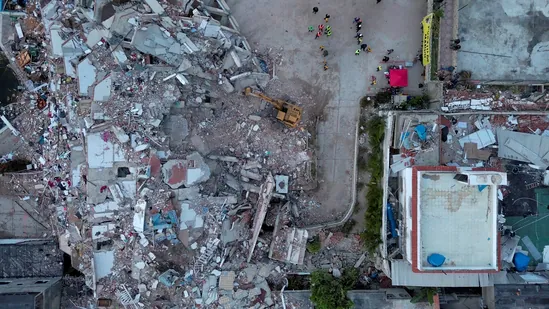
THE earthquakes that struck Venezuela on June 24th killed more than 2,000 people, by the official count. Many more are listed as missing, and the UN has ordered 10,000 body bags. But the true toll will probably never be known. After decades of brutal kleptocracy, Venezuela is no longer the kind of country where bodies are properly counted.
A drone view shows rescuers working at the site of collapsed buildings, in the aftermath of earthquakes, in La Guaira, Venezuela, July 2, 2026. (REUTERS)
The regime’s response to the disaster has been dismal. In La Guaira, the worst-hit state, survivors say no official help came in the first 48 hours—the crucial period when there is the best chance that people trapped under fallen buildings might still be breathing. Families were left to scrabble for their loved ones in heaps of dust and broken concrete. Heavy machinery for moving the rubble was slow to come and sometimes lacked fuel. Some rescue teams had no torches. The stench of rotting corpses is now pervasive. Injured survivors who make it to hospital find the wards short-staffed and ill-equipped. The regime, which is as incompetent as it is authoritarian, has been slow to distribute aid.
Dig deeper
Since January, when Donald Trump sent military forces to capture Venezuela’s dictator, Nicolás Maduro, Venezuela’s problems have become America’s, too. President Trump replaced Mr Maduro with his more biddable deputy, Delcy Rodríguez, and has boasted that he now runs the country through her. That is an exaggeration, but America does directly control Venezuela’s oil revenues, and Ms Rodríguez must to some degree co-operate with Uncle Sam if she wishes to avoid her predecessor’s fate. (He is stuck in an American prison.)
America’s unique involvement in Venezuela brings unique responsibilities. It should do more to fulfil them. About 300 American rescuers have arrived, along with 900 marines. But of $300m promised in aid, only $100m is new money. All help is welcome, but the need is great.
Meanwhile, other challenges are looming. Venezuela’s most popular politician, the opposition leader María Corina Machado, is in exile. The Trump administration has told her not to try to return, for fear that her arrival in Caracas would spark unrest. Until now, she has complied. But, after the quakes, she is understandably desperate to get back to her people. In the past week America and the regime have blocked her. That is wrong. As a Venezuelan, she has a right to go home.
Elections have been promised, but many fear the regime will keep delaying them. Fury is building. Mr Trump’s popularity in Venezuela, sky-high just after he removed the hated Mr Maduro, has been falling. This is a dangerous mix. An election may not be feasible soon, but America and the regime should set a timetable for one. That might assuage public anger. It might also give foreign investors hope that the country will one day be less lawless, and hence worth investing more in.
The earthquakes have aggravated another huge challenge: the mess that is the government’s debts. By one estimate, Venezuela’s sovereign debt adds up to $240bn, or 240% of GDP. If that is accurate, a restructuring would be the most ambitious ever attempted anywhere. Worse, the IMF, which is normally a neutral arbiter, is not involved and the mix of creditors includes Chinese banks, Russia’s government and others who choose to remain anonymous.
American officials say they hope a deal can be struck by the end of the year, but that sounds fanciful. America must not accept a partial, botched agreement merely to stay on schedule. That would be open to legal challenge and accusations of corruption. To give Venezuela its best shot at stable finances, America must instead press its government to stick to international rules and engage with the IMF, even if it takes longer.
For the thousands crushed or smothered by the quakes, it is too late. For Venezuela, there is a chance of renewal, but they deserve better than Mr Trump and his dire protégée.
Subscribers to The Economist can sign up to our Opinion newsletter, which brings together the best of our leaders, columns, guest essays and reader correspondence.