During a wide-ranging discussion with journalists at the National Press Foundation’s International Reporting Fellowship, a scathing assessment of Pakistan was delivered, characterising the nation as a state “teetering on the brink of failure”.
The critique was offered by Bilahari Kausikan, the Chairman of the Middle East Institute, an autonomous institute of the National University of Singapore, who served as Permanent Secretary of Singapore’s Ministry of Foreign Affairs from 2010 to 2013.
Speaking on the topic, “On Keeping Perspective in Volatile Geopolitical Times”, the longtime diplomat dismantled the image of Pakistan as a stable international actor, exposing the profound internal instability, radicalisation, and severe systemic economic vulnerabilities plaguing the country.\
Also Read| Pakistan, mediator in US-Iran war, is now launching strikes in Afghanistan. Here’s why
The severe reality of the South Asian nation’s domestic decay was brought to the forefront when a Pakistani journalist questioned the diplomat regarding the impact of the US-Iran conflict on Pakistan and where the country stands over the next five years. The journalist outlined a grim account of internal turmoil, detailing how the domestic fallout has triggered massive inflation, doubled fuel prices, and caused Qatar to suspend its visa-on-arrival facility for Pakistani passport holders.
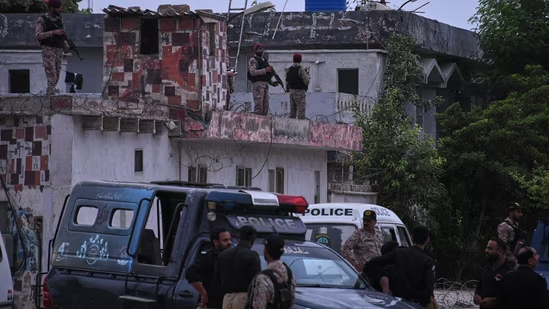
Highlighting the breakdown of internal security and law and order, the journalist also pointed to violent public attacks on the US Consulate in Karachi that forced the facility to shut down, alongside partial lockdowns that have plunged the public into a massive crisis.
In a blunt reality check, Kausikan firmly rejected the idea that Islamabad’s tactical diplomatic manoeuvres could compensate for its structural vulnerabilities, noting that temporary external optics fail to address the core miseries of its population.
“I’ll be very blunt. Pakistan was very agile and very successful in taking advantage of a diplomatic opportunity, and that has gone some way to rehabilitate Pakistan diplomatically in the eyes of the U.S. anyway. But, you know, that doesn’t feed the Pakistani people,” Kausikan stated.
Tearing down the illusion of international rehabilitation, the veteran diplomat explicitly labelled the Pakistani state a chronically unstable entity, pointing out its continued tolerance of extremist elements that threaten global security.
“Pakistan is a state that is teetering on the brink of failure, and has been for some time. It hasn’t quite fallen over, for which we should all be grateful, but that diplomatic success doesn’t change that fundamental reality. And I don’t think the U.S. is going to lift whatever restrictions in totality it has on Pakistan, because the fact is Pakistan is a hotbed of all kinds of strange groups that are not necessarily working for U.S. interests,” Kausikan explained.
The former top diplomat also targeted the country’s powerful military establishment, noting that tactical foreign policy moves are completely overshadowed by a profound internal rot driven by severe economic mismanagement and a failure to contain radical movements.
“Pakistani military was very agile and very successful, that you have to give them credit, but diplomatic success doesn’t feed people–that’s the hard reality. Pakistan’s problems are not diplomatic; Pakistan’s problems are much more fundamental within Pakistan. Mismanagement of the economy, letting various jihadist movements get out of hand–if you don’t fix those problems, you’re always going to be teetering on the brink of state failure,” he warned.
Concluding his sharp analysis, the Singaporean academic observed that global attention towards the faltering state is driven solely by international anxiety over its strategic weapons arsenal, rather than any genuine respect for its geopolitical standing.
Watch| After Japan, another Indo-Pacific country challenges China over potential Taiwan war? | Singapore,US
“And everybody is worried about it because you happen to have nuclear weapons. If you had no nuclear weapons, nobody would care,” Kausikan remarked.