
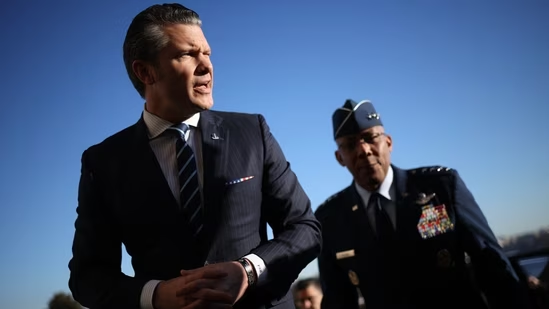
CQ Brown, the retired general forced out of his post as the nation’s top military officer last year, has provided his most direct critique of the Trump administration’s handling of the U.S. military, questioning the deployment of troops in U.S. cities and warning against tainting the armed forces’ service with politics.
In an essay published Friday with two co-authors, Brown cautioned that sending the military into American cities for “politically contentious missions” like fighting crime risked compromising its traditionally apolitical role and diverting it from its combat mission.
His essay in Foreign Affairs magazine followed an appearance the previous week when he voiced concerns about the Pentagon’s moves to strike officers from military promotion lists and push high-ranking personnel into retirement.
“What is starting to happen now, it is not about merit,” Brown said at a discussion of civil-military relations hosted by the Aspen Institute. “All of these people who are being removed are very well experienced.”
His comments came as panelists at the discussion addressed efforts by Defense Secretary Pete Hegseth and his aides to remove officers from promotion lists and push others toward retirement, such as Gen. Chris Donahue, who officially relinquished his post Thursday as the top Army officer in Europe after the Pentagon downgraded his command.
Known for speaking in measured terms, Brown has sought to strike a nonpartisan stance, noting in his essay that both Democratic and Republican presidents have expanded the military’s domestic role during periods of national crisis, such as the Covid-19 pandemic.
Brown didn’t criticize President Trump by name or mention Hegseth in his essay.
His careful comments stand in contrast to the blunt words of Gen. Mark Milley, his predecessor as chairman of the Joint Chiefs, who said in his 2023 exit speech that American troops take an oath to the Constitution and don’t report to a “wannabe dictator,” a reference to Trump, who was then out of office and had previously called Milley a traitor.
But Brown’s message was still clear, including his apparent concerns about Trump’s deployment during his second term of thousands of troops to Los Angeles; Washington, D.C.; Chicago and other cities in a public show of force the White House said was needed to fight lawlessness. Following a series of legal challenges, the Trump administration ended its efforts to deploy the National Guard in Chicago, Los Angeles and Portland, Ore. But National Guard members are still on patrol in Washington.
“In the face of a genuine national disaster, the public will readily embrace the military’s help,” Brown wrote in his essay. “But when presidents use the armed forces for more politically contentious missions, such as addressing domestic crime in cities, the work of the military becomes more fraught.”
He added: “Resorting to a military solution rather than fixing the underlying incapacity or dysfunction in civilian institutions diverts the military from focusing on its primary combat mission. And as [George] Washington knew, it is not the military’s job to save the republic from political impasses. Indeed if you ask too much of the military, you risk the entire enterprise.”
Brown, who is an executive-in-residence at Duke University, wrote his essay with Duke professor Peter Feaver, an expert on civil-military relations who served on the National Security Council during the George W. Bush administration. Feaver said during the Aspen discussion that both Democrats and Republicans were dragging the military into the nation’s culture wars, including over the Biden administration’s efforts to enhance diversity in the military’s ranks. Andrew Kragie, a Duke University alumnus and lawyer, also co-wrote the article.
Frank Kendall, who was Air Force secretary during the Biden administration, said that Brown had been “the model of an apolitical military professional” and was speaking out of concern for the armed forces.
An African-American officer and former fighter pilot, Brown was nominated in 2020 by Trump during his first term to serve as the Air Force’s chief of staff. At that time, Trump took credit for nominating the “first-ever African-American military service chief.” Trump added in a social-media post then that Brown was “a Patriot and Great Leader.‘’
Brown was picked to serve as chairman of the Joint Chiefs of Staff by former President Joe Biden, making him the nation’s top military officer and the second Black general to serve in the post. The first was Gen. Colin Powell.
Hegseth, in his 2024 book “The War on Warriors,” questioned whether Brown was selected for the top military post because he was Black.
In February 2025, Hegseth called Brown while he was in Texas to review the administration’s border mission to tell him he was being removed. Trump later announced the decision in a social-media post.
In his Aspen Institute appearance, Brown said the Pentagon’s approach to personnel decisions was spurring doubts in the ranks. “My concern is the impact it has on those who are still continuing to serve. Are they going to have a fair opportunity to advance in their career going forward?” he asked. “Anecdotally, I know some folks that have some concerns about that, whether they are going to have a fair shot.”
Write to Michael R. Gordon at michael.gordon@wsj.com