The largest Muslim civil rights group in the US has sued the governor of Florida for designating it a “domestic terrorist organisation”, potentially alongside some of the most deadly drug cartels in the Americas.
The Council on American-Islamic Relations (Cair) filed the lawsuit on Thursday in partnership with non-profits The American Civil Liberties Union and the Southern Poverty Law Center, calling the new law “baseless”.
The designation opens up Cair to “immediate and irreparable harm, including the shuttering of all their operations and advocacy in the state”, the group said in a statement.
Florida has further listed the Muslim Brotherhood, which has no known operation in the US or a centralised headquarters globally, as a terrorist organisation, as well as “antifa”, which is short for the anti-fascist movement. It also has no defined scope or location.
“Officials can brand nonprofit corporations with debilitating stigma and then use an array of state authorities to immediately silence and incapacitate the organization, its employees, its members, and a wide range of others associated with the group through extraordinarily broad and severe criminal, civil, and administrative penalties,” Cair said.
CLICK FOLLOW: TO FOLLOW US
Sign up to get the latest insights and analysis on
Israel-Palestine, alongside Turkey Unpacked and other eSPORTY
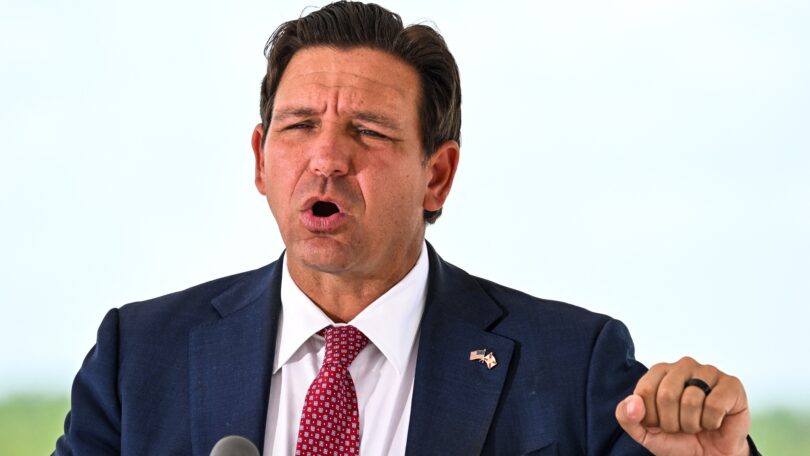
Governor Ron DeSantis has recommended that 90 other groups fall under the new terrorism law, including the Islamic Revolutionary Guard Corps, the Venezuela-based criminal gang Tren de Aragua, and the deadly Mexico-based Sinaloa Cartel.
The designation stems from HB 1471, which was passed by the Florida legislature in March. DeSantis signed it in April, and it went into effect on 1 July.
DeSantis had previously tried to go it alone, signing an executive order in December to blacklist Cair, but a federal judge blocked it earlier this year.
“The question before this Court is whether the Governor can, in a non-emergency situation, unilaterally designate one of the largest Muslim civil rights groups in America as a ‘terrorist organization’ and withhold government benefits from anyone providing material support or resources to the group,” judge Mark Walker wrote in his order.
“This Court finds he cannot.”
Cair is now seeking an emergency injunction to stop the enforcement of HB 1471.
HB 1471’s language indicates that providing support to designated terrorist groups will lead to criminal liability, and ensures that religious codes – sometimes protected by the First Amendment – do not supersede Florida law.
Cair and its partners said in the lawsuit that the designation model “contains no requirement that notice to the designated group include all the reasons for the designation and all the material evidence—inculpatory and exculpatory—that state decisionmakers may rely on to make or approve the designation. It does not require the State to prove or even provide evidence that the organization violated any law”.
Muslim Brotherhood
Cair is a US-based non-profit organisation that advocates for civil liberties and relies on donations to carry out its work.
Judge blocks Florida governor from labelling Cair a terrorist organisation
Read More »
While executive orders against it were in effect in both Florida and Texas, Cair was prevented from buying land and from engaging in government contracts, Edward Ahmed Mitchell, Cair’s deputy director in Washington, DC, previously told Middle East Eye.
In both states, the Muslim Brotherhood was also labelled a terrorist organisation.
Republicans, most vocally led by Texas Senator Ted Cruz, have said the Muslim Brotherhood maintains influential ties to Cair and is out to impose Sharia law on Americans.
Cair has long faced those accusations, but it maintains that its budget is overwhelmingly derived from donations by the American public, Muslim or otherwise.
The Muslim Brotherhood is currently listed as a terrorist group in the United Arab Emirates, Bahrain, Syria, Egypt, and Saudi Arabia.
There is also a US terrorism designation at the federal level of Muslim Brotherhood chapters in Egypt, Jordan, and Lebanon, as ordered by President Donald Trump.
Critics have long insisted that blacklisting the political movement is a way of ensuring it will no longer pose a threat to monarchies and authoritarian leaders in the Middle East.
Cruz said the Muslim Brotherhood – whose popularity remains high in parts of the Arab world because of its combination of Islamic religious tradition, political activism and social welfare programming – is a threat to US national security.
Middle East Eye previously put the question to George Washington University professor Nathan Brown, who is an expert on Middle East politics and sits on the board of trustees at the American University in Cairo.
In what ways is the Muslim Brotherhood a threat to US national security?
“None at all,” he said.