
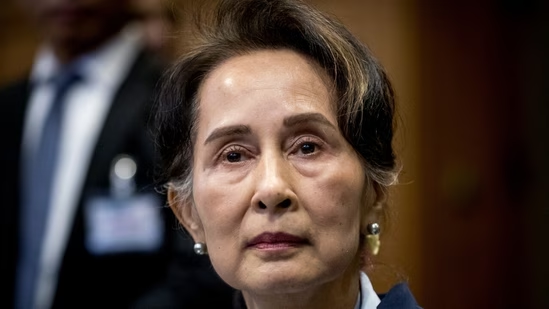
Unanswered questions about the whereabouts and well-being of Myanmar’s former leader and tainted pro-democracy icon Aung San Suu Kyi have emerged as an obstacle to a push by the country’s military junta to end years of international isolation.
Suu Kyi, who turned 81 in June, has been jailed since a 2021 coup that followed her party’s landslide election win and plunged her country into a devastating civil war. Two months ago, the junta announced that she had been moved to house arrest. It cited humanitarian grounds, but offered no further explanation or details on where she was being held.
Suu Kyi’s family and supporters haven’t seen her since, and the junta has denied a request from the Association of Southeast Asian Nations, or Asean, to get access to her. The European Union demanded Suu Kyi be given regular access to her family and legal counsel. The U.S. reiterated calls for her release and urged authorities to ensure she has proper medical care.
“Her age is advancing and her health is deteriorating,” Suu Kyi’s son, Kim Aris, 48, said from his home in London. “Time is of the essence, basically.”
Led by Min Aung Hlaing, until recently the commander in chief of the military, Myanmar’s government is in the middle of an international campaign for recognition. Earlier this year, it concluded stage-managed elections and released a number of other political prisoners.
In recent weeks, Min Aung Hlaing has visited both India and China. Thailand, the junta’s closest ally in Asean, just sent its foreign minister to the country.
The junta’s goal is recognition by Asean, which after the coup blocked Myanmar’s leaders from participating in meetings. Recognition by the regional trade bloc could pose a dilemma for Western nations: They are wary about normalizing ties with Myanmar, but also concerned about growing Chinese influence in Southeast Asia.
Aris, one of Suu Kyi’s two sons with her late husband, a British scholar, says he received the last letter from his mother more than two years ago. In May, state media published a photo showing Suu Kyi talking to officials, but Aris says it may have been doctored.
At a press conference on Tuesday, Myanmar presidential office spokeswoman Khaing Khaing Soe said that it may be possible for Suu Kyi to meet with international representatives once she has completed her sentence. She added that Suu Kyi is in very good health and receiving regular medical check-ups. Earlier, the government didn’t respond to requests for comment on Suu Kyi’s situation.
Suu Kyi served a total of 15 years under intermittent house arrest imposed by the country’s military rulers between 1989 and 2010, and early in that ordeal she won the 1991 Nobel Peace Prize. In 2016, she became the de facto leader of a democratically elected government.
Suu Kyi’s international reputation tumbled, however, when she failed to stop and at times appeared to defend the military’s atrocities against the Rohingya, a mostly Muslim minority. The U.S. and other governments judged the campaign of murder, rape and arson that forced more than 700,000 Rohingya into neighboring Bangladesh a genocide.
Though she failed to resist the military’s persecution of the Rohingya, she was again arrested in 2021. She received a lengthy prison sentence—33 years at one point, although it has been reduced—after being convicted on a series of charges, including corruption.
Aided by a forced-conscription drive and support from China, Myanmar’s military this year has made important territorial gains against pro-democracy fighters and armed ethnic groups. More than 95,000 people have been killed, including many civilians in junta airstrikes on hospitals, schools and other civilian facilities, according to conflict-monitoring group Armed Conflict Location & Event Data.
Meanwhile, the economy is in shambles and the country has become a hot spot for online-scam centers and opium production.
Sean Turnell, Suu Kyi’s former economic adviser who was incarcerated in the same prison as her for a time, said that when he last saw her in 2022, she had already lost significant weight.
Food included a bean soup, rice and a meat dish—which he said was “bone gristle and a sort of oily residue.” There was a separate “hut” for Suu Kyi in the middle of the prison, surrounded by high concrete walls.
“They’re the sort of conditions that I think would test a 20-year-old, let alone an 81-year-old,” said Turnell, who was released in November 2022.
Some countries in the region are welcoming the military taking on a more civilian guise, said Nicholas Coppel, a former Australian ambassador to Myanmar. Still, he said, Suu Kyi’s fate remains a concern to the country’s Asean neighbors.
“It would be a simple matter for the Myanmar authorities to allow people to meet with her,” Coppel said. “And I really can’t see why they are refusing to do that.”
Write to Mike Cherney at mike.cherney@wsj.com