The word of this tennis season could be ‘withdrawal’. Just think of the main headlines of Wimbledon so far.
Two-time winner Carlos Alcaraz is not present. British hopeful Jack Draper has withdrawn. Emma Raducanu pulls out on the eve of her match and is later spotted on crutches. World No 1 Jannik Sinner wilted in the heat of Paris at the French Open. The list goes on.
A University of Barcelona study published two years ago found that match retirements had increased by 25 per cent on the ATP Tour and 50 per cent on the WTA Tour since 1999, while length of matches and distance covered by players is also on the rise.
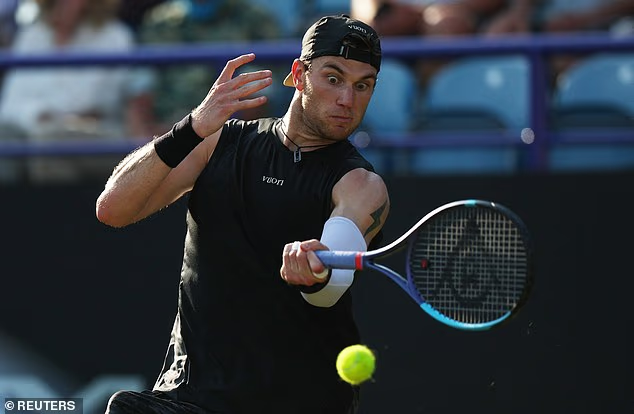
Draper, the best male British player since his mentor Sir Andy Murray retired, said this week: ‘It’s pretty worrying the state of men’s tennis, especially now. The amount of injuries, especially through young players… Lorenzo Musetti, Arthur Fils had a lot of trouble, Carlos Alcaraz’s wrist.
‘When I look at the draws for the weeks when I was out, everything is shoulder, arm and wrist. Whether that’s the quality of the balls… I don’t think there’s more matches nowadays and stuff.
‘Definitely the way athletes are getting better and hitting the ball harder and moving better, in my opinion (the ATP) need to really take a close look at what we’re doing on tour. Definitely with the state of the Masters 1000s, the 12-day events.
Jack Draper withdrew from Wimbledon this year due to injury and many top stars are suffering
‘I was privy to those conversations when I was a top-10 player. Now I’m not. They don’t care as much about what I say. The tournaments are going to suffer a lot if not much changes. It’s a really important topic. I hope that as time goes on things do change.’
So why is it such a problem, especially in the men’s draw, and what can be done to stop so many injuries at the elite end of the game?
Firstly, there is no hiding place in high-level tennis, a brutal individual sport. If you are in need of a rest, you cannot just sit on the substitutes bench for the majority of the match. You can’t ease yourself back from an injury like in team sports.
This is nothing new but the calendar is becoming more relentless.
Then there is the travel and demanding nature of this sport, especially in the Grand Slams. The heart-rate will seldom drop during high-intensity matches that can sometimes tick into four or five hours if they go the distance.
Being away from home means sleep is not as good as usual and there are changes in diet due to being on the road. Time-zone stress will be an issue and adjusting to new climates as well as playing surfaces.
Stephen Smith, founder and CEO of the world’s leading sports performance intelligence company, Kitman Labs, reckons the aforementioned points play a difference but there are also niche factors, such as racquet technology.
‘There’s lots of different components, but even things like racquet technology,’ he tells Daily Mail Sport. ‘We know that modern frames are stiffer, they’re more powerful, they generate much more spin than, you know, we could achieve 10 years ago in the game.
‘That’s great for a spectacle – the ball moves faster, the rallies are more explosive – but biomechanically, more spin means more internal rotation of the shoulder in the arm, both serves and front strokes.

Emma Raducanu withdrew from Wimbledon shortly before the tournament began
‘The stiff frames mean they transfer more vibration into the arm and wrist, so that requires more strength. So there’s decent evidence that racket characteristics, particularly like length and stiffness, have a meaningful association with upper-body injury risk.
‘Also things like court speed, right? That’s another piece of the puzzle. I’ve seen it in other sports, like the NFL, we’ve even seen it now through the football World Cup. The type of grass, how they’ve weaved it, how they have the irrigation through it.
‘The trend across tennis has been towards slower, higher bouncing surfaces which, in theory, should reduce the explosive loading on serves and movement patterns, but slower courts produce longer rallies.
‘There’s more cumulative loading on the lower body, on knees and hips. The variation across the calendar – whether it’s hard, clay, grass – in rapid succession means that players are constantly adapting to different surfaces, different biomechanical demands and ball behaviours.’
Another significant problem is tennis’s reluctance to conduct meaningful research into this area. We don’t have the answers to the many questions that the experts are asking in search of a solution.
Leading men’s player Alcaraz started wearing a fitness wrist-watch by American company Whoop, which England’s footballers have with them at the World Cup. The band tracks sleep, heart rate, blood oxygen levels.
Alcaraz, alongside Sinner and top women’s player Aryna Sabalenka, were told to stop wearing them. The decision was slammed by Whoop founder Will Ahmed, who described the Alcaraz decision as ‘ridiculous’ in a post on X, adding: ‘Let the athletes measure their bodies.’

Carlos Alcaraz is the biggest name missing from Wimbledon due to a wrist injury
Players complained and they were since allowed to wear the trackers at Roland Garros and will be allowed to do so here at Wimbledon. But more can be done by the authorities to help players understand their health and learn lessons from their own bodies.
Compare this to, say, football, where fitness coaches know everything about their players including live data that can tell them when someone is at risk of a muscle injury and needs to be taken out of the training session for a rest.
Expert Smith tells us: ‘It’s a shame that Carlos Alcaraz is not at Wimbledon. It’s a shame that Jack Draper had to pull out. The fans miss out on that. The competition’s not as good without them.
‘One of the biggest issues that tennis faces is the fact that it is an individual sport. If it was football, then you’ve got these massive organisations, hundreds of physios behind them that are pouring all their effort into making sure that these athletes stay fit.
‘Tennis players are pretty much on their own, really. They can obviously assemble teams, but there’s not a big organisation working on their fitness and trying to keep them fit.
‘You’re seeing more and more top tier players coming out and kind of almost demanding that, I suggest we should ask questions about schedule, surfaces, timing of games. It’s in everybody’s best interest.
‘Like, if you’re the federation or governing body or the rights holder in that scenario, it isn’t as good a tournament when the best players aren’t there. So it’s in their best interest to start taking more interest in it, a bigger investment in it.
‘It is about realising that clear health and safety actually is, like, probably one of the biggest levers that they can pull from an economic standpoint to protect their businesses. To keep players healthy is going to drive their revenue model.’