As Iran and the US exchanged strikes across the Persian Gulf over the weekend against the backdrop of a signed memorandum of understanding (MoU), the two sides have now reportedly agreed to stop attacking each other and meet in Qatar’s capital on Tuesday to resolve their dispute over the Strait of Hormuz.
The already fragile ceasefire felt the ground beneath it become more shaky as the two sides renewed attacks against each other over the weekend. Follow US-Iran war live updates
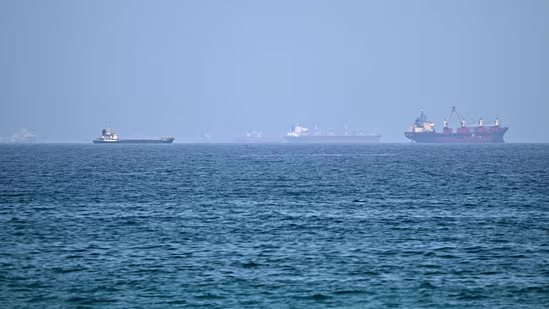
Tensions between Tehran and Washington escalated after commercial vessels in the Strait of Hormuz came under attack. The US blamed Iran for continued threats to commercial shipping and bombed Iranian military sites.
Meanwhile, Tehran denied responsibility for the initial attack but retaliated to the US strikes by targeting American military facilities in Kuwait and Bahrain.
Iranian foreign minister Abbas Araghchi described the recent US strikes as both a violation of the UN charter and of the MoU. President Donald Trump, on the other hand, defended US ops and said the American forces had targeted Iranian missile, drone and radar facilities after Tehran violated the ceasefire.
‘We decided to stop’
The growing attacks triggered concerns of war resumption across the Middle East and the world.
The two sides have finally agreed to halt the attacks and meet in Qatar on Tuesday to resolve this. “We decided to stop all the kinetic activity,” a senior US official told Axios. Kinetic activity means military strikes and other attacks.
ALSO READ | What is Article 5 of the US-Iran MoU, how it is behind the latest strikes | Explained
The two sides will stand down, “for now”, and “vessels can move freely” in the Hormuz as technical talks are set to continue, a second US official was cited as saying.
The talks on Tuesday were originally scheduled to take place in Switzerland to address the Iranian nuclear programme, the report stated, citing a source with knowledge of the talks. However, the weekend escalation prompted the talks to be moved to another venue and redirected towards Hormuz.
Nick Stewart, head of the US technical team, is reportedly likely to participate in the Tuesday talks.
Why US-Iran started fighting again?
The US and Iran started fighting again over their interpretations of the MoU to end the war, especially the clauses on the Strait of Hormuz.
Both sides accused each other of violating the agreement, particularly Article 5, which governs the reopening and management of the crucial waterway.
Article 5 states: “Upon the signing of this MoU, the Islamic Republic of Iran will make arrangements using its best efforts for the safe passage of commercial vessels with no charge, for 60 days only, from the Persian Gulf to the Sea of Oman and vice versa.
ALSO READ | Mines, tolls and US strike on Iran: Shipping through Strait of Hormuz remains complicated
The traffic of commercial vessels will immediately start, and considering the need for removing the technical and military obstacles, and demining by the Islamic Republic of Iran will be instated within 30 days.
The Islamic Republic of Iran will conduct a dialogue with the Sultanate of Oman to define the future administration and maritime services in the Strait of Hormuz in discussion with other Persian Gulf littoral states in line with the applicable international law and the sovereign rights of coastal states of the Strait of Hormuz.”
What it means? Article 5 of the US-Iran MoU lays out the framework for restoring commercial movement in the Strait of Hormuz, a crucial waterway that carries roughly one-fifth of the global oil and liquified natural gas supply.
Iran agreed to facilitate a safe passage for commercial ships without charging transit fees for 60 days. Tehran also committed to removing military and technical obstacles, including mines, from the Hormuz within 30 days.
According to the provision, Iran will hold discussions with Oman and other Gulf littoral states on the future administration and services of Hormuz, while adhering to international law and the rights of coastal states.