
With Israel’s international standing severely damaged by the genocide in Gaza, invasion of Lebanon and the war on Iran, it is continuing to develop ties with breakaway regions in search of recognition.
The latest of these is Bosnia’s Serb-run breakaway entity, Republika Srpska, with analysts telling Middle East Eye that Israel is hoping to “dilute European unity on the Palestinian issue”.
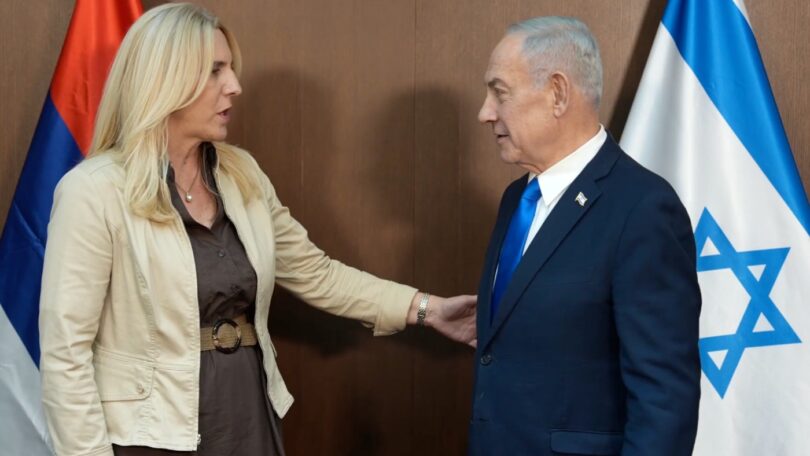
Zeljka Cvijanovic, the Serb member of Bosnia’s tripartite presidency, recently wrapped up a week-long visit to Israel, where she met with a slew of senior officials, including Israeli Prime Minister Benjamin Netanyahu and Foreign Minister Gideon Saar.
The meeting spurred a wave of criticism and condemnation. Photos showed Cvijanovic – despite being a member of Bosnia’s presidency – standing next to Netanyahu without any Bosnian flag present.
Instead, it was the flag of Republika Srpska – which, like another new Israeli ally, Somaliland, hopes to become its own sovereign state – that was set up alongside the Israeli one.
CLICK FOLLOW: TO FOLLOW US
Sign up to get the latest insights and analysis on
Israel-Palestine, alongside Turkey Unpacked and other eSPORTY
Cvijanovic’s Alliance of Independent Social Democrats (SNSD) party is actively pushing for the majority-Christian Republika Srpska, which makes up just under half of Bosnia’s territory, to secede from Bosnia.
Responding to the meetings, Bosnian Foreign Minister Elmedin Konakovic sent a protest note to Israel over the breaking of diplomatic protocol and lack of respect for Bosnia’s sovereignty.
Serb-Israeli relations
Cooperation between Serb and Israeli leaders has increased noticeably of late. In March 2025, Netanyahu held talks in Jerusalem with Milorad Dodik, then-president of Republika Srpska. In January this year, Dodik, who was removed from office in June 2025, met with Netanyahu once again.
‘They perceive Israel and its lobby groups as a gateway to the White House’
– Vuk Vuksanovic, political analyst
In May, not long after it was announced that Serbia and Israel would jointly produce combat drones, Serbia’s Foreign Minister Marko Djuric announced a strategic partnership with Israel during a visit to Jerusalem.
As for Republika Srpska’s leadership, they have calculated that they need “strong partners”, which at the moment means Israel, Vuk Vuksanovic, a lecturer in the Department of War Studies, King’s College London, told MEE.
“They perceive Israel and its lobby groups as a gateway to the White House,” he said, noting that lobbying activities via the President Donald Trump’s administration have paid off for Dodik.
In October, the US lifted longstanding sanctions on the nationalist Serb leader and dozens of his allies and family members. Dodik had been sanctioned since 2017 for corruption and for threatening the Dayton peace agreement that ended the Bosnian War in the 1990s.
Dodik, who has been pushing for Republika Srpska’s secession for two decades now, is also well-known for his close ties and regular meetings with Russian President Vladimir Putin.
US reaffirms Somali sovereignty in blow to Somaliland and Israel
Read More »
“The US, the Trump administration and Israel have somewhat overshadowed Russia as a political partner, as the biggest international partner of Republika Srpska for that matter,” Vuksanovic said.
“I hardly think that they will ever be able to push for the full independence [of Republika Srpska], but they definitely do believe that they need international partners and that that will secure them more strategic leeway.”
As for Israel, Vuksanovic said it’s looking to form diplomatic and security partnerships in its wider periphery, to “gain new votes, new friends in Europe that could dilute European unity on the Palestinian issue.
“The whole world is angry at how [Israel’s] government has handled Gaza, Lebanon and Iran. There is a strong degree of antipathy towards Israel, so they are always looking for people who are willing to communicate with Israel, to show that they are not fully isolated.”
Over Christmas last year, Israel became the first country in the world to formally recognise Somaliland, a breakaway region of Somalia, and Israeli and Somaliland officials have met multiple times to discuss a range of economic and security cooperation issues.
Ethnic cleansing and supremacist identities
At the meeting in Israel, Cvijanovic said she opposed the International Criminal Court’s decision to issue an arrest warrant for Netanyahu.
“We unequivocally support [Israel’s] right to self-defence,” Israeli media reported her saying.
Saar said they had discussed “the need to safeguard the Christian minorities in Bosnia and Herzegovina,” which many found to be bizarre, as Christians comprise about half of Bosnia’s population.
The Bosnian constitution defines Bosniaks, Serbs and Croats as the three “constituent peoples”, and none of the ethnicities can be legally treated as a minority.
Unfounded claims about Christians being threatened as a group in Bosnia were part of propaganda that circulated in the lead up to the war in the 90s.
Denijal Jegic, assistant professor at the Lebanese American University in Beirut, told Middle East Eye that Republika Srpska and Israel, which have both faced “scrutiny and isolation”, share numerous parallels.
“Republika Srpska and Israel are natural allies… both entities were built on ethnic cleansing and their identities are constructed on supremacist concepts,” Jegic said.
‘Republika Srpska and Israel are natural allies… both entities were built on ethnic cleansing and their identities are constructed on supremacist concepts’
– Denijal Jegic, analyst
“Both entities’ existence depends on narratives of ethno-nationalism and self-segregation.”
In July 1995, Serb forces committed genocide against Bosniak Muslims in Srebrenica, Bosnia, as confirmed by the International Court of Justice and the International Criminal Tribunal for former Yugoslavia.
From 1992 until the end of 1995, Serb forces committed war crimes against the non-Serb population in Bosnia, with the goal of creating a Greater Serbia.
The signing of the Dayton peace agreement in December 1995 officially ended the war, but it fragmented Bosnia into two entities – the Bosniak-Croat run Federation entity, and the Serb-run Republika Srpska.
“When it comes to Bosnia, this is a country that, after the war, was designed on purpose by the international community … to never be fully sovereign, so it is a very weak state, where it is easy for the Israel regime to interfere,” Jegic said.
The burgeoning relationship between Israel and Serb nationalists is not exactly a new one, either.
Documents have shown that the Israeli government trained Serb forces and supplied them with weapons during the war in Bosnia in the 1990s.
Vuksanovic noted that political and diplomatic ties between Republika Srpska and Israel date back 15 years, with then-Israeli foreign minister Avigdor Lieberman visiting Dodik in Bosnia multiple times in 2011, both on official visits and on holiday.
That year, Dodik, as Serb member of Bosnia’s presidency, blocked the country from voting in favour of Palestine joining the United Nations.
An Israeli diplomatic win in Belgrade
Arms and ammunition exports to Israel from Serbia have surged since October 2023 and the beginning of the genocide in Gaza.
Haaretz reported in March that arms exports had jumped by 140 percent to $131m, despite Serbian President Aleksandar Vucic declaring that year in June that he would halt all weapons exports from the country.
Some 10-15 years ago, Belgrade was cautiously neutral in the diplomatic arena, when it was on friendly terms with both Israelis and Palestinians, Vuksanovic said.

World Cup 2026: Bosnia advances to next round surrounded by ‘Free Palestine’ chants
Read More »
Serbia was the only country in the western Balkans to support Palestine’s upgraded status as a non-member observer state at the UN in 2012, and voted to admit Palestine as member of Unesco in 2011.
But in the past few years, Serbia’s stance has shifted in favour of Israel, as Vucic, like Dodik, has tried to use Israeli lobby groups to become more friendly with the Trump administration.
“Definitely, Belgrade has been something of a small diplomatic win for Israel, because Belgrade hasn’t fully abandoned, but has slightly toned down some of the friendliness it used to have with the Palestinians,” Vuksanovic said.
Both Jegic and Vuksanovic agreed that support for Israel isn’t limited to just Serb political elites; collaboration has been occurring across the region, including in Albania.
“The Israelis believe, like many other players in the Balkans, that Serbs and Albanians are the two most strategically consequential ethnic groups in the Balkans, being the largest, so they want to have a diplomatic foothold for both of these ethnic groups respectively,” Vuksanovic said.
Regarding wider influence, with Israel developing close ties with Republika Srpska, this is also a way to “irritate and frustrate Erdogan’s Turkey, given the close relationship between Sarajevo and Ankara”, Vuksanovic said.
“But I don’t think that this it is in the long-term interest of either the Serbs or the Bosniaks to be perceived as sort of a proxy battleground for outside Middle Eastern conflicts.”