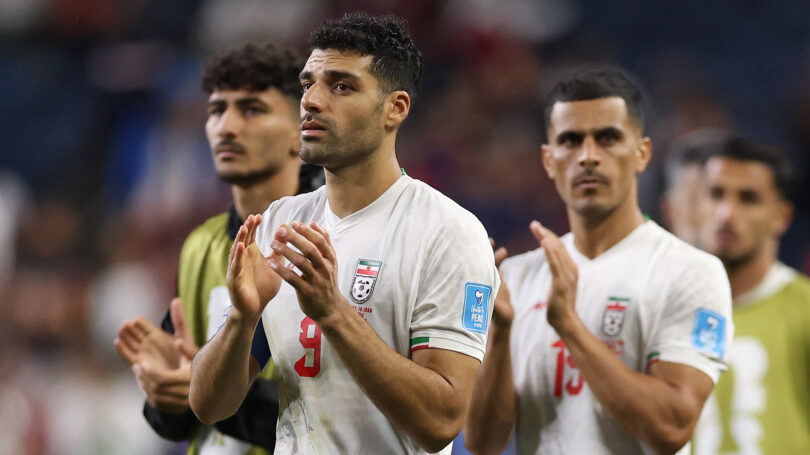
Iran’s World Cup 2026 campaign is over, but the team’s farewell has sparked an outpouring of support that stretches far beyond the results on the pitch.
Team Melli exited the tournament unbeaten after three draws, including a 1-1 result against Egypt in Seattle. But Iran’s goodbye came with a final moment of heartbreak: defender Shoja Khalilzadeh appeared to have scored a stoppage-time winner that could have transformed their qualification hopes, only for VAR to rule it out for offside.
The decision sparked a fierce debate among fans online, many of whom argued that the call was so marginal as to be out of the spirit of the game.
Iran finished with three points and had to wait for results elsewhere. When Austria struck a last-gasp equaliser against Algeria the following day, both teams went through, and Iran was eliminated.
FIFA’s president Infantino was right about one thing — Iran played well, united the world, and made everyone proud. Everything else was a lie. He knew they were harassed. He did nothing. But he did help push them out of the World Cup. 🇮🇷 pic.twitter.com/35qv5S5Z4P
— Mohamad Al Shami محمد الشامي (@mamashami2) June 28, 2026
For supporters, a refereeing decision became the final image of a campaign in which Iran had already been made to contend with far more than just footballing matters.
CLICK FOLLOW: TO FOLLOW US
Sign up to get the latest insights and analysis on
Israel-Palestine, alongside Turkey Unpacked and other eSPORTY
From the outset, the team was forced to operate under extraordinary travel restrictions imposed by the Trump administration, with the squad based in Tijuana, Mexico, and required to cross the border for matches in the US. Extremely restrictive conditions gave them no time to acclimatise to the match circumstances.
🚨 IRAN TEAM TREATED LIKE CRIMINALS
Forced out of the US after their match. Exhausted players arrive in Tijuana, Mexico at 4 AM.
This is empire weaponizing visas and football against any Global South nation that refuses to bow. Same playbook used on African teams and Lumumba… pic.twitter.com/rYLmbovTi2
— New Direction AFRICA (@Its_ereko) June 28, 2026
Iran’s coach, Amir Ghalenoei, said the conditions had undermined the team’s preparations, while the federation said it intended to file a formal complaint with Fifa over what it described as unequal treatment.
The team had initially been allowed to enter the US only shortly before matches and required to leave again immediately after the games, meaning players repeatedly travelled back to Tijuana rather than staying close to venues for recovery and preparation.
US authorities later eased the rules before Iran’s final group-stage match in Seattle, allowing the squad to arrive two days earlier. But they were still required to leave the country immediately after the matches.
The situation became even more difficult when the captain of Iran’s team, Mehdi Taremi, and assistant coach Saeed Alhoei were reportedly delayed by US airport officials on arrival in Seattle, disrupting the team’s preparations ahead of its final decisive match.
For critics, the arrangement made a mockery of Fifa’s repeated claims about equal competition and the World Cup as a tournament for everyone.
Iran’s players were expected to compete against elite international opponents while dealing with border crossings, compressed recovery windows, visa uncertainty, and political scrutiny that other teams did not face.
Players treated like politicians
The burden placed on Iran’s players was not limited to travel.
Throughout the tournament, the team was repeatedly asked questions during press conferences about geopolitics, Iranian domestic politics, flags, war, and regional tensions. No other team was asked to explain their country’s political positions or human rights record.
The pressure reached another level ahead of the match against Egypt in Seattle, which coincided with the city’s Pride weekend and was promoted locally as a Pride-linked fixture, but it was not an official Fifa match designation.
Taremi was asked after the game about the LGBTQ+ community and the controversy surrounding the match.
The Iranian captain answered, saying, “Our religion doesn’t accept that, but we respect all of the LGBT people. That’s their own idea. It’s not about us. We are here to play football.”
His remarks were widely shared, with many people praising the dignity and calmness of his response.
But the viral exchange also drew attention to a more basic question. Why was a football captain being asked to account for politically charged issues that had little to do with his team’s performance, tactical preparation or the match itself?
🚨 🇮🇷 BREAKING — Iran Captain:
“We respect all of the LGBT people.” pic.twitter.com/TuPr7phj6k
— Pamphlets (@PamphletsY) June 27, 2026
People argued that Taremi was being treated less like an athlete and more like a stand-in for an entire country, its government, and political system.
It is a pattern familiar to players from Iran, Palestine, African countries and other parts of the Global South, who are often expected to answer for wars, state policies, social issues, and geopolitical conflicts.
Meanwhile, critics argued that players from the US, the Netherlands, and other western nations are not expected to talk about anything other than football.
Comedian Trevor Noah captured that double standard in a widely shared post, writing: “Funny how some teams get asked about football… and others get asked to explain the world. Shoutout to the Iran team for carrying that weight.”
Funny how some teams get asked about football… and others get asked to explain the world.
Shoutout to the Iran team for carrying that weight.#WorldCup #Iran pic.twitter.com/6NwTklLqXE
— Trevor Noah (@Trevornoah) June 28, 2026
Iran’s final game was also played amid a politically fraught atmosphere, with the team facing boos during the anthem and supporters displaying competing symbols of Iranian identity. The games were repeatedly overshadowed by tensions far larger than the players on the field.
Yet Iran’s players continued to insist on the simplest point: they were there to play.
That message has resonated with fans bidding farewell to the team after a difficult campaign.
👋 Iranian players bid farewell to Tijuana and its locals following their 2026 World Cup elimination. pic.twitter.com/gaYfY4oeT2
— Persian Soccer (@PersianFutbol) June 29, 2026