It is testament to the complicated, tortured relationship between Brazil and their football-obsessed public that the team’s shining light at this World Cup — on whom their hopes now so squarely rest — is not loved the way he might be back at home.
Things have always been complicated between Vinicius Jr and his nation. He was the prodigy who left Flamengo for Real Madrid at the age of 16, having played only 17 minutes of senior football, and conversations with Brazilians at this World Cup attest to how many have still not forgiven him.
‘They all want to play for Real Madrid or Barcelona,’ says one woman. ‘They get there and forget who they are, where they came from.’
Less widely appreciated is the baggage that can come with having been at Flamengo — the Brazilian club with most fans, most money, most media attention, and reviled by the rest because of it.
Many across Brazil seemed to be waiting for Vinicius to fail when he left. There was social media abuse, some of it racist, in response to his posts.
People called him Neguebinha, ‘little Negueba’ — a reference to the striker who showed huge promise in his early career at Flamengo but never managed to fulfil his potential. Media analysts declared that Vinicius would never appear for Real Madrid or that Rodrygo, who had just left Santos for Real, was better.
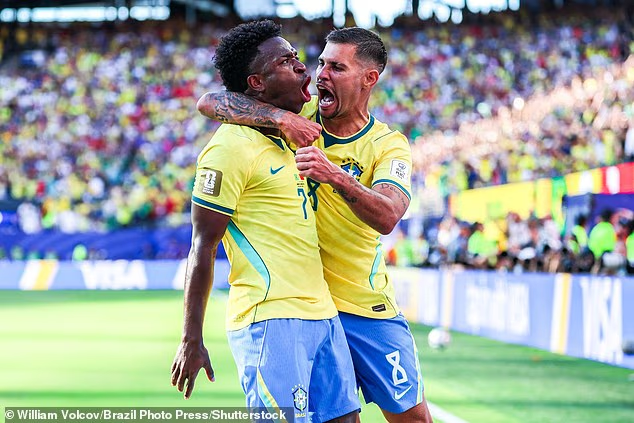
Vinicius Jr is Brazil’s talisman at this summer’s World Cup – but he hasn’t got the undivided support of those back home in South America

For many Brazilians, Neymar Jr is still their country’s star player, even if he is likely to be on the periphery of Carlo Ancelotti’s squad

Brazil face Japan in the Round of 32 on Tuesday evening in Houston, and will likely be looking to Vinicius for inspiration
It goes without saying that he’s proved many wrong. Yet still that ambiguity remains, some of it still descending into hate. And as always in contemporary Brazil, the vast, all-consuming presence of Neymar is part of the equation.
Neymar is on the margins now, a 34-year-old whose contribution at this World Cup will be as an impact substitute at best. Yet he is still deified by many Brazilians who cannot accept he is not the player he once was. Being his natural successor — ‘the new Neymar’ — is another reason why some find Vinicius hard to like.
Yet for all that, the evidence points to him being the one who will be carrying Brazil, whose knockout phase starts with a tricky match with Japan here tonight.
He is driven by a yearning for his nation’s missing affections — just like Lionel Messi, who was not so cherished in the barren years when he struggled to be what Diego Maradona had been for Argentina. Messi, too, was seen as a player who left for Spain too soon. ‘I hope I can make every Brazilian cheer for me one day,’ Vinicius said in one interview. It remains an aspiration.
In Carlo Ancelotti, he also has a coach who appreciates and knows his football intimately and who has built a Brazil team designed to help him shine, just as he did in Madrid.
The evidence of the group stage is that Ancelotti has created the optimal environment for Vinicius, freeing him from defensive duties so that he is in a position to capitalise on attacking opportunities.
When Brazil beat Italy on penalties in the 1994 World Cup final in Pasadena, with Ancelotti as the Italians’ assistant coach, they had been able to give their twin strike-force of Romario and Bebeto the same free rein that Vinicius is being granted now.
The significant difference is that those forwards, part of a squad who were runners-up four years later, were world class. The current Brazil squad lacks any No 9 fitting that description.
‘I’ll do 10 times more if I have to,’ Vinicius has said. If Brazil can come within touching distance of the trophy which once seemed theirs by default, then he will find the love he yearns for.
If not, he will probably get the blame.
Have you paid attention to the action so far? Try our World Cup quiz HERE.