
L.P. Hartley’s novel “The Go-Between”, written in the 1950s but set in 1900, made that summer’s heatwave perhaps the most famous in English literature. As Leo, the 12-year-old protagonist, becomes more deeply enmeshed in the events that will lead to his breakdown, the heat weighs on him ever more heavily. It is made all the worse by the fact that at first he delights in it, even urging it on: “The thermometer stood at eighty-four: that was satisfactory but I was confident it could do better.”
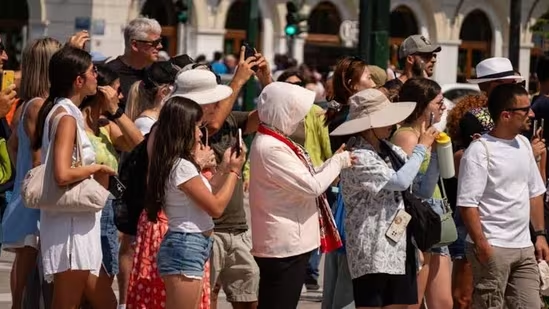
On June 25th thermometers all over Europe were doing considerably better. AFP, a news agency, calculated that 380m Europeans experienced temperatures above 30ºC (86ºF) that day. That included 63m people in France—94% of the population. On June 26th World Weather Attribution, an international scientific collaboration that looks at the degree to which climate change is responsible for various sorts of weather, concluded that this was the most severe heatwave on record in its study area (broadly speaking, western Europe).
As I reported while sitting in various events held in London as part of London Climate Action Week (those that weren’t cancelled because of the weather, that is) thereason for the excessive heatis not a mystery. Emissions of greenhouse gases, mostly from the burning of fossil fuels, are heating up the planet at around 0.27ºC a decade. A phenomenon called polar amplification means the Arctic is warming faster than anywhere else. Largely as a result of this, Europe, quite a lot of which is in or fairly close to the Arctic, is warming faster than any other continent: 0.56ºC a decade. World Weather Attribution notes that maximum daytime temperatures are rising even faster.
This means that summer-time domes of high pressure which bring clear skies and high surface temperatures, and which have been around forever, now get a lot hotter than they did before the atmosphere had 1.8 trillion tonnes of carbon dioxide dumped into it. According to the Central England Temperature record kept by Britain’s Met Office, Leo’s sweltering, life-changing summer of 1900 was at the time the sort of thing that then happened perhaps once in a decade. In the 21st century it would count as unusually cool. In the past 25 years, England has seen 18 summers hotter than that of 1900.
This is not good for Europe, where heatwaves are already the most deadly natural hazards. Using a model of relations between temperature and mortality published by academics in 2023, my colleagues on the data team put together rough and ready predictions for mortality acrosshundreds of European citiesduring the heatwave’s peak: 12,000 deaths over three days.
That model does not take into account humidity, which makes things worse. In hot weather humans dump their excess heat through evaporation, and higher humidity makes this harder; sweat pools on the skin instead, and the body gets hotter. World Weather Attribution predicts record “wet-bulb” temperatures—which take into account the degree to which humidity increases the effects of heat—over many towns and cities in the Netherlands, Germany and Poland by June 30th as the heat wave moves east.
Northern Europeans are not used to dealing with such conditions. Among other things, they largely lead lives without air-conditioning, especially in their homes. As our Charlemagne columnpointed out last weekthere are a variety of technical and cultural reasons for this; many green Europeans would rather see other forms of adaptation prioritised. But on a continent where electricity is getting greener; where summers are getting hotter; and where some parts of the public are increasingly suspicious of green policies it sees as costly and constraining, rather than helpful, support for more air-conditioning—and cheaper electricity—is an obvious win.
It is not the be-all and end-all of the adaptation needed to save tens of thousands of lives on an increasingly regular basis. But it is a part of it. All sorts of changes need to be made if Europe’s worsening summers are to be weathered over the next few decades, which is how long it should take to bring down emissions and get global warming under some sort of control.
Beautifully handled though its evocation of a wilting summer is, “The Go-Between”’s greatest claim to fame is its opening line: “The past is a foreign country; they do things differently there.” In a warming world the future, too, is a foreign country. And it, too, will require things to be done differently.