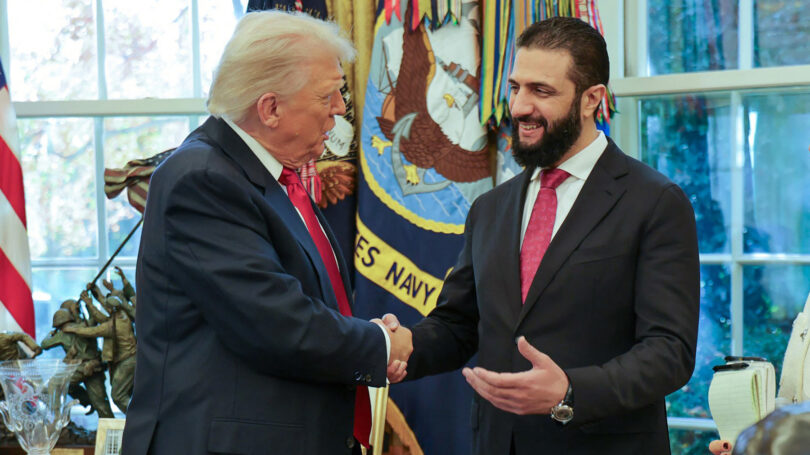
US President Donald Trump has repeatedly suggested handing responsibility for dealing with Hezbollah to Syrian President Ahmed al-Sharaa, reviving fears in Lebanon of renewed Syrian military involvement despite denials from Damascus.
Trump’s increasingly explicit statements have also appeared to contradict an earlier denial by US envoy to Syria Tom Barrack, who dismissed reports that Washington had pressured Damascus to send forces into Lebanon as “false and inaccurate”.
The latest remarks came on 21 June, when Trump told Fox News that he was disappointed by Israel’s failure to defeat Hezbollah without causing widespread destruction.
“They can’t do anything without knocking buildings down,” Trump said. “I’m close to giving it over to Syria.”
Trump did not explain what he meant by “giving it over”, leaving it unclear whether he was referring to a Syrian military operation, political mediation, pressure on Hezbollah, tighter border controls or cooperation with the Lebanese state.
CLICK FOLLOW: TO FOLLOW US
Sign up to get the latest insights and analysis on
Israel-Palestine, alongside Turkey Unpacked and other eSPORTY
But his comments were the latest in a series of public statements indicating that Washington has considered assigning Damascus a role in dealing with the Lebanese group.
His remarks reinforced the impression that Washington sees Damascus as a potential partner in efforts to curb Hezbollah’s influence in Lebanon.
US pressure denied
The issue first emerged on 17 March, when Reuters reported that Washington had encouraged Damascus to consider sending forces into eastern Lebanon to help disarm Hezbollah.
Five people briefed on the discussions told the news agency that Syria was reluctant to become involved, fearing it could be drawn into the wider regional war and inflame sectarian tensions in both Syria and Lebanon.
The proposal had initially been discussed by US and Syrian officials in 2025 and was raised again around the outbreak of the US-Israeli war on Iran in late February, according to the report. Barrack responded later that day with a categorical denial.
Exclusive: How Hezbollah rebuilt while its enemies declared it dead
Read More »
“Reporting regarding the United States encouraging Syria to send forces into Lebanon is false and inaccurate,” he wrote on X.
However, a Syrian source told Middle East Eye that a meeting was subsequently held between Sharaa and leaders of armed factions to discuss the reports.
“Those present agreed that Syria had neither the intention nor the desire to intervene militarily in Lebanon,” the source said.
A senior Lebanese source also told MEE that Beirut received several messages of reassurance that Damascus was not planning to send forces across the border.
The Syrian authorities indicated that they would seek the help of their regional allies, particularly Saudi Arabia, Qatar and Turkey, to resist US pressure for an intervention, the source said.
As pressure mounted, Sharaa sought to sidestep Washington’s demands by setting conditions that would be extremely difficult for the US to meet before Syria would even consider any involvement in Lebanon, a second senior Syrian source told MEE.
Sharaa ‘would love to help’
Trump first publicly suggested a Syrian role in Lebanon during an NBC Meet the Press interview on 5 June.
Calling for a more “surgical” campaign against Hezbollah, Trump said Washington could assist or “recommend Syria”.
“We can help them with that, or we can recommend Syria,” he said, praising Sharaa and adding that the Syrian president “would love to help”.
‘Those present agreed that Syria had neither the intention nor the desire to intervene militarily in Lebanon’
– Syrian source
Trump’s remarks stopped short of explicitly calling for Syrian forces to enter Lebanon. But during the G7 summit in Evian-les-Bains, France, on 16 June, the US president was considerably more direct.
“I suggested to Israel to let Syria take care of Hezbollah, because, to be honest with you, I think they do a better job of doing it,” he told reporters.
Trump criticised Israel for taking too long to defeat Hezbollah and for killing civilians and destroying residential buildings.
He also said Sharaa has done an “amazing job” consolidating control over Syria and “does not like” Hezbollah.
The following day, when asked whether he had discussed Hezbollah with Sharaa, Trump said “yes” but declined to say whether the Syrian president had agreed to become involved, telling reporters he would address the matter later.
The exchange indicated that Trump’s statements were not solely an abstract proposal directed at Israel, but that a possible Syrian role had been raised directly with Damascus.
Damascus rules out military role
In recent weeks, Sharaa has sought to counter the growing speculation. During a meeting with dignitaries from the Damascus countryside on 11 June, he described reports of an impending Syrian entry into Lebanon as unfounded rumours.
Ahmed Muwaffaq Zaidan, an adviser to the Syrian presidency, later told Al Arabiya that Washington had proposed Syrian involvement during the regional escalation, but that Damascus had rejected any military or security role in Lebanon.
He added that Syria supported extending the Lebanese state’s authority across the country, but through strengthening its institutions rather than deploying Syrian forces.

In south Lebanon, Israeli drones use the sound of crying children to lure civilians
Read More »
Sharaa addressed the matter more extensively in an interview with Al Mashhad TV on 21 June, saying Trump’s comments had been misinterpreted as suggesting Syrian forces would enter Lebanon “tomorrow morning”.
He added that Trump had expressed concern over the war and discussed how Syria could contribute to a safe and peaceful resolution, rather than calling for an invasion.
Sharaa said Syria’s priority was to end the war and Israeli bombardment, and that Damascus had discussed political, economic and social approaches with Washington.
“Our vision is based on supporting the Lebanese state once again, strengthening its institutions, and seeking a solution that everyone believes in,” he said.
“We are looking for economic channels between Lebanon and Syria, not military ones.”
Sharaa said Damascus was willing to communicate with all Lebanese parties, including Hezbollah.
Although Hezbollah’s role in Syria’s civil war had left what he described as a “deep Syrian wound”, he said he would meet its representatives if it served Lebanese and Syrian interests.
Lebanese President Joseph Aoun welcomed Sharaa’s clarification, saying it had been positively received and had helped put an end to speculation over a Syrian military role in Lebanon.
The Syrian assurances have eased some of the immediate concern in Beirut. However, Trump’s repeated remarks, coupled with contradictory accounts of earlier US-Syrian discussions, have left unresolved questions over what role Washington expects Damascus to play in the future of Hezbollah and Lebanon.