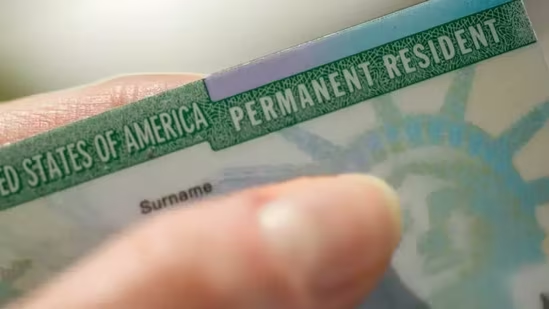
Green Card alert: The United States Supreme Court has delivered a notable victory to the Trump administration regarding immigration enforcement, determining that border officials are not required to have clear and convincing evidence of criminal activity prior to categorizing a returning green card holder as an individual seeking admission into the country — a designation that may ultimately lead to deportation proceedings.
In a 6-3 ruling in the case of Blanche v. Muk Choi Lau, the court reversed a previous lower court decision that mandated immigration authorities to have more substantial evidence at the moment of a lawful permanent resident’s re-entry into the United States.
The case centered around Muk Choi Lau, a lawful permanent resident who was granted immigration parole after a short visit to China in 2012, during which he was facing criminal charges related to counterfeiting in New Jersey. After he subsequently entered a guilty plea, the Department of Homeland Security commenced removal proceedings against him. Lau contended that immigration officials had incorrectly classified him as an applicant for admission prior to his conviction for any offense.
Also Read: US visa bulletin July: Major setbacks for Indian job seekers, here’s what changes for Green Card applicants
Here’s what Justice Clarence Thomas said
In a majority ruling, Justice Clarence Thomas stated that the Immigration and Nationality Act allows authorities to consider a green card holder as seeking admission if the person has “committed” a crime that involves moral turpitude. Furthermore, he noted that border officials are not obligated to prove this fact with clear and convincing evidence at the time of entry.
This ruling remands the case to lower courts to assess whether Lau’s offense meets the criteria of a crime involving moral turpitude, which is a significant classification under US immigration law.
Justice Ketanji Brown Jackson warns against a ‘blank check’
Justice Ketanji Brown Jackson, along with Justices Sonia Sotomayor and Elena Kagan, expressed strong opposition to the ruling, contending that it undermines the protections typically granted to lawful permanent residents.
Jackson raised worries as the Court has effectively given the Government a “massive blank check.” In her dissent, Jackson cautioned that officials might now categorize returning Green Card holders as applicants for admission initially and rationalize that choice subsequently during removal hearings.
The dissent contended that the ruling jeopardizes the security linked to permanent residency and generates confusion for lawful immigrants when traveling internationally.
Immigration attorneys expressed concerns over wider repercussions
The case garnered considerable attention from immigration attorneys and advocacy organizations even prior to the ruling due to its possible effects on the nearly 13 million lawful permanent residents in the United States.
Several immigration law specialists had showed that a decision favoring the government might broaden the situations in which green card holders are regarded as applicants for admission upon their return from international travel.
The law firm Tarter Krinsky & Drogin LLP highlighted before the hearing that the case could lead to “significant consequences” for permanent residents by facilitating the ability of border authorities to categorize returning green card holders as seeking admission, which could potentially subject them to detention and removal proceedings, The Business Standard reported.
Immigration attorney Cyrus Mehta contended that the prior ruling by the Second Circuit provided enhanced protection for permanent residents, as it barred authorities from categorizing returning green card holders as applicants for admission solely based on mere suspicion of criminal activity.
In a similar vein, the Asian American Legal Defense and Education Fund (AALDEF), which supported Lau, cautioned during the legal proceedings that the government’s stance could diminish permanent residency to a status that could be jeopardized at the border based solely on suspicion.
Green Card holders and international travel
After Tuesday’s ruling, several immigration professionals indicated that the decision underscores the necessity of obtaining legal counsel before international travel for green card holders with pending criminal charges or unresolved legal issues.
The progressive organization Alliance for Justice stated that the ruling may create a broader avenue for the revocation of Green Cards.
Conversely, Advancing American Freedom, an organization established by former Republican Vice President Mike Pence, described the case as significant for facilitating the removal of individuals who “abuse the privilege of being granted lawful permanent resident status.”
The ruling is part of massive immigration conflict
This decision comes as the Supreme Court deliberates on several significant immigration issues related to President Donald Trump’s extensive immigration policies, including cases concerning birthright citizenship, asylum limitations, and temporary protections for migrants.
Although the Lau case began well before Trump’s presidency, the administration has encouraged the court to embrace a broad interpretation of executive power, contending that mere suspicion of criminal activity can justify placing a lawful permanent resident on immigration parole while awaiting further legal action.
Why is this important?
The ruling could increase the risks associated with international travel for green card holders who have unresolved criminal issues, as border officials now possess greater discretion to classify them as applicants for admission and initiate removal proceedings.