
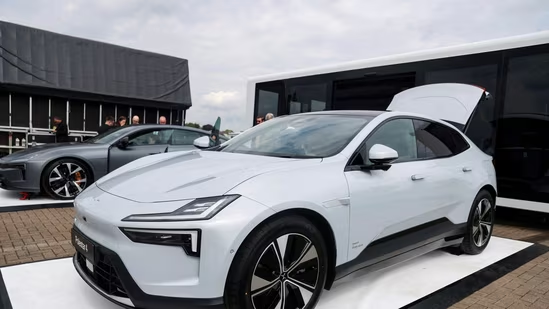
Electric vehicle maker Polestar said it will stop selling cars in the United States starting with its 2027 model year vehicles, because the Trump administration is forcing the company out of the market. After the announcement, Polestar’s shares fell 5.7% in early trading. The problem is linked to a U.S. regulation called the Connected Vehicles Rule.
The U.S. Department of Commerce did not give Polestar permission to keep selling vehicles under this rule. The rule bans the import and sale of vehicles that use connected-vehicle technology linked to China, starting with the 2027 model year. Technologies covered under the rule include Bluetooth, Wi-Fi, cellular connectivity and some satellite communication systems.
US cites security concerns
U.S. officials say these technologies could allow vehicles to collect sensitive information about American drivers, creating national security risks. The Connected Vehicles Rule was originally adopted in January 2025 under former President Joe Biden, as noted by Reuters report. The Trump administration has decided to keep the rule in place and enforce it. The move is part of a wider U.S. effort to restrict Chinese-made vehicles and support domestic auto manufacturing.
Chinese electric vehicles already face high U.S. tariffs, and lawmakers are also pushing for even tougher restrictions. Polestar is a Swedish EV company, but it is majority-owned by Chinese automaker Geely, as per the report by Reuters. Even though future sales will stop, Polestar said it will continue selling its existing Polestar 3 and Polestar 4 inventory in the U.S. The company also said U.S. customers will still have access to its service and support network.
Polestar had already warned in 2024 that the Connected Vehicles Rule could effectively block the company from selling cars in America. The company warned that the restrictions could affect all its vehicles, including those built inside the United States.
Also read: Bitcoin drops below $60,000 as concerns over Strategy spark fresh crypto market fears
Europe becomes key market
Polestar CEO Michael Lohscheller said the global auto industry is becoming more regional, with companies focusing on local markets, as noted by Reuters. He said Europe is now Polestar’s biggest growth market and the company plans to build its future Polestar 7 model in Europe.
Polestar has been shifting more of its business toward Europe because sales in the U.S. have remained weak. The company has faced stronger competition and slower consumer spending in the American market. During the first quarter, only 6% of Polestar’s total sales came from the U.S, as per Reuters report.
In comparison, 78% of its sales came from Europe, showing how important that region has become. Polestar has struggled financially and has not yet become consistently profitable. The company has repeatedly needed financial support from owner Geely Holding and chairman Li Shufu.
Polestar’s stock price has fallen sharply in recent years. Last year, the company carried out a reverse stock split to keep its Nasdaq listing. Polestar is not the only automaker affected by the rule. Several car companies, including Ford Motor, are trying to get government approval to continue selling models that have been on U.S. roads for years.
Volvo gets US approval
Polestar’s sister company Volvo Cars received authorization from U.S. regulators in May. However, Volvo said it still has to make sure all of its U.S.-sold vehicles meet the rule’s requirements. Volvo also said it needed special approval because of its ownership links to China. The decision creates uncertainty around the future of the Polestar 3, which is currently Polestar’s only vehicle manufactured in the United States.
In March, Volvo announced plans to concentrate Polestar 3 production at its factory in South Carolina. The company had planned to stop making the model in Chengdu and focus production in the U.S. plant. On Thursday, a Volvo spokesperson told Reuters that production in China has not yet been stopped.
Volvo also said it is still too early to know whether the latest U.S. decision will change those production plans. Because of tariffs and market pressure, Polestar has chosen to update older models instead of launching many completely new vehicles.
The company expects deliveries of a new version of the Polestar 4 to begin later this year. It also plans to launch an updated version of the Polestar 2 sedan in 2027. Polestar’s next completely new vehicle will be the Polestar 7 compact SUV. The Polestar 7 is planned to be built at Volvo’s future factory in Slovakia.
Overall, the U.S. government’s decision means Polestar will effectively exit the U.S. market for new vehicle sales from the 2027 model year onward, marking another major step in Washington’s crackdown on China-linked vehicle technology.