
Updated: 24 Jun 2026 17:24 BST |
5 min read

Make us your Google favourite
Cities in North America, particularly in the USA, became notoriously car-centric in the 20th century, but the 2026 World Cup is showing early signs of boosting the emergence of a different kind of urbanism.
Readers interested in urbanism will be familiar with the dystopian pictures of Houston from the 1970s, with downtown essentially being one big, contiguous parking lot dotted with a few buildings.
Houston wasn’t just one extreme example, however. It was the rule rather than the exception.
The US became the heartland of modern capitalism in the 20th century, which was reflected in the design of the country’s cities.
The boom of the automotive industry and the government’s receptiveness to its lobbying efforts resulted in the now-infamous zoning laws and suburban sprawl that came to define the face of American cities.
Communalist public transport gave way to car-dependency. Individualism, already widespread, became a core American principle in the country’s crusade against the Soviet Union and everything it represented, including Soviet urbanism, which favoured building cities with “microraions” – dense “microdistricts” where all necessary amenities were within walking distance.
It’s genuinely wild that Downtown Houston in the 70s was a literal parking lot. pic.twitter.com/AcfVL0eMaL
— Hayden (@the_transit_guy) January 6, 2023
Capitalist Europe adopted American principles during the interwar and post-World War II periods, but it was more difficult to take it to the same extreme level due to the continent’s centuries-old, dense cities. By the 1970s and 80s, Americanisation was increasingly frowned upon.
In the US, the process of rejecting car-centricity has been much slower because of the damage done by urban sprawl. How can you live when all the stores, schools and hospitals are miles away and public transport is woefully outdated?
Nevertheless, many cities have adopted pedestrianisation in recent decades in order to become, quite frankly, more livable. The Seattle waterfront, for example, looks unrecognisable since the demolition of the Alaskan Way Viaduct.
How the World Cup is boosting pedestrianisation
For all the criticism about the 2026 World Cup, it does appear to be helping in reshaping the narrative around urbanism and how cities should look.
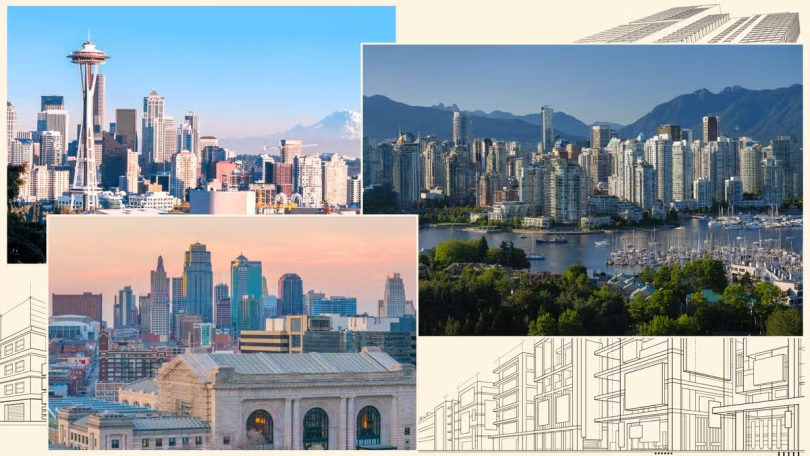
Of course, its impact should not be overstated, but it is noticeable, particularly in cities with downtown stadiums like Vancouver and Seattle. CTV News reports that the city of Vancouver is already in discussions to extend the ban on cars on portions of Granville Street beyond the World Cup.
Deputy Mayor Sarah Kirby-Yung called the current closure a “runaway success” and added: “People are so thrilled with how it’s going that they’d love to see it happen now.”
Business on the strip has been booming, with even the local police department saying that “everyone is feeling the vibe.”
Seattle’s Pioneer Square has been a similar success story. Approximately 149,800 people visited the pedestrian-only zone on the day of the US-Australia game, which was a resounding success for the city of Seattle. Numerous public transport records were broken on what proved to be a momentous day.
Crazy good time in Pioneer Square outside of the Occidental fine art center. go USA!!! https://t.co/BDXJVaxAJz pic.twitter.com/VbYs4KhMzs
— Andrew Conru (@andrewconru) June 19, 2026
“As a huge soccer fan, it has been so exciting to see fans from all over the world come to Seattle and experience our city,” Seattle Mayor Katie Wilson said. “The energy across our region has been incredible, and you can feel it as people move through the city and gather for matches. Days like last Friday show just what is possible with great public transit.”
Speaking on the Lobbing Scorchers podcast shortly before the World Cup kicked off, Wilson admitted that she was “very interested” in more pedestrianisation, though she refused to actively suggest that Pioneer Square could become a permanent car-free zone.
“Ideally we’re moving toward bold reimaginings of our neighbourhoods, including more car-free space, in a way that brings everyone along,” she explained. “Ultimately, the reason we’re doing this is because I believe that this is what is going to make Seattle just way more vibrant and it’s going to be good for business owners, for residents. As a parent, having places where your kid can run around or bike around without being afraid of getting hit by a car – that is gold, and we need so much more of that around the city.”
However, the impact of the World Cup is not only being felt in host cities with downtown stadiums. In Kansas City, the interest generated by FIFA’s Fan Fest in midtown has locals optimistic that the new downtown stadium for the Royals, the city’s MLB team, will be a success.
“It’s electric down here,” Royals fan Kristie Zimmerman told KSHB 41. “I’ve just loved so much just having fans in town, other countries in town, and being able to show them what downtown is about.”
Another fan, David Allen, added: “I think we’re proving that we do have the infrastructure to have people down there.”
The Kansas City Streetcar Authority has announced that the World Cup has so far been an “unqualified success” after recording record numbers in the first week of the tournament.
The World Cup is doing its part in making people realise that easily accessible, pedestrianised cities with good public transport are the future.
View full bio