Iranian President Masoud Pezeshkian on Tuesday said that without the country’s missile programme, the United States and Israel would have “razed Iran like Gaza.”
“If the missiles we have for our defence did not exist, Israel and the United States would have ploughed through Iran just like Gaza, showing no mercy to either the old or the young,” he said during a visit to Pakistan, AFP reported.
He also slammed the United States for what he described as its hypocrisy on human rights, calling it a “big lie.” Pezeshkian added that Iran would never, under any circumstances, negotiate with anyone over its defensive capabilities.
Also Read: Senate passes resolution to end US military action against Iran in rare rebuke to Trump
“We will never, ever negotiate with anyone over our defence capability,” he said.
Pezeshkian also reiterated that Iran’s missile programme was not included in its memorandum of understanding (MoU) with the United States and would never be open to negotiations.
“The discussion over our missiles does not exist in the MoU, and it never will,” he said, according to CNN.
Also Read: ‘I get problems solved, including with Bibi’: Trump after Netanyahu vows Israeli forces will stay in Lebanon
‘MoU does not mention Iran’s missile programme’, says Sharif
Pakistan Prime Minister Shehbaz Sharif also confirmed that the MoU signed between US and Iran does not mention ballistic missiles.
Responding to a question about Iran’s nuclear and missile technology, Sharif said that he would say “without fear of contradiction that Iran’s ballistic missile programmewas not a subject of discussion between the US and Iran…It was not on the table.”
“There cannot be double standards… that some countries can have ballistic missiles and Iran shouldn’t have. You cannot digest this duplicity.”
“You cannot digest this kind of duplicity,” he added.
14-point MoU
The 14-point memorandum released last week by the United States and Iran does not mention any provisions related to Tehran’s ballistic missile programme. The only explicit weapons-related restriction is Iran’s pledge not to “procure or develop nuclear weapons.”
It also includes provisions for reopening the Strait of Hormuz, easing certain financial restrictions on Iran and setting out expectations for future technical talks on Iran’s nuclear programme.
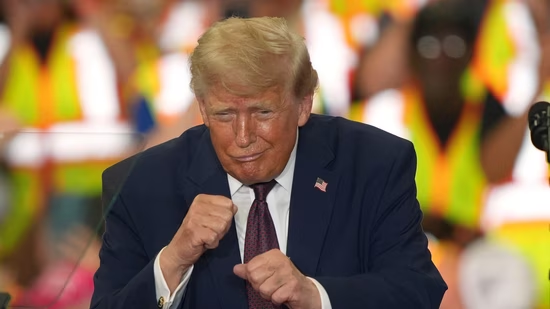
US President Donald Trump has also seemed to soften his stance on Iran’s missile programme. During the G7 Summit last week, he said, “I’m saying that if other countries have them, it’s a little bit unfair for them not to have some.”
He had earlier, before the war, sought to include the ballistic missile programme, as well as Tehran’s support for armed proxies, in negotiations over Iran’s nuclear activity, according to AFP.
Why is the Iranian delegation in Pakistan?
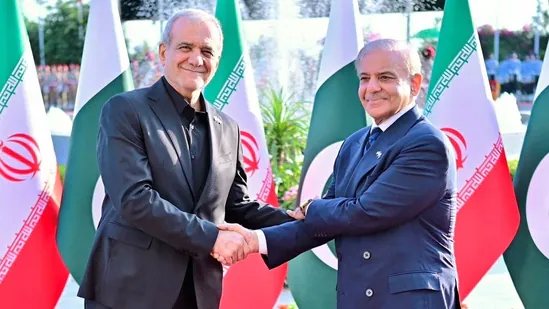
The Iranian president arrived in Pakistan on Tuesday on his first state visit since the US and Israel launched strikes on Iran on February 28. Iran’s foreign minister Abbas Araghchi also arrived in Islamabad.
Pezeshkian was received by his Pakistani counterpart Asif Ali Zardari, Prime Minister Shehbaz Sharif, and Deputy Prime Minister and Foreign Minister Ishaq Dar.
Also Read: 11 India-bound oil, gas, and fertiliser vessels cross Hormuz after US-Iran deal
The leaders discussed regional developments and ongoing peace efforts involving the United States, while reaffirming Tehran’s commitment to strengthening bilateral ties with Pakistan and promoting regional peace, PTI reported.
During his meeting with Field Marshal Asim Munir, President Pezeshkian praised Pakistan’s role in fostering dialogue and reducing regional tensions.
“He acknowledged Pakistan’s consistent efforts to encourage peaceful resolution of disputes and foster understanding among regional stakeholders at a time of heightened geopolitical challenges,” the Pakistan Army said in a statement, according to PTI.