A US fighter jet pilot who was rescued by special forces after his aircraft was shot down over Iran in April has now revealed that he saw a large group of Iranian drones flying in what looked like a “jellyfish” pattern shortly before he was forced to eject, as per a new report.
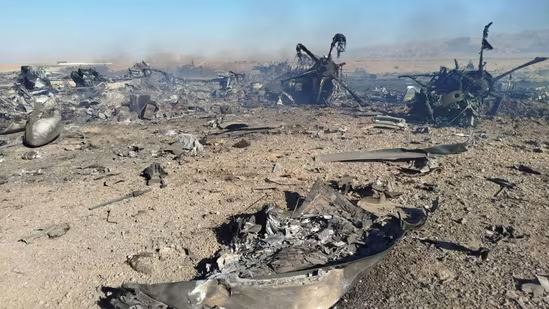
In early April, Iran shot down a United States F-15E Strike Eagle fighter jet. The pilot was rescued within hours after ejecting from the aircraft. Meanwhile, the weapons systems officer avoided capture by hiding in mountainous terrain for more than a day before rescue teams reached him.
The destruction of the F-15 was the first confirmed instance of a US military aircraft being shot down over Iran during the conflict.
‘Real alien sh*t’: What US pilot saw during the encounter
During questioning by intelligence personnel after the incident, the pilot reportedly described seeing a large drone formation operating together in a way that reminded him of a jellyfish, sources familiar with the debrief told CNN.
If the pilot’s account is accurate and the drones were moving as a coordinated unit, it may indicate a big development in Iran’s drone warfare capabilities.
“Multiple drones interconnected and moving as one, with smaller drones below the bigger drones like legs,” one of the sources familiar with the pilot’s witness statement told CNN. “Real alien sh*t.”
Another source familiar with the matter told CNN that the pilot described the scene to a “minefield of drones”.
Investigators are still examining exactly what caused the F-15 to be shot down. However, early assessments suggested that the drone formation may have played a role in helping Iranian forces target the aircraft, two sources familiar with the investigation told the media outlet.
It remains unclear whether the weapons systems officer also observed the drone activity.
A second American aircraft, an A-10, was shot down during efforts to recover the downed crew. Its pilot successfully ejected and landed outside Iranian territory.
‘One-to-many meshed networking’
Although US intelligence agencies had not previously concluded that Iran possessed the specific capability described by the pilot, there have been reports suggesting that Tehran received support from China and Russia in advancing its drone technology, the report said, quoting two sources.
The capability reportedly by the pilot is known as “one-to-many meshed networking”, as per the sources.
In simple terms, meshed networking enables a single operator to direct and coordinate multiple drones simultaneously.
What did the officials say?
American intelligence officials were divided over how to assess the pilot’s account and whether his recollection of events was entirely reliable.
One reason for the uncertainty was that he suffered a concussion when the aircraft went down. According to the report, it was also the second time he had been forced out of an aircraft during the Iran conflict. Earlier in the war, he had survived a friendly-fire incident involving Kuwaiti forces.
Officials involved in the debrief reportedly questioned the pilot’s account, saying something along the lines of: “Are you sure you saw what you are saying you saw?”
After the pilot was safely recovered, the US military began a large-scale rescue operation to locate and extract the missing weapons systems officer, who, according to US officials quoted by The Independent, was stranded in Iran and had only a handgun for protection.