Been there, seen it, done it – and won it multiple times over.
For a man who has conquered club football’s highest peaks, Carlo Ancelotti is now plotting one final ascent to the greatest summit of all.
As the first foreign manager of the Brazilian national team, the 67-year-old Italian came into this World Cup with a very simple remit; to end a drought which now extends to 24 years.
Brazil have not won the World Cup since the last of their five triumphs in 2002. In terms of a barren spell, 24 years equals their longest run without getting their hands on the trophy (1970-1994).
There are parallels with ‘94, not least the fact that tournament was also held in America. Brazil also changed managers in the build-up to that tournament.
Ancelotti was appointed last May, at the tail end of an unimpressive qualifying campaign which saw Brazil finish fifth, losing six of their 18 matches.
‘Don Carlo’ Ancelotti is aiming to revive the fortunes of five-time World Cup winners Brazil

Ancelotti dishes out the instructions to his Brazil side as they prepare to face Scotland in Miami
If this is far from a vintage Brazil side, then it is thanks to the healing hands of Don Carlo that few would be willing to bet against them going deep into the tournament and challenging for a sixth World Cup.
Ancelotti’s trophy cabinet is unrivalled. Both as a player and a manager, there are few figures in the history of football who have woven such a rich tapestry of success.
In terms of his managerial career, he is a five-time winner of the Champions League; two with AC Milan, another three with Real Madrid. It stands as a record total.
He has won league titles in Italy, Spain, England, France and Germany. He was won three Club World Cups. Yet, the true essence of Ancelotti extends beyond the numbers and achievements.
In an era of false nines, inverted full-backs and counter-pressing, the beauty of Ancelotti’s philosophy can be found in its simplicity.
He remains the ultimate pragmatist, a footballing chameleon whose ability to adapt and evolve has kept him at the pinnacle of the game for over two decades.
Speaking on the eve of the World Cup, Ancelotti said: ‘Football continues to change. I try to adapt to what’s happening.
‘Football today is more analytical, much more intense, more physical. Some tactics, particularly defensive ones, aren’t as important today as they were 10 years ago.
‘The new generation of coaches focus more on attacking play than on defence.’
Born in the small, rural town of Reggiolo, Ancelotti’s early life was humble. His father ran a cheese factory, instilling values of hard work and simplicity that would define his managerial persona.

Ancelotti talks to superstar Vinicius Junior, a player he also coached at Real Madrid
As a player, Ancelotti was a creative midfielder with vision and leadership. He began at Parma in the late ‘70s before moving to Roma, where he won one Serie A title and the Coppa Italia on four occasions.
His peak came at AC Milan under Arrigo Sacchi, winning two European Cups 1989, 1990, two Serie A titles, and representing Italy at the 1986 and 1990 World Cups.
Injuries and the high-intensity demands of Sacchi’s pressing game took a toll, but the experience was formative.
Sacchi’s tactical revolution influenced Ancelotti deeply, yet he would later reject its rigidity in favor of flexibility.
Retiring in 1992, Ancelotti briefly assisted Sacchi with the Italian national team before starting his own managerial journey.
As manager of Parma, he famously sidelined Roberto Baggio because the system-a strict 4-4-2-had no place for a classic No 10.
It was a mistake Ancelotti would later cite as a turning point. He started to realise the value of a No 10 and playmaker, with the genius of Zinedine Zidane coming to the fore under Ancelotti at Juventus in the late ‘90s.
His return to AC Milan in 2001 marked his big breakthrough. With a squad featuring Paolo Maldini, Alessandro Nesta, Cafu, Andrea Pirlo, Rino Gattuso, Clarence Seedorf, Rui Costa, Kaká, Filippo Inzaghi and Andriy Shevchenko, Ancelotti orchestrated one of the great club sides.
He won the 2003 Champions League at Old Trafford, beating Juventus on penalties, and the Serie A title with a record points haul in 2004.

Ancelotti is a manager that’s pretty much won it all and is universally respected
The 2007 Champions League triumph over Liverpool in Athens – featuring a stunning Kaká masterclass-cemented his status.
Milan reached three Champions League finals in eight years under him, winning two, whilst losing in the most painful way imaginable against Liverpool in Istanbul in 2005.
At Milan, Ancelotti evolved from Sacchi’s disciple into his own man. He had an abundance of world-class players in every position. He innovated with a fluid diamond in midfield, prioritizing player comfort.
His calm dressing-room demeanour and man-management became arguably his greatest strength alongside his tactical dexterity. Gattuso reportedly cried when Ancelotti left for Chelsea in 2009.
Ancelotti’s subsequent career reads like a grand tour of European football’s powerhouses, each stop showcasing further adaptation and refinement of his skills.
In the English Premier League’s intense, physical environment, he won the double with Chelsea (Premier League and FA Cup).
He adjusted to the more direct style of English football while maintaining technical flair and managing egos like Didier Drogba and John Terry.
With Paris Saint-Germain, he won the league title as the Qatari financial revolution began to explode, blending emerging talents with stars like Zlatan Ibrahimović. Tactical fluidity met big-club politics.
In his first spell with Real Madrid, he delivered La Decima – the club’s 10th Champions League – with the talents of Cristiano Ronaldo, Gareth Bale and Karim Benzema to the fore.
He won a Bundesliga with Bayern Munich, before embarking on spells with Napoli and Everton that tested difference facets of his managerial armoury.
When he returned to Madrid between 2021-25, these were arguably the peak years of Ancelotti’s career. He won two more Champions League titles, pulling off some outrageous comebacks, and two La Liga titles.
Even whilst he amassed a slew of trophies, Ancelotti has never been wedded to one system. The formations and overall tactical approach have changed across his various clubs.

Ancelotti and Neymar (right) in training ahead of Wednesday’s clash against Scotland
‘The system is not the most important part,’ he once said. ‘You have to adapt the system to the characteristics of the players.’
Ancelotti studies his squad, evaluates the tools at his disposal, identifies leaders, and creates environments of positivity. He knows how to strike the balance between empowering veterans and blooding young talent.
Players across his previous clubs describe him as a father figure who communicates individually-tough love for some, encouragement for others.
This adaptability explains success in diverse cultures: If Ancelotti already has a legitimate claim as the greatest manager of his generation, winning a World Cup with Brazil would bring immortality.
He is bidding to become only the third manager in history to win the World Cup and Champions League, after Marcello Lippi and Vicente del Bosque.
As the manager of a nation who view the World Cup as their own personal property, there can be no greater pressure.
As Brazil and Liverpool goalkeeper Alisson noted last week: ‘Since Ancelotti’s arrival, the environment has been transformed.
‘He carries a strong presence and gives us the tranquility of an environment focused on work, without controversy.
‘He’s a multi-champion. He has won everything in football and is here with joy and enthusiasm. His position perhaps has more pressure than being the president of the country.’
In football terms, Ancelotti carries more than presidential authority. Quite simply, he is the Don. If anyone were to compile their own Mount Rushmore of managers, he would have to be on it.
His achievements in the game are unmatched. If Steve Clarke can outfox Ancelotti in the searing heat of Miami tomorrow night, it would be his finest result as Scotland manager.
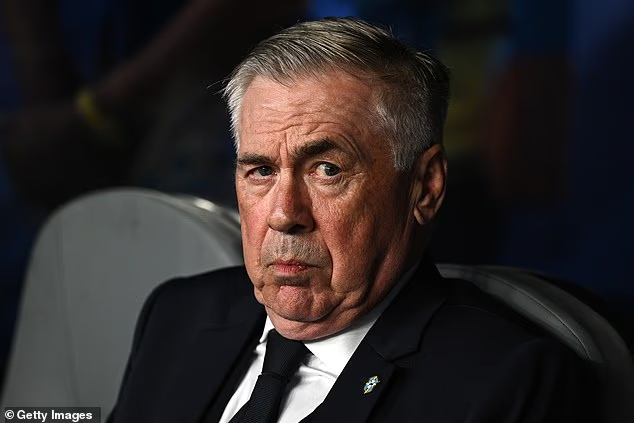
One which would raise plenty of eyebrows to match the famously elevated brow of Don Carlo himself.