There’s a wisdom in football which managers have used for decades to try and keep players calm, focused and in the present.
It extols the benefits of playing the game and not the occasion. It has currency when an otherwise unremarkable fixture takes place in rarefied environment.
It feels more futile when the opponent and the situation have the propensity to make you go weak at the knees.
It may be pointless for Steve Clarke to lean on it in Miami tomorrow evening. His players must deal with both dynamics.
Scotland’s first meeting with Brazil took place 60 years ago this week, a 1-1 draw in a friendly at Hampden.
There have been nine subsequent encounters, with the four World Cup clashes from 1974 to 1998 seared in the memory of the nation.
Scotland prepare for their seismic World Cup Group C clash with Brazil in Miami

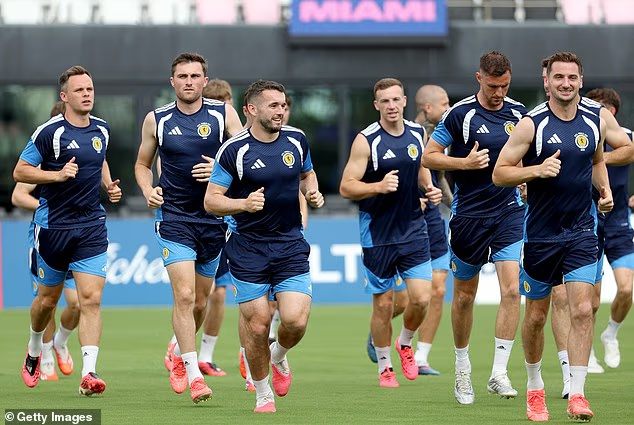
Scotland head coach Steve Clarke looks on as Scotland train in the searing Miami heat
Even those with only a passing interest in the game remember where they were and who they were with on those days for a simple reason.
With their spellbinding names, their joyful fans, their excitable commentators and their five World Cups, the very name of Brazil resonates like no other.
Facing them is the ultimate game. Playing them in Florida in the defining match of a World Cup group is the ultimate occasion. It does not and will not get any bigger than this.
Reminders of the reasons why Steve Clarke’s side are attempting to become the first in dark blue to beat the South Americans have been etched on the back of those hypnotic canary yellow jerseys throughout this vibrant city across the past two days.
Pele and Garrincha. Zico and Socrates. Ronaldo and Ronaldinho. Kaka and Romario. Roberto Carlos, Cafu and, of course, the returning superstar, Neymar. It seems that with each wave crashing upon it, the beaches of Brazil produce world-class footballers.
By common consent, the squad currently at the disposal of Carlo Ancelotti doesn’t match up to many of those of yesteryear. But all things are relative.
The great Italian can still call upon Champions League winners in Alisson, Marqinhos, Fabinho, Neymar, Casemiro and Vinicius Junior.
While seven of their 26 are unusually home based with the likes of Flamengo, Botafogo and Santos, they have multiple players steeped in English Premier League experience.
This includes Gabriel Magalhaes and Gabriel Martinelli (both Arsenal), Casemiro and Matheus Cunha (Manchester United), Igor Thiago (Brentford) and Bruno Guimaraes (Newcastle).
A fifth-place finish in the CONMEBOL qualifiers, the worst ever performance of A Selecao, can largely be disregarded. Even though it’s hard to predict what 34-year-old Neymar (now with Santos) will offer ahead of his first appearance since October 2023, the array of talent is still frightening.

Key players Andy Robertson and John McGinn train ahead of the Brazil game
The gargantuan egos which have hampered a succession of managers since Brazil last lifted the trophy in 2002 is less of a concern this time.
Himself a five-times Champions League winner as a manager alone, Ancelotti is paid $10m per year on a contract to 2030 because no man on earth is better at man-management.
Appointed after qualification, he has effortless charisma and a personal history with many of the star names including Vinicius Junior.
The first foreign manager in Brazil’s history, Ancelotti carries the hopes of 213 million people on his shoulders. The expectation of winning the tournament never wavers. Going a record six World Cups without cradling the greatest prize in sport is simply unthinkable.
It’s not just the Brazilian players and the aura which perpetually surrounds them which Clarke’s players must contend with tomorrow.
Compared to Charlotte and Boston, the heat in Miami is stifling. It’s still predicted to be 30 degrees when the game kicks-off at 6pm local time. But it’s the humidity which is the real concern.
Stroll among the high-rises here for a few minutes and it feels like you are wearing a wet blanket. Scotland at least have banked the experience of training here at the start of the month prior to moving up to New Jersey.
Sat in the shade at Scotland’s base camp in North Carolina the other day, Clarke made his case for the defence.
This came in the wake of the rumblings of discontent which followed the loss to Morocco in which his side failed to muster a single shot on target.
Rejecting suggestions that he is an inherently cautious coach, the Ayrshireman underscored the folly in hunting down the North Africans for 90 minutes.. He made a convincing argument.
He also acknowledged that the outcome and the lack of punch in the final third were unacceptable. It’s his contention that the remedy is not to change the strategy but for the players to be better and more assertive.

Carlo Ancelotti watches on as Brazil put the final touches on their preparation

Matheus Cunha (right) in training for five-time World Cup winners Brazil
There assuredly can no repeat of the abysmal start last Friday which saw them fall behind on 70 seconds to a goal which would have embarrassed a Sunday league team.
They must be resolute, but also brave enough to progress up the park. There’s a balance to be struck between pragmatism and showing enterprise when the time is right.
With Aaron Hickey struggling, Clarke is likely to choose between Nathan Patterson and Tony Ralston at right-back. Patterson struggle against Morocco. Nine years after his famous tête-à-tête with Neymar as Celtic fell to Paris Saint-Germain, Ralston might well be poised for a delicious rematch.
The smart money would be on Clarke reverting to a 4-2-3-1. Lewis Ferguson, the best player to this point, should start. Excellent when he came on against Morocco, there would also be much merit in playing Kenny McLean beside him.
The likely selection of Ben Gannon-Doak on the right will be designed to advance and stretch the game as often as possible. It will be essential that the Bournemouth winger is just as effective on the back foot.
Clarke was quick to defend Scott McTominay the other day. This was entirely understandable. It did not change the fact that the Napoli man has been underwhelming in the two games to date.
In this defining moment, the side needs more from him. There would be no better time for him to deliver another iconic goal to go with his bicycle kick against Denmark.
John McGinn’s goal against Haiti, Scotland’s first on this stage for 28 years, was a stolen moment. It underscored the need to occasionally shoot to score. Clarke’s side cannot walk off the park again without causing an opposing keeper some moments of concern.
Che Adams is evidently more likely to score than Lyndon Dykes. Yet the Charlton man does seem to get more out of McTominay. He is better at linking the play and bringing the likes of McGinn and Gannon-Doak into the match. It would be no great surprise if he starts.
Seven years after Oliver Burke’s scuffed finish against Cyprus at Hampden got him off to a winning start, Clarke is poised to join Willie Ormond, Jock Stein, Andy Roxburgh and Craig Brown as Scots who have managed against Brazil in a World Cup. None of them tasted victory.
To stand half a chance of pulling off the greatest result in the national team’s 154-year history, it’s imperative than neither the game nor the occasion overwhelms anyone concerned.
The thought of facing Brazil in Miami with a place in the knock-out of the World Cup on the line could easily consume you. Or it can define you for all time.