
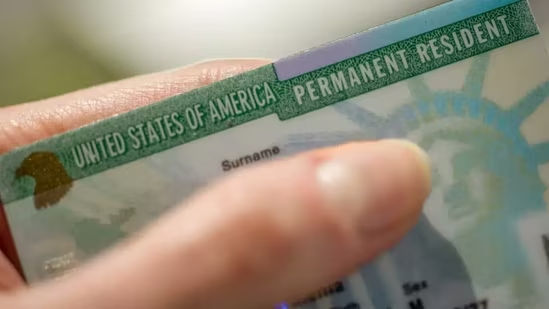
The Supreme Court on Tuesday ruled in favor of the Trump administration in a case concerning immigration and the government’s authority over green card holders who are accused of criminal activities, reported NBC News.
The 6-3 ruling focuses on a 2012 decision made by immigration officers to place lawful permanent resident Muk Choi Lau on immigration parole upon his return from a brief visit to China, due to allegations of involvement in a counterfeiting offense.
Also Read: William Lee Spartacus Falkner and Jordan W Rincker: 5 things to know as FBI arrests two over plot to attack WH UFC event
Here’s what Muk Choi Lau said
Lau contended that this action exceeded the officer’s jurisdiction and that it improperly permitted the Department of Homeland Security to initiate deportation proceedings promptly after he admitted guilt to selling counterfeit apparel in New Jersey.
The high court expressed a different opinion. Border officers were not required to prove by clear and convincing evidence that Lau had engaged in a “crime involving moral turpitude,” stated Justice Clarence Thomas.
Justice Ketanji Brown Jackson voiced her disagreement, noting that the choice to place Lau on immigration parole essentially condemned him to an “immigration limbo” prior to any criminal conviction. “I worry that the Court has now handed the Government a massive blank check,” she remarked in a dissent that was supported by her two liberal colleagues.
HC looks into immigration-related matters amid immigration enforcement measures
The ruling arises as the high court examines various immigration-related matters in light of President Donald Trump’s extensive immigration enforcement measures, although this particular case commenced prior to Trump assuming office.
The administration contended that mere suspicion of criminal activity is sufficient to place a lawful permanent resident, commonly referred to as a Green Card holder, under immigration parole. Federal attorneys encouraged the court to adopt a broad interpretation of executive power concerning immigration.
Additionally, the court is reviewing cases related to Trump’s initiative to abolish birthright citizenship, potentially reinstate a stringent asylum policy, and terminate temporary legal protections for migrants escaping conflict and natural disasters in their countries of origin.